I am learning flutter from JustAcademy, They provide very much great environment where people gather and work simultaneously. totally project based training institute.
MOHD ABU BAKAR ANSARI
Flutter Developer
Awesome Experience. I am a Front-end Web Designer working at Star India for 3 years now. I applied for Full-stack development and my experience has been phenomenal & they really do help with placements exceptionally. Thank you Roshan sir so much.
Which software languages actually lead to offers, how to pick one without regret, and why live mentor led practice beats watching videos alone
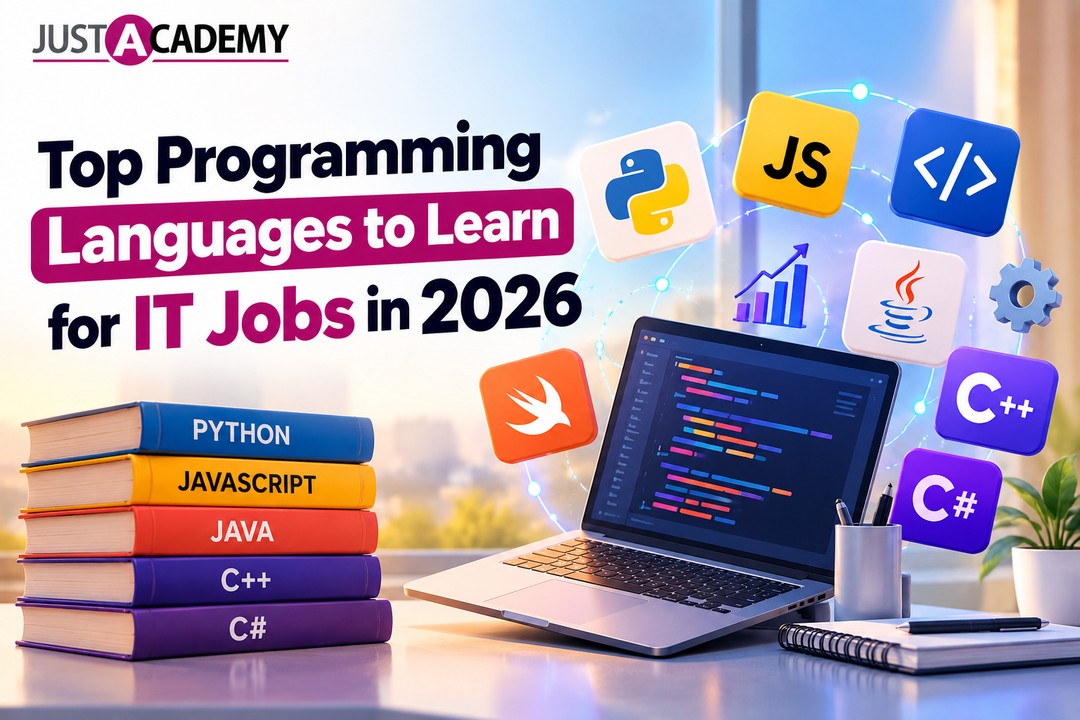
Every few months a new list of the best programming languages for jobs goes viral, and every few months a fresh batch of beginners in Pune panics because the language they just started learning has been declared dead by someone with a confident thread and a stock photo. Relax. The programming languages in demand 2026 look surprisingly similar to the ones that were in demand two years ago, with a few real shifts around artificial tech, data work and cloud backends. This guide is written for the student in Baner, the fresher in Hinjewadi, the working professional in Kharadi who wants to move into IT jobs for software developers, and anyone who is tired of contradictory advice.
We wrote it at JustAcademy, where trainers spend their days watching beginners struggle, recover and eventually get hired. One thing we have noticed again and again is that Pune learners do not lack talent or hunger. What they lack is a clear, honest filter for the noise. So the whole article is built around the way we teach: live and interactive, instructor led, and backed by mentor led sessions where somebody actually reads your code. If you want to feel how that classroom works before you read further, you can book a free demo session and sit through one yourself.
A quick note on geography, because it matters. Our offline institute is in Mumbai, and Mumbai learners walk into a classroom for the full experience. Pune learners join the same trainers through live interactive training online, with the same pace, the same doubt clearing and the same placement support. Nothing in this guide assumes you live near a campus. It assumes you have a laptop, a few evenings a week and a real wish to build a career in tech.
Why Pune Is Quietly Rewriting the Rules of IT Hiring
The Pune job market in plain language
Pune is one of those cities where you can overhear a conversation about Kubernetes at a tea stall. Product companies, service giants, startups, banks running their own engineering arms and a large number of global capability centres all compete for the same pool of people. That competition is good news for you. It means that IT employment in Pune is not limited to one narrow profile. A company in Hinjewadi might want a backend developer, a company in Magarpatta might want a data analyst, and a startup in Viman Nagar might want somebody who can do a little of everything and learn the rest on the job.
What employers repeat in interviews is surprisingly consistent. They want people who can write clean code in at least one language, explain what they wrote, and pick up a second language without panic. Nobody is hiring you because you collected certificates for twelve different technologies. They are hiring you because you can think, and the language is simply the tool through which that thinking becomes visible.
Programming languages in demand 2026 and what recruiters keep asking for
If you read job descriptions for a week, patterns jump out. Python appears constantly, across data, automation, backend and AI. JavaScript appears everywhere the browser is involved, which is nearly everywhere. Java remains the backbone of banking, insurance and large enterprise systems. SQL sits quietly in almost every listing, even when the title says something else. C and C++ show up in embedded, systems and performance sensitive roles, while TypeScript and Node JS have become normal parts of product company stacks.
That list is not a ranking of which language is morally superior. It is simply a map of where the money flows in technology right now. Think of it the way you would think of Pune’s localities. Baner is not objectively better than Kothrud, but if your office is in Baner, the choice becomes obvious.
Where IT jobs for software developers are actually appearing
The honest answer is: in more places than the usual lists suggest. Beyond classic developer titles, there are growing openings for automation engineers, data engineers, analytics developers, cloud support engineers and QA professionals who can script. Even HR IT jobs, the roles where recruiters and technology teams meet, increasingly ask candidates to understand what a developer is saying when they describe a stack. Learning a programming language, then, is not only about becoming a developer. It is about becoming fluent in the vocabulary of the industry.
Choosing Your First Language Without Losing Your Mind
Coding languages for beginners: what makes a language beginner friendly
A beginner friendly language is not the one with the fewest keywords. It is the one that lets you see results quickly, gives readable error messages and has a community that has already answered your silly questions. That is why most conversations about programming languages for beginners start with Python, and why a large number of people also start with JavaScript, because a browser is already sitting on every computer in the world. You write a line, refresh a page and something changes. That feedback loop is gold during the first fragile month.
Many people also ask about the easiest coding languages as if there is a single winner. There is not. Python is easy to read, JavaScript is easy to run, and Java is easy to structure once you accept its rules. What feels easy depends on how your brain likes to learn. Some learners need immediate visual output, others prefer clean logic and numbers, and a good instructor spots which type you are within the first two sessions.
The best coding language is the one you will finish learning
Ask ten developers what the best coding language is and you will hear ten passionate answers. Here is the unglamorous truth we share with every batch: the best coding language for you is the one you will stick with long enough to build three projects in. A mediocre plan followed for six months beats a perfect plan abandoned in week three. Choose based on the roles you want, the time you have, and whether you will have someone to explain things when you are stuck.
That last point is the one people underestimate. Self study works brilliantly for a small group of disciplined people and quietly fails for everyone else. Having an instructor in a live session who can see your screen, or a mentor who tells you your function is doing three jobs instead of one, saves weeks of confusion. We will come back to this when we talk about training structure later.
Natural language programming and why your fundamentals still matter
You have probably seen the headlines. Tools can now turn plain English into working code, and the phrase natural language programming is being thrown around as if typing syntax will soon be obsolete. Our view is more grounded. These tools are powerful assistants, but somebody still has to read the output, spot the subtle bug and decide whether the logic fits the business problem. Employers are not looking for people who can paste prompts. They are looking for people who understand the code well enough to trust or correct it.
So the programming fundamentals you build now, loops, conditions, data structures, functions and debugging habits, are not outdated. They are the reason you will be able to use these new tools well while others are simply used by them. If you want a wider view of the skills that sit around code in this new landscape, this breakdown of top IT skills to learn in 2026 for high paying jobs pairs nicely with what you are reading here.
Python, the Quiet Language Running Half of Modern Tech
About Python language and why it keeps winning
If you want a short answer about the Python language, here it is. It is a general purpose language designed to read almost like plain English, and that single design decision explains most of its popularity. A newcomer can understand a ten line Python script without having seen code before. A senior engineer can use the same language to run machine learning pipelines, automate infrastructure, process millions of records or power an API that serves a busy application.
That range is exactly why Python sits near the top of any serious computer languages list for 2026. It is not just a teaching language. It is a working language, used in startups and large enterprises alike. When people say Python is the best programming language for jobs, they usually mean it opens the widest number of doors for the narrowest amount of initial effort.
Python tutorial for programmers: moving from basics to something employable
Most online material gets you through variables and loops and then abandons you. A useful Python tutorial for programmers, whether you are a total beginner or someone moving over from another language, has to push further. After the basics you need functions, file handling, working with APIs, object oriented thinking, virtual environments and a habit of writing small tests. Then you need to build something that looks like real work, such as an expense tracker, a job portal scraper or a small inventory service.
If you would like that journey guided rather than guessed, the live Python training in Pune programme walks learners through exactly that progression, with an instructor who writes code in front of you and a mentor who reviews yours afterwards. The difference between watching and doing is enormous, and sessions like these are designed around it.
Backend Python and the pull of artificial intelligence
Backend Python is one of the safest bets in tech. Frameworks like Django and Flask let you build secure, scalable services, and because Python also dominates data science, a backend developer who understands data workflows becomes especially valuable. Companies building products around analytics, recommendations or automation love this combination.
Then there is the pull of AI. Anyone aiming to become an artificial intelligence developer will meet Python almost immediately, because the major libraries for machine learning, deep learning and data handling are built around it. You do not need a PhD to begin. You need solid Python, comfortable maths basics, a little statistics and the patience to experiment. Everything else, honestly, comes with practice and good guidance.
JavaScript and the Entire Web Stack Under One Roof
Coding languages for web development in one paragraph
When people ask about coding languages for web development, the list usually starts with HTML and CSS for structure and styling, then JavaScript for behaviour, and then something on the server such as Node JS, Python, Java or PHP. Among these, JavaScript is special, because it is the only language that runs natively inside every browser and, thanks to Node, can also run on the server. One language, two worlds. For a learner trying to cover maximum ground with minimum cognitive overhead, that is a very attractive deal.
Pune has a particularly strong demand for web talent, since so many startups and product teams are building customer facing applications. If a clean interface, fast pages and smooth interactions matter to the product, JavaScript is involved somewhere along the line.
Node JS programming and the idea of full stack engineering
Node JS programming lets you use JavaScript on the server, which means a single developer can build the interface, the API and the logic behind it in the same language. This is the heart of full stack engineering as most startups understand it. You learn React or Angular for the front, Node and Express for the back, and MongoDB or another database to store information. The stack feels coherent, and you can ship an entire product on your own, which is a wonderful confidence builder for a fresher.
Full stack developer hiring has stayed warm precisely because small teams value people who can move between layers. If you want to learn JavaScript properly before stepping into frameworks, the live JavaScript training in Pune course covers the language itself in depth, including the parts tutorials skip, like asynchronous behaviour, closures and the event loop. Those are the exact topics interviewers love to poke at.
JavaScript for machine learning: hype, reality and a sensible takeaway
Yes, JavaScript for machine learning exists. Libraries allow models to run in the browser or on a Node server, which is useful for lightweight, interactive experiences. Is it the main route into serious ML work? Not really. Python still leads there. But knowing that JavaScript can touch machine learning matters, because modern products often blend AI features into web interfaces, and a developer who can connect a model to a polished front end becomes surprisingly valuable.
The sensible takeaway is not to pick sides. Learn one language deeply, understand the other one well enough to collaborate, and let your projects decide where to go next.
From scattered tutorials to a job ready full stack path
Here is where many learners hit a wall. They finish a JavaScript course, then a React course, then a Node course, and still cannot build an application from scratch because nobody ever showed them how the pieces fit. A structured full stack programme fixes that. The live MERN Stack bootcamp in Pune is built around product style projects, so you learn the stack by building something that feels like a real startup product, with code reviews, deployment and interview preparation woven in. If you want an unhurried first look at what that environment feels like, our free demo is always open.
Java, the Steady Giant of Enterprise Hiring
Java coding language and why banks and large firms still rely on it
Java is rarely trending on social media and almost always present in job descriptions. The Java coding language powers a huge amount of banking software, insurance platforms, telecom systems and large enterprise applications. Its strict typing, mature ecosystem and strong performance make it ideal for systems that must run reliably for years. If you have ever used a banking app or booked a ticket online, there is a decent chance some Java was involved.
For a job seeker in Pune, where large service companies and enterprise teams hire in volume, Java remains one of the safest and most predictable routes into IT employment. It may not feel as glamorous as AI, but it pays well, and the roles tend to be stable.
Java computer language, object oriented thinking and the database connection
Learning the Java computer language forces you to understand object oriented programming properly: classes, objects, inheritance, polymorphism and encapsulation. These ideas carry into nearly every other modern language, so time spent here is never wasted. Java developers also work closely with databases, and sooner or later you will meet the concept of an object oriented database or an ORM that maps objects to tables. Understanding how your code and your data talk to each other is one of the biggest differences between a junior who struggles and a junior who contributes.
A good Java language course will pair these concepts with Spring Boot, REST APIs, JDBC or JPA, and unit testing, so that by the end you can build a small but real service. Without that practical layer, theory tends to evaporate by the time interviews arrive.
Android language choices and where Java still fits
People often ask which android language to learn. The modern answer is Kotlin, which Google strongly promotes for new Android apps. Java is still widely used in existing Android codebases, though, and a developer who understands Java can read and maintain a surprising amount of production code. If mobile development appeals to you, starting with Java concepts and then moving to Kotlin or even a cross platform tool is a perfectly reasonable path.
C and C Plus Plus, the Languages That Teach You How Computers Think
C programming fundamentals and the real uses of C language
C is old, and it is not going anywhere. The uses of C language stretch from operating systems and embedded devices to drivers, networking tools and the interpreters of other languages. When people ask why they should bother with C programming in 2026, the best answer is that it shows you what other languages hide. Memory, pointers, stack and heap stop being abstract words and become things you can break, which is the fastest way to truly understand them.
Strong C programming fundamentals also make you a better developer in every other language. Once you have fought with a segmentation fault at eleven at night, a Python list or a Java object feels like a gift. Colleges often teach C first for precisely this reason, even if students do not always appreciate it at the time.
Basic C programs for beginners and the practice habit
Nobody learns C by reading about it. You start with basic C programs for beginners: printing patterns, reversing a number, checking for palindromes, working with arrays and strings, and writing small functions. Then you move into pointers, structures, file handling and dynamic memory. Writing C coding exercises every day for even thirty minutes does more than a long weekend of passive reading.
You do not need heavy tools to begin either. A C language compiler online or a simple online compiler for C program is enough for your first weeks, and later you can switch to a local setup with GCC. Platforms that offer problem sets, including HackerRank C language practice tracks, are excellent for building speed and confidence. Just remember that solving a problem is only half the exercise. Explaining your solution aloud is the other half, and that is where a mentor makes a difference.
C Plus Plus programming software, sample code and function programs
C++ builds on C and adds object oriented features, templates and the standard library, which is why it is common in game development, trading systems, simulation and performance critical applications. To begin, you will need some C++ programming software such as Code::Blocks, Visual Studio or a simple editor connected to a compiler. A friendly first exercise is a function program in C++, like a calculator where each operation sits inside its own function, which teaches modular thinking.
When you study C++ sample code, read it slowly and ask why each line exists. Notice how classes group data with behaviour, how constructors set up objects and how references avoid unnecessary copying. If those ideas feel heavy, that is normal. They get lighter with repetition and with someone around who can say, calmly, that you are overthinking it.
PLC programming languages and an unexpected corner of tech
Here is a corner many learners never hear about. PLC programming languages are used in industrial automation, where programmable logic controllers run factory machines, assembly lines and utility systems. Languages like ladder logic and structured text sit in this world, and engineers from electrical, mechanical and instrumentation backgrounds often cross over. Pune, with its large manufacturing and automotive base, has real openings here. It is not the usual path into IT, but it shows how widely the word technology can stretch.
R, SQL and the Data Side of Tech
R tutorial thinking for statistics and analysis
R is a language built by statisticians, and it still shines in analysis, research and visualisation. If you search for an R tutorial or an R language tutorial, you will find most of them start with data frames, vectors, and plotting with ggplot2. That is the right order. R makes it very pleasant to explore data, test hypotheses and produce clean charts, which is why universities, healthcare analytics teams and market research firms still use it.
For job hunting in 2026, though, R is usually a secondary skill. Python and SQL appear more often in data job listings, so many learners treat R as a useful extension rather than a first language. If your interests lean towards statistics, research or academic style analysis, R deserves a serious place in your plan.
SQL, the language almost every job quietly expects
SQL is the language nobody brags about and everybody needs. Whether you are a developer, tester, analyst or business consultant, you will end up querying data. Learning SELECT statements, joins, grouping, subqueries and window functions is one of the best returns on time in all of technology. Pair SQL with Python and you can already do a surprising amount of real analytical work.
If data is what pulls you in, a structured route like the live Data Analytics course in Pune combines SQL, Python, Excel and dashboarding tools with projects based on real business problems, so you finish with a portfolio and not just a certificate.
Programming languages for beginners who like numbers more than interfaces
Not everyone dreams of building apps. Some people love patterns in numbers, and for them the data path may feel more natural than web development. In that case, the sensible sequence is Excel first, then SQL, then Python, and only then R or specialised tools. That order lets you earn small wins early, which keeps motivation high while the harder material arrives.
A Quick Comparison of the Languages Worth Your Time
Computer languages list with honest notes
Tables are usually boring, but this one is worth a minute. It condenses a lot of what you have read so far into a single view, so you can match languages to your own temperament and goals.
Language
Best suited for
Learning curve
Common roles
Python
Data, automation, backend, AI
Gentle
Python developer, data analyst, automation engineer
JavaScript
Websites, web apps, full stack products
Gentle to moderate
Front end developer, MERN developer, full stack developer
Data analyst, database developer, tester, business analyst
R
Statistics, research, visual analysis
Moderate
Statistical analyst, research analyst
How to read the table without overthinking it
Notice that gentle does not mean weak and steep does not mean better. A gentle language can still lead to a very well paid career, and a steep one can feel punishing if you start with it too early. Use the table as a conversation starter with your mentor, not as a verdict. Most successful developers end up knowing two or three of these languages and having one they know deeply.
Highest Paying IT Careers and the Languages Behind Them
Highest paying IT careers: what really moves the number
Lists of the highest paying IT careers tend to focus on titles, but the pay difference rarely comes from the title alone. It comes from the problem you are trusted to solve. Engineers who work on distributed systems, cloud architecture, AI products, security or complex data platforms usually earn more than those doing routine maintenance, and the languages behind those roles are the ones we have already covered: Python, Java, JavaScript, C++ and SQL, often combined with cloud skills.
Salaries differ between companies, cities and years, so be wary of anyone who quotes a single number for a language. What is more reliable is the pattern. Depth in a language, plus proof of building things, plus the ability to communicate clearly, pushes compensation upward in almost every segment. You can see this reasoning spelled out in more detail in our guide to the top 10 IT skills to learn in 2026 for better career opportunities, which looks at skills beyond language syntax.
Top IT jobs and top IT careers beyond pure coding
Not every one of the best IT careers is a pure coding role. An IT business consultant, for example, translates business needs into technical solutions and has to understand what developers can and cannot do. An IT technical architect designs how large systems fit together and usually grows out of years of hands on engineering. IT testers verify that software behaves the way it should, and modern testers write automation scripts in Java or Python, which makes language skills very relevant to them. HR IT jobs also benefit from this understanding, because a recruiter who can tell the difference between a Java developer and a JavaScript developer saves everyone hours of wasted interviews.
So even if your long term goal is leadership, consulting or architecture, programming remains the foundation. You do not have to write code forever, but you need to have written enough to speak the language with credibility.
Programming languages in demand 2026 by career stage
For a fresher chasing an IT job vacancy for freshers, Python, JavaScript, Java and SQL give the broadest base. For a professional with two or three years of experience, adding cloud, testing frameworks, system design and a second language is usually what unlocks the next jump. For someone with eight or more years behind them, the conversation shifts to architecture, mentoring and domain depth, and language choice becomes less about learning syntax and more about picking the right tool for the problem.
The Skills That Sit Quietly Beside Your Language
Software development languages are only half the story
Ask any hiring manager in Pune what separates two candidates who both know Python, and the answer is rarely syntax. It is how they handle everything around the code. Can they use Git without breaking the repository? Can they read an error message calmly? Can they write a test, or at least explain how they would test the function they just wrote? These habits sit beside every one of the software development languages we have discussed, and they travel with you when you switch stacks.
Think of it like cooking. Knowing a recipe is useful, but a good cook also knows how to taste, adjust, clean the station and plate the dish. Employers hire the cook, not the recipe collector.
IT languages, tools and the habit of reading documentation
Across all the IT languages in this guide, one habit pays off more than any other, and that is reading official documentation without fear. Beginners often avoid it because it feels dry, then wonder why experienced developers solve problems faster. The reason is simple. They go to the source. Spend a few minutes each day reading how a function, a library or a framework is meant to be used, and your speed will quietly improve.
Communication belongs in this category too. A developer who can explain a bug in two clear sentences, write a readable commit message and ask a precise question in a team chat will be trusted with more responsibility, sooner. Those are tech skills as much as any framework is, and they are very teachable in a live batch where you are regularly asked to explain your thinking.
Cloud, testing and a little system design for the long run
Once you are comfortable with one language and a couple of projects, widen your base gently. Learn how applications are deployed on the cloud, how automated tests are written, and how a basic system is divided into services, databases and queues. You do not need to master all of it. You only need enough familiarity to hold a sensible conversation in an interview and to grow into more senior work without starting from zero later.
A Realistic Ninety Day Plan for Pune Beginners
Weeks one to four: build the base and stay consistent
The first month is about consistency, not brilliance. Choose one language, ideally Python or JavaScript, and commit to an hour or two daily. Cover variables, data types, conditions, loops, functions and basic data structures. Write small programs every day, even silly ones. At the end of each week, explain what you learned out loud to a friend, a mentor or even a mirror. If you cannot explain it, you have not understood it yet.
This is also when live interactive sessions become valuable. A scheduled class gives your week a spine. You show up, you ask questions in real time, and you leave with exercises that need to be done before the next session. That tiny structure, repeated, is what builds momentum.
Weeks five to eight: build real projects, not tutorial clones
Month two is where most learners drift, because the novelty fades and the difficulty rises. This is exactly the right time to start building projects. Build a to do app, a budget tracker, a small API, a quiz game or a simple dashboard. Make mistakes, break things, fix them. A project teaches you what a tutorial cannot, namely how to get unstuck on your own.
Recruiters in Pune consistently say that projects change the conversation in an interview. Instead of asking you to define a concept, they ask how you solved a problem, which is a far friendlier question. We wrote an entire piece on this idea, how real projects help freshers get IT jobs, and it is worth reading while you plan your own build list.
Weeks nine to twelve: polish, publish and prepare
The final stretch is for polish. Clean up your repositories, write readable README files, deploy at least one project so that it has a live link, and prepare a short story for each project covering what you built, why you built it and what went wrong. Then begin mock interviews, first on fundamentals and then on problem solving. A mentor led session at this point can feel uncomfortable, because the feedback is direct, but it is exactly the kind of feedback that turns a nervous candidate into a confident one.
Why Live Mentor Led Training Beats Random Tutorials
The difference between watching and being watched
Tutorials are wonderful, and we use them ourselves. But a recorded video cannot see your screen, notice that you copied a line without understanding it, or sense that you have been quiet for twenty minutes because you are lost. In an instructor led session, a trainer teaches the concept in real time, adapts when the room looks confused and encourages questions. In a mentor led session, a smaller conversation happens around your own code, your own project and your own career doubts. Both are different from watching a video, and both matter.
That combination is what we mean when we say live and interactive. It is not a marketing phrase. It is a way of teaching in which a human being is accountable for whether you understood the topic, and in which you are accountable for showing up and trying.
Mumbai classrooms, live online batches for Pune and placement support
JustAcademy is an ISO certified technology training institute, and many learners call it the best course in Mumbai for hands on, job focused training. Learners in Mumbai attend classroom batches at our institute, while learners in Pune join live interactive training online, taught by the same trainers and following the same curriculum. Both groups get project work, assignments, interview preparation, resume reviews and placement support designed to connect trained candidates with hiring companies. We cannot promise outcomes, and nobody honest can, but we can promise a structured path and people who care whether you reach the end of it.
If you would like to see how the course content is organised, the timelines and the project lists, you can download the brochure and read it at your own pace, no pressure attached.
How to choose a training programme that actually respects your time
Before you pay for any course, ask a few plain questions. Are the sessions live, or mostly recorded? Is there an instructor who answers doubts the same day? Will somebody review your projects? Is placement support described honestly, with specifics? Are the trainers practitioners who have worked in industry? Can you attend a demo first? A good institute will answer all of these without hesitation. If the answers are vague, treat that as information.
Common Mistakes That Quietly Slow Down New Programmers
Collecting languages instead of building depth
The most common mistake we see is language hopping. A learner starts Python, hears that Java pays more, switches, hears that JavaScript is easier, switches again, and after six months has seen three syntaxes and built nothing. Depth in one language beats shallow familiarity with five. Once you are comfortable, the second language comes much faster, because you already know how to think like a programmer.
Ignoring data structures, debugging and version control
Another common habit is skipping the unglamorous basics. Data structures and algorithms, debugging techniques, Git and GitHub, basic testing and reading documentation do not look exciting, but they separate hobbyists from professionals. Interviewers in the technology sector frequently test these directly. Even a modest, steady practice routine, a couple of problems a day and one commit a day, builds a visible track record over a few months.
Learning alone for too long
Finally, a lot of people suffer silently. They get stuck, feel embarrassed, assume everyone else understands, and quietly stop. Learning with a community, whether a batch, a study group or a mentor, makes struggle feel normal, and normal struggle is much easier to push through than private struggle.
Frequently Asked Questions About Choosing Programming Languages
Which is the best programming language for jobs if I am a complete beginner in Pune?
For most beginners the best programming language for jobs is Python or JavaScript, because both are friendly to learn and both lead to a wide range of roles. If you are drawn towards enterprise software or banking, Java is a very solid first choice as well. The right answer depends on the type of work you want to do, so it helps to talk it through with a mentor before committing.
Do I need to learn C before learning other languages?
No. C is valuable because it deepens your understanding of memory and performance, but you can start with Python, JavaScript or Java and return to C later. Many people find the fundamentals easier to absorb after they have built a few simple projects and have some context for why they matter.
How long does it take to become job ready?
With consistent daily practice and guidance, many learners reach an entry level standard in six to nine months, although this varies with prior background, time available and the role you target. What matters is the depth of your projects and your ability to explain your work, not the number of weeks on the calendar.
Can I switch into IT from a non technical background?
Yes. Many successful developers, analysts and testers started in commerce, arts, mechanical or other fields. The path usually starts with one beginner friendly language, a few projects and a structured programme that supports you through the confusing early months. Your earlier domain knowledge can even become an advantage in business facing roles.
Conclusion
The best programming languages for jobs in 2026 are not a secret. Python, JavaScript, Java, SQL, C and C++ keep appearing for good reasons, and each one fits a different kind of learner and a different kind of career. The harder question is not which language wins. It is whether you will pick one, practise it daily, build real projects and let people who know more than you guide your progress. Pune has the jobs, the companies and the energy. What it needs from you is steady effort and a plan that survives the boring weeks.
If you would like that plan to come with live and interactive classes, instructor led teaching, mentor led reviews and genuine placement support, take the first small step today. Join a live session, ask your awkward questions, and see whether the style of teaching suits you.
A practical, no nonsense guide to software jobs for freshers, from picking a skill path to cracking interviews and aiming at the highest paying software engineering jobs
40 real questions and detailed answers on Kotlin, Jetpack, architecture, performance and security, so you walk into your next android technical interview ready to talk like a working developer.
From your first line of JavaScript to a react native app on the Play Store and App Store, here is the honest, practical route that beginners in India can actually follow.