I am learning flutter from JustAcademy, They provide very much great environment where people gather and work simultaneously. totally project based training institute.
MOHD ABU BAKAR ANSARI
Flutter Developer
Awesome Experience. I am a Front-end Web Designer working at Star India for 3 years now. I applied for Full-stack development and my experience has been phenomenal & they really do help with placements exceptionally. Thank you Roshan sir so much.
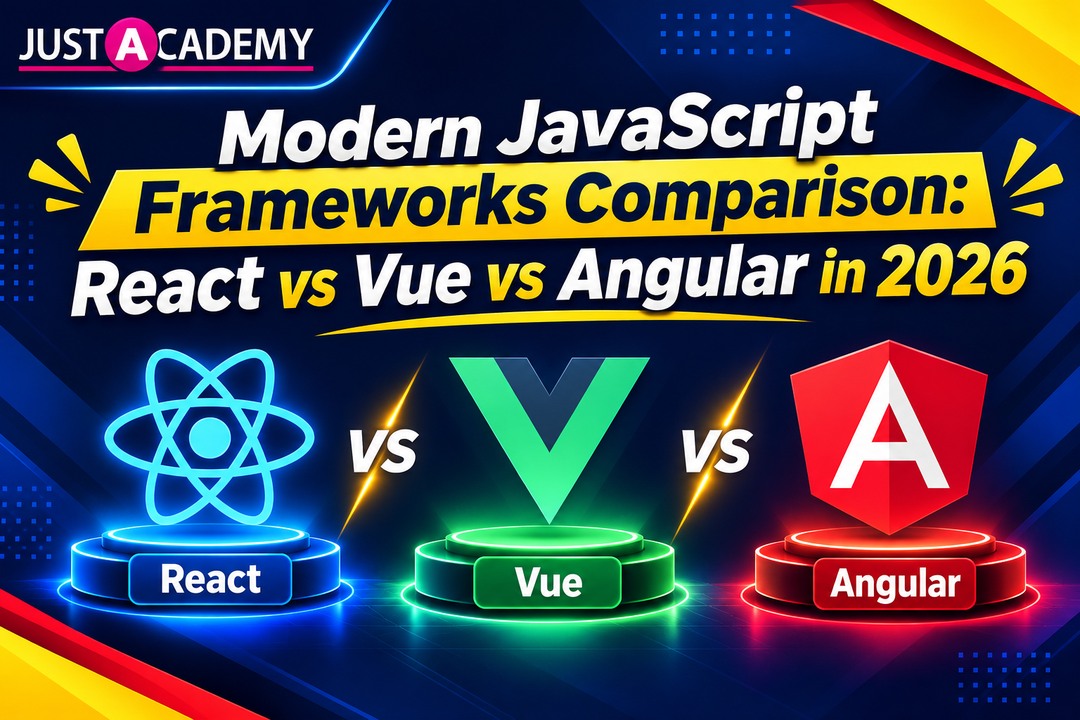
A mentor style breakdown of React, Vue and Angular for Hyderabad learners, covering market share, hiring demand, learning curve and the smartest way to train.
If you have spent even ten minutes in a Hyderabad developer group chat, a HITEC City tea stall conversation or a college placement cell, you have heard the question. Which one should I learn, React, Vue or Angular? The debate around react vs vue vs angular popularity has been running for years, and it refuses to die because every answer is partly true. React dominates the headlines, Angular quietly runs half of the enterprise dashboards you have ever used, and Vue keeps winning the hearts of developers who value clean, readable code. So how does anyone actually decide?
This guide is written for people who live and work around Hyderabad, where product companies, global capability centres, startups and service firms all hire frontend talent but ask for very different things. Before you touch any framework, though, you need solid ground under your feet, and that ground is JavaScript itself. If you want to build that base with a trainer sitting across from you, the JavaScript training in Hyderabad is a sensible place to begin, and you can register for a free demo session to see how a live, instructor led class actually feels before you commit to anything.
Here is what we will do together. We will read the popularity numbers carefully, because numbers can mislead. We will meet each contender in plain language, then look at the difference between React and Vue, the difference between Angular and React, and the angular and vue differences that rarely get explained honestly. We will look at what the Hyderabad job market rewards, compare everything in one table, and finish with a simple method for choosing. Throughout, you will notice a theme: frameworks are tools, and the way you learn them, with live, mentor led guidance, matters more than which logo you pick.
Reading the Popularity Numbers Without Getting Fooled
Every few months a new chart goes viral showing React far ahead of everyone else. The chart is not wrong, but it hides more than it reveals. Before you let a graph decide your career, it helps to understand what each kind of popularity data actually measures.
Survey Data Versus Job Postings
Developer surveys, the large annual ones run by Stack Overflow and similar platforms, ask people what they use. In recent years, React has been used by roughly two fifths of respondents, while Angular and Vue each sit in the high teens. Treat those figures as approximate and check the latest edition when you read this, but the pattern has been stable: React first, then Angular and Vue trading second place depending on the survey and the year.
Job postings tell a different story. Postings reflect what companies must hire for today, and legacy code is sticky. A bank that built a large Angular application four years ago is not going to rewrite it because Twitter prefers React this month. That is why Angular keeps showing up in enterprise listings far more often than its survey share suggests. Meanwhile Vue appears often in agencies, startups and companies with Asian and European product roots, where the framework has a strong following.
What React vs Angular vs Vue Market Share Really Measures
When people search for react vs angular vs vue market share, they usually want one number. There is no single honest number. Market share by npm downloads favours React heavily because its ecosystem includes countless supporting packages. Market share by company adoption includes Angular strongly in enterprises. Market share by developer satisfaction often lifts Vue, because people who use it tend to like it a lot. Each metric answers a different question, and mixing them leads to bad conclusions.
A useful habit is to ask, popular among whom? Popular among hobbyists, popular among startups, popular among hiring managers at large companies? For a Hyderabad learner, the third group matters most, and we will come back to it shortly.
Reading a Popularity Graph in Plain Words
Whenever you see a react vs angular vs vue graph, check three things. First, the time range, because a five year trend and a one year snapshot can tell opposite stories. Second, the source, because a graph from a React focused community will naturally look rosier for React. Third, what the axis represents: usage, interest, satisfaction or job demand. A popularity react vs angular vs vue graph that does not label its axis clearly is entertainment, not evidence.
If you take only one lesson from this section, take this one. Popularity tells you how large the community is, which affects how easily you will find tutorials, libraries and jobs. It does not tell you which tool is best for the project in front of you, and it certainly does not tell you which one will suit your brain.
Meet the Three Contenders in Plain Language
Comparisons often skip the basics and jump straight to benchmarks. Let us slow down and describe each framework the way you would describe it to a friend who has never written a line of frontend code.
React: The Flexible Library Everyone Builds Around
React began at Meta and is technically a library for building user interfaces, not a full framework. You describe your interface as small reusable pieces called components, and React takes care of updating the screen when your data changes. Everything else, routing, state management, forms, data fetching, you choose from a large ecosystem. That freedom is why React feels so powerful and, at the beginning, a little overwhelming.
React 19 brought refinements around actions, form handling and server components, and the surrounding ecosystem, especially Next.js, has pushed the whole community toward server rendering and better performance by default. If you want structured, mentor led practice with it, the React JS training covers components, hooks, state and real project work step by step.
Vue: The Approachable Framework With a Gentle Slope
Vue was created by Evan You after he worked at Google, and it has always carried a design philosophy of being progressive. You can drop it into a single page, or build a full application with routing and state management using its official tools. Its single file components keep template, logic and styling together in a way that many beginners find immediately readable.
Vue 3 introduced the Composition API, which gave larger applications better organisation, and the ecosystem around Vite, Pinia and Nuxt has matured nicely. When people argue about vue or react which is better, the Vue side usually points to readability and a smoother first month. The React side points to ecosystem size and job volume. Both sides are correct, which is exactly why the argument never ends.
Angular: The Complete Framework With Strong Opinions
Angular, maintained by Google, is a full platform. It ships with routing, forms, an HTTP client, dependency injection and a command line tool, all designed to work together. It uses TypeScript from day one, which means your code is checked before it runs. That structure is a gift for large teams, because everyone writes code in roughly the same way.
One quick clarification, since search queries like angular js vs vue js and angularjs vs react js vs node js vs vue js keep appearing. AngularJS, the original version from 2010, reached end of life in 2022 and is not what people mean when they discuss Angular today. Modern Angular is a complete rewrite, with standalone components, signals and a new control flow syntax making it far lighter than it once was. If you are curious about the framework itself, the Angular training walks through it from fundamentals to project work. And node js, which appears in that long query, is not a competitor at all. It is a runtime for running JavaScript on servers, a different category entirely.
The Difference Between React and Vue, Explained Like a Mentor Would
Of all the pairings, react vs vue gets the most attention from learners, because both are approachable and both are widely used. Let us walk through the difference between React and Vue the way a good trainer would, using real thinking patterns rather than marketing language.
Difference Between React and Vue in Syntax and Mindset
React asks you to think in JavaScript first. Your markup lives inside your functions, written in JSX, which looks like HTML but is really JavaScript in disguise. If you are comfortable with array methods, conditionals and functions, React feels natural. You render lists with map, you show or hide elements with ternary expressions, and your component is just a function that returns a description of the screen.
Vue asks you to think in templates first. You write something that looks like HTML, add directives such as v-if and v-for, and keep your logic nearby in a script block. Learners with a design or HTML background often find this friendlier. When someone asks about the difference between react and vue at the mindset level, this is the honest answer: React bends HTML toward JavaScript, while Vue bends JavaScript toward HTML.
Difference Between React and Vue in Tooling and Ecosystem
React gives you a smaller core and expects you to assemble the rest. For routing you might pick React Router, for state you might choose Redux Toolkit, Zustand or the built in context, for data fetching you might use TanStack Query. Choice is wonderful until you are a beginner staring at five options per problem.
Vue offers official answers for most needs. Vue Router handles navigation, Pinia handles state, and Vite handles builds. The vue react contrast here is simple: React has more options and a bigger third party universe, Vue has fewer decisions and a tighter official path. Neither approach is wrong, but they suit different personalities and team structures.
Vue Performance vs React in Real Applications
Benchmarks make good headlines, but vue performance vs react rarely decides real projects. Both use a virtual DOM approach, both have been heavily optimised, and Vue’s reactivity system tracks dependencies automatically so it often updates only what changed. React relies on rendering and reconciliation, with tools like memoisation and the React compiler helping reduce wasted work.
In a typical business application with forms, tables and dashboards, a user will not feel a difference. Poorly structured code, oversized images and excessive network calls will hurt you far more than your framework choice. Performance matters when you reach very large lists, heavy animations or constrained devices, and even then, skilled developers fix problems in both ecosystems. So when you read a headline claiming one library crushes the other, ask what was measured, and remember that your own code quality decides most of what users experience.
If you are leaning toward one of these two and want a trainer to review your learning plan, you can book a free demo with a mentor and talk through your goals before enrolling.
Where Angular Fits When You Put It Beside React and Vue
A lot of learners treat Angular as the odd one out, and that is understandable. It is bigger, stricter and more opinionated. But in the Hyderabad market, ignoring it would be a strategic mistake.
Difference Between Angular and React in Philosophy
The difference between angular and react comes down to who makes the decisions. With React, you make them, or your team lead does. With Angular, the framework already made most of them for you. Folder structure conventions, dependency injection, form handling and testing setups follow established patterns, which is why large teams love it.
That also explains the learning curve. Angular demands that you understand TypeScript, decorators, modules or standalone components, services and observables with RxJS. It takes longer to feel productive, but once you do, you can join almost any Angular codebase and recognise its patterns quickly. Developers who ask about angular and react as a pair are often really asking whether they want freedom or structure. Freedom suits fast moving startups, while structure suits long lived enterprise products.
Angular and Vue Differences That Rarely Get Discussed
The angular and vue differences are more interesting than most articles admit. Both support two way style binding patterns, both have official routing and state tooling, and both embrace single file or component based thinking. Yet Angular is TypeScript first, uses dependency injection heavily and favours a rigid structure, while Vue is flexible, supports TypeScript optionally and trusts developers to organise themselves.
Teams that care about consistency across fifty developers lean toward Angular. Teams that want to move quickly with a small group often prefer Vue. When people debate vue js vs angular, they are really debating the size and structure of the team, not the quality of the tools. Vue js vs angular performance is similarly misleading as a headline topic. Angular’s newer signals based reactivity and improved change detection have narrowed any gap, and both handle serious production workloads well.
Moving From Angular to Vue, or the Other Way Around
Some of you will already know one framework and wonder about switching. Moving from angular to vue is common among developers who feel Angular is too heavy for the project at hand. They usually find the Vue templates familiar, appreciate the smaller boilerplate, and need time to adjust to the looser structure. Going the other way, Vue developers moving into Angular need to get comfortable with TypeScript, services and RxJS patterns.
The encouraging truth is that the core ideas transfer. Components, props, events, routing, state and lifecycle thinking are the same concepts wearing different clothes. Once you understand one framework deeply, the second takes a fraction of the time. This is why strong fundamentals beat framework loyalty every time.
What Hyderabad’s Hiring Scene Rewards in Practice
Hyderabad is one of India’s major technology hubs, with large product companies, global capability centres, a thriving startup scene and a long established services sector. Each group hires differently, and understanding that helps you aim your learning where it counts.
Product Companies and Global Capability Centres
Large product organisations and global capability centres often maintain big, long running applications. In these environments you will frequently meet Angular for internal and enterprise tooling, and React for customer facing products, with Vue appearing less often but still present. Interviewers in this group tend to test fundamentals hard: JavaScript concepts, closures, asynchronous behaviour, component design, state management, performance thinking and testing habits.
For this audience, react vs angular vs vue is less about picking a winner and more about showing depth in one while remaining comfortable discussing the others. A candidate who can explain why they would choose React for one scenario and Angular for another impresses far more than one who simply declares a favourite.
Startups, Agencies and Service Companies
Startups and agencies want people who ship quickly. React is the most requested here, partly because of its enormous library ecosystem and partly because Next.js makes it easy to build fast, search friendly sites. Vue appears in agencies that value rapid prototyping, and Nuxt is a favourite for content heavy sites. Service companies serving global clients follow client preferences, which means all three show up, with React usually leading.
If your goal is to become job ready across several of these environments, a full stack route is often smarter than a single framework route. The MERN Stack Developer Bootcamp in Hyderabad combines React with Node.js, Express and MongoDB so you can build complete applications, which is precisely what many startup interviews ask you to demonstrate.
Freshers Versus Experienced Developers
Freshers should usually pick one framework, learn it properly and build a few projects. Hiring managers rarely expect a fresher to know all three. They want to see that you can think, debug and explain your choices. Experienced developers have different pressures. If you are already working with Angular, learning React as a second skill can widen your options considerably, and the reverse is equally true.
What nobody tells you openly is that most interviews focus on how you reason, not on which logo is on your resume. Know your JavaScript, know one framework deeply, and be honest about the rest. That combination is more employable than a shallow tour of everything.
The Comparison Table You Can Screenshot
Tables compress a lot of thinking into a small space, so here is a quick reference for the react angular vue comparison you have been reading about. Treat it as a starting point rather than a verdict, because context always matters.
Factor
React
Vue
Angular
Created and backed by
Meta and a large community
Evan You and community sponsors
Google
Type
UI library
Progressive framework
Complete framework
Language focus
JavaScript or TypeScript
JavaScript or TypeScript
TypeScript first
Learning curve
Moderate, ecosystem choices add weight
Gentle, smooth first month
Steeper, rewarding once learned
Structure
Flexible, team decides
Flexible with official guidance
Strict and opinionated
Best suited for
Startups, product apps, content sites
Rapid builds, agencies, small teams
Enterprise apps, large teams
Common companion tools
Next.js, Redux Toolkit, TanStack Query
Nuxt, Pinia, Vite
Angular CLI, RxJS, NgRx
Job volume in India
Highest
Smaller but steady
Strong in enterprise hiring
Community size
Largest
Large and loyal
Large, enterprise leaning
Typical learner profile
Developers who like JavaScript and freedom
Designers and HTML comfortable beginners
Developers who like structure and typed code
How to Read This Table Honestly
A table like this can make choices feel more final than they are. Notice that no column wins every row. React leads on job volume and ecosystem, Vue leads on approachability, Angular leads on built in structure. Anyone who tells you one of them wins everywhere is selling something, usually a course or a personality.
Also remember that the react vs vue usage question looks different depending on your city, your industry and the year. Revisit these comparisons every so often, because frameworks evolve quickly. What stays constant is that your fundamentals, JavaScript knowledge and problem solving ability carry across all of them.
Quick Verdicts by Situation
If you are a complete beginner who wants the largest job market, React is a safe bet. If you come from a design or HTML heavy background and want a gentle start, Vue deserves a serious look. If you are targeting enterprise teams or love strongly typed code, Angular is the sensible route. None of these verdicts is permanent, and plenty of developers move between them over a career.
Learning Curve, Honest Edition
Every framework looks easy in a thirty second demo video. The real test comes in week three, when state gets tangled, an API call misbehaves and nothing seems to update on screen. Let us talk about what learning actually feels like.
Your First Thirty Days
In the first month, Vue tends to feel smoothest because the template syntax resembles HTML. React feels a little steeper initially, because you meet JSX, hooks and the idea of immutable state almost at once. Angular feels heaviest, because you meet TypeScript, decorators, services and modules together.
None of this means Angular is bad or Vue is superior. It means the starting experience differs, and the starting experience affects motivation. Many learners quit not because a framework is too hard but because nobody explained why something broke at ten at night. This is exactly where mentor led support changes outcomes, because a quick explanation from an experienced trainer can save an entire weekend of frustration.
The JavaScript Foundation That Makes All Three Easier
Here is the secret that quietly decides most success stories. Developers who understand JavaScript well pick up React, Vue or Angular quickly, while those who skipped the basics keep hitting walls. Destructuring, arrow functions, modules, promises, async and await, and array methods appear in every framework you will ever touch.
If any of those feel shaky, revisit them with a focused read such as these JavaScript ES6 features every developer must know. Time spent there pays back many times over when you start building components, because framework code is mostly JavaScript wearing a particular outfit.
Projects That Actually Teach You Something
Tutorials teach syntax, but projects teach judgement. Build something small, break it, fix it, and then build something slightly harder. A task manager, a weather dashboard, a product listing with filters and a simple authentication flow cover most of what junior interviews explore.
If you are short on ideas, this collection of JavaScript projects every beginner should build for a portfolio gives you a practical starting list. Build the same small project in two frameworks if you can. Nothing explains the difference between react and vue, or vue vs react js in practice, better than implementing identical features twice and noticing where each approach felt natural and where it felt awkward.
Beyond the Framework: Next.js, Nuxt and the Wider Picture
Frameworks do not live alone. Real products involve rendering strategies, design handoff, backends and sometimes mobile apps. Understanding the wider picture makes you far more valuable than someone who only knows component syntax.
React vs Vue vs Next and Why the Question Is Slightly Off
You will often see searches like react vs vue vs next, which mixes categories. Next.js is a framework built on top of React, adding routing, server rendering, static generation and API routes. Its Vue counterpart is Nuxt. So the real comparison is React with Next.js against Vue with Nuxt, or React against Vue at the library level.
Why does this matter for jobs? Because many React roles today are really Next.js roles, and employers expect familiarity with server side rendering, file based routing and performance tuning. If you learn React, plan to learn Next.js soon after. The same logic applies if you choose Vue and its Nuxt layer. Understanding this layered picture also helps your search friendly site thinking, since server rendered pages are easier for search engines to crawl.
Design Handoff and the Role of Figma
Frontend developers who understand design tools work faster and argue less with designers. Reading a design file, understanding spacing systems, components and variants, and exporting assets properly saves entire sprints of back and forth. Whether you pick React, Vue or Angular, you will receive designs and be expected to implement them faithfully.
That is why learning a design tool alongside your framework pays off. The Figma training in Hyderabad helps frontend learners understand design files from the inside, which makes component thinking much more intuitive when you move into code.
Mobile Ambitions: Flutter and React Native
Plenty of learners ask whether web frameworks lead naturally into mobile. They can. React knowledge transfers directly to React Native, which lets you build mobile apps using the same component thinking. Vue and Angular have mobile routes too, through hybrid tools, though React Native has the bigger professional footprint.
Flutter, built by Google using Dart, is a separate route, but it has grown quickly in Hyderabad’s product and startup scene. If mobile excites you more than web, the Flutter training in Hyderabad is worth exploring as a parallel or follow up path. The broader point is that frontend skills are a doorway, not a destination, and your component thinking will serve you on many platforms.
How to Pick Your Framework in Three Honest Questions
After all this comparison, decision time arrives. Instead of another list of pros and cons, ask yourself three questions and answer them truthfully.
What Are You Trying to Get, a Job, a Freelance Income or a Product?
If a job in the next six to twelve months is your priority, look at current openings for your target companies and count which framework appears most. In Hyderabad, React will usually win that count, with Angular strong in enterprise listings. If freelance income matters, React and Vue both have strong demand, with Vue often favoured for quick client sites. If you are building your own product, choose what lets you ship fastest, which for many solo builders means Vue or React with Next.js.
How Do You Like to Learn and Work?
Some people enjoy structure and clear rules, and they thrive in Angular. Some like freedom and are happy to assemble their own toolkit, which is React’s territory. Some want the gentlest possible ramp, and Vue delivers that. Be honest about your temperament, because the best framework is the one you will actually keep practising through the boring middle weeks.
Who Will Guide You When You Get Stuck?
This question gets ignored and decides more outcomes than any benchmark. Self learners do succeed, but they take longer and quit more often. Having a trainer who can look at your actual code, spot your actual mistake and explain it in plain language compresses months into weeks. A framework with a trainer beside you will always beat a theoretically better framework learned alone at midnight.
Why Mentor Led Live Training Changes the Outcome
We have spent this entire article comparing tools, so it is worth ending on the factor that matters even more: how you learn them. Recorded courses are cheap and abundant, and they work for some people. For most learners, especially those changing careers or starting fresh, they leave a gap between watching and understanding.
Live Interactive Sessions Keep You Moving
In a live, instructor led session, you can interrupt, ask the awkward question, and get an answer fitted to your confusion rather than a generic explanation. Trainers notice when a concept lands badly and adjust. They show you how real developers debug, how they read error messages and how they decide between two reasonable approaches. That kind of tacit knowledge rarely survives in recorded content, and it is exactly what interviewers probe for.
JustAcademy, a Mumbai based and ISO certified technology training institute, builds its teaching around live interactive sessions. Hyderabad learners can join live online batches or explore the Hyderabad classroom courses linked above, while learners in Mumbai and Pune can attend classroom training at the institute’s own branches, which many students rate as the best course in Mumbai for hands on frontend training. Wherever you sit, the experience centres on talking to a real mentor in real time.
Mentor Led Doubt Clearing and Project Reviews
A mentor does more than teach topics. A mentor reviews your project and tells you that your component is doing too much, that your state lives in the wrong place, or that your folder structure will hurt you later. These reviews build judgement quickly, and judgement is what separates a person who completed a course from a person who gets hired.
This is also where the framework question quietly loses its drama. A good mentor will teach you transferable principles, so whether you start with React, Vue or Angular, you finish understanding components, state, data flow and architecture rather than memorising a single syntax.
Placement Support and Career Readiness
Technical skill is half the battle, and presenting it is the other half. Resume building, portfolio review, mock interviews and interview guidance all help you convert skill into offers. JustAcademy offers placement support alongside its training, helping learners prepare for the interview realities of product companies, startups and service firms.
Learners who want a complete route, not just a framework, often choose a bootcamp. If you are weighing options, compare the Hyderabad linked MERN programme with the other available tracks, and use a free demo session to ask a trainer which path suits your background. Ask questions, bring your confusion, and judge the teaching style before you commit.
Frequently Asked Questions About React, Vue and Angular
These are the questions learners ask most often, answered directly.
Which is more popular, React, Vue or Angular?
React is the most widely used of the three by developer surveys and job volume. Angular remains strong in enterprise settings, and Vue holds a loyal and substantial following. Popularity differs by region and industry, so check current job listings in your own target market.
Is Vue or React better for beginners?
Vue often feels gentler in the first few weeks because its templates resemble HTML. React has a larger ecosystem and more job openings, which makes it attractive for career focused beginners. If you are comfortable with JavaScript, React is a very reasonable first choice, and if you prefer a smoother ramp, Vue is excellent.
Is Angular still worth learning in 2026?
Yes. Modern Angular is much lighter and more refined than older versions, and many large organisations depend on it for critical applications. If you target enterprise roles or like typed, structured code, Angular remains a strong investment.
Should I learn all three frameworks?
Not at the start. Learn JavaScript thoroughly, pick one framework, build real projects, and then explore a second one later. Once you understand one deeply, the others become much faster to pick up.
What is the difference between React and Vue in one sentence?
React treats your interface as JavaScript functions returning markup, while Vue treats your interface as templates enhanced with reactive logic. Both build component based applications and both are production ready.
Can I switch frameworks later in my career?
Absolutely. Components, props, state, routing and lifecycle ideas transfer between them. Developers regularly move from Angular to Vue, from Vue to React, or add a second framework within a few weeks of focused practice.
How long does it take to become job ready?
With solid JavaScript fundamentals and consistent practice, many learners reach junior job readiness in a few months. Mentor led, project focused training tends to shorten that timeline because you get feedback early and often.
Is a classroom or live online course better?
Both work when the sessions are genuinely live and interactive. Classroom training suits people who want in person energy, while live online sessions suit those who need flexibility. What matters most is that you can ask questions and receive feedback from an actual instructor.
Conclusion
The honest answer to the react vs vue vs angular debate is that all three are good, and the right choice depends on you. React offers the largest job market and ecosystem, Vue offers the friendliest learning slope, and Angular offers structure that large teams depend on. Popularity charts help you understand the landscape, but they cannot replace your own goals, your temperament and the guidance you receive while learning.
For Hyderabad developers, the practical path is clear. Strengthen your JavaScript, choose one framework that matches your goals, build real projects, and learn alongside a mentor who can see your code and correct your thinking. The framework you choose today is a starting point, and the habits you build while learning it will serve you across every tool you meet afterwards.
Ready to take the next step? Choose the option that suits you best.
A mentor style breakdown of React, Vue and Angular for Hyderabad learners, covering market share, hiring demand, learning curve and the smartest way to train.
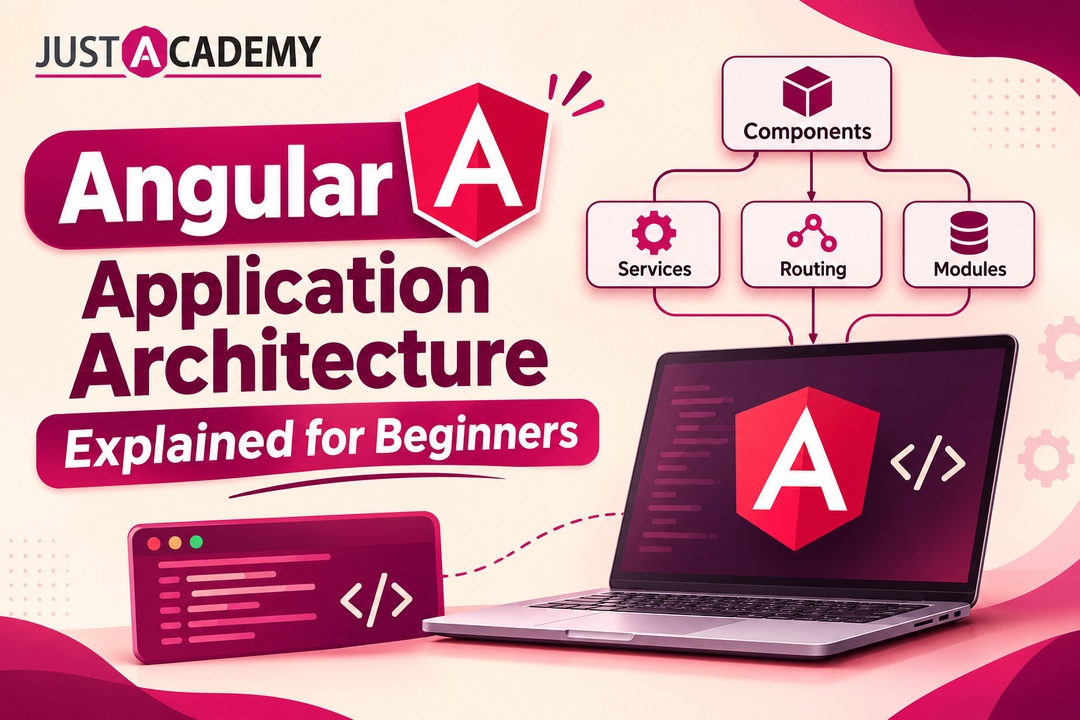
How components, services, standalone building blocks and the Angular CLI fit together, explained in plain words with live interactive and mentor led learning in mind
A practical guide for Hyderabad developers to react hooks, custom hooks and the design patterns that keep real projects clean, taught through live interactive, instructor led and mentor led learning
A practical, honest guide to choosing your first language, understanding modern iOS development, and building a career in Hyderabad’s growing app ecosystem through live interactive, instructor led and mentor led training.
A Hyderabad friendly walkthrough of how real apps get planned, designed, built, tested and shipped, and how live interactive, instructor led and mentor led learning gets you there faster
A grounded, honest guide for Hyderabad learners, career switchers and business owners who want to build real apps with Flutter and learn from mentors, not just videos.
Forty questions, honest answers and the design skills hiring panels in Delhi quietly score, shaped around live interactive, instructor led and mentor led learning
From your very first Laravel build to client ready applications, a Delhi learner’s guide to growing real backend skills through live interactive, instructor led and mentor led practice.
Drop us a Query
+91 99871 84296
Available 24x7 for your queries
Want To Connect with us
🚀 Kickstart Your IT Career
with JustAcademy
Learn Industry-Focused Courses with Live Projects & Placement Assistance
Full Stack Java(Java, Spring Boot, Hibernate, REST API, React JS)
Data Analytics(Excel, SQL, Power BI, Python, Tableau)