I am learning flutter from JustAcademy, They provide very much great environment where people gather and work simultaneously. totally project based training institute.
MOHD ABU BAKAR ANSARI
Flutter Developer
Awesome Experience. I am a Front-end Web Designer working at Star India for 3 years now. I applied for Full-stack development and my experience has been phenomenal & they really do help with placements exceptionally. Thank you Roshan sir so much.
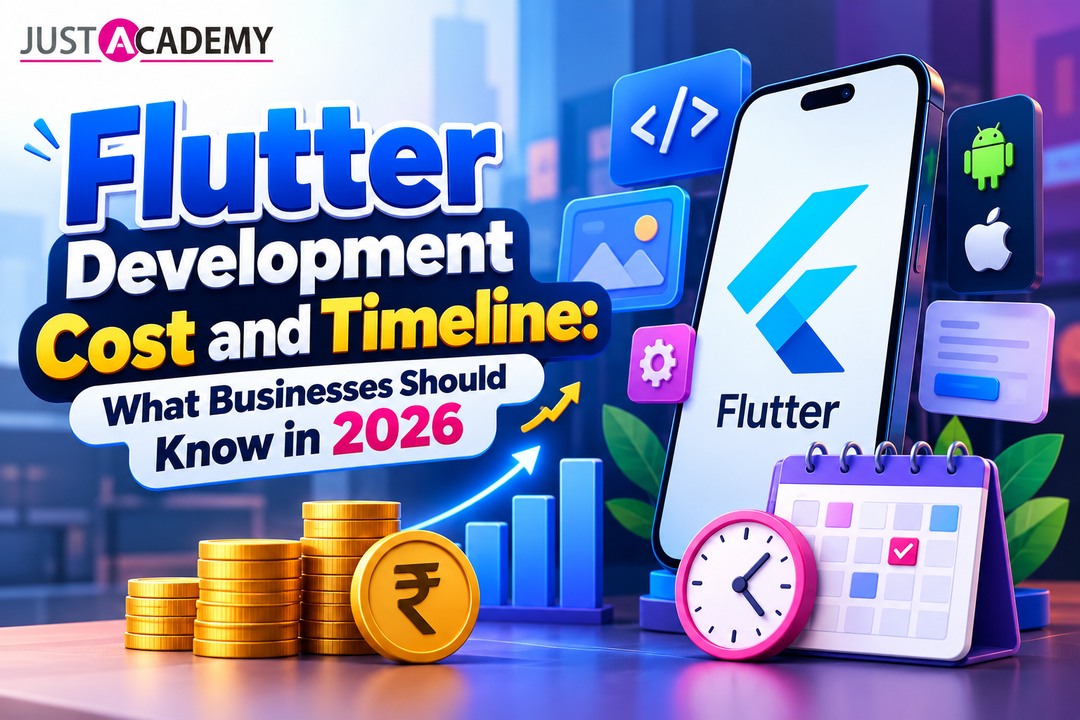
A plain spoken guide to budgets, build times, team choices and the learning path behind every dependable Flutter project
Almost every founder, product manager and small business owner in Delhi asks the same thing before a single line of code gets written: what will this app really cost me, and when will I be able to hold it in my hand? The honest answer to flutter app development cost is that it depends, but "it depends" is a frustrating thing to hear when you are staring at a budget sheet. So this guide does the harder job. It breaks the numbers down, shows you where money quietly leaks away, and explains how Flutter changes the arithmetic compared with building two separate apps.
If you are reading this because you want to be the person who actually builds these apps rather than the person who pays for them, there is a faster route than reading about it. The Flutter training course for Delhi learners is built around live interactive sessions where an instructor writes code in front of you and a mentor reviews yours afterwards, and you can see how it feels by booking a free demo session before you commit to anything. Our offline institute sits in Mumbai, and Delhi learners join the same instructor led batches live online, so nobody is watching a recording and hoping for the best.
Back to money. Think of this article as a conversation with someone who has watched many Flutter projects go well and a few go sideways. We will talk about what drives the price, what a realistic timeline looks like for a first release, how to decide between an agency, a freelancer and your own in house team, and why more Delhi businesses are choosing to train their own people. Every figure here is an indicative range from the Indian market, not a quotation, so treat it as a sensible starting point for your own conversations with vendors.
Why Flutter Changed the Way Businesses Budget for Apps
One codebase instead of two separate products
Before cross platform tools matured, launching on Android and iPhone meant hiring two teams, maintaining two repositories and fixing every bug twice. Flutter, Google's open source ui framework flutter developers rely on, lets one team write the app once in Dart and ship it to both stores. That single fact is the heart of the cost story. Instead of paying for flutter android work and then paying again for a native iPhone build, you pay for one shared product with a small slice of platform specific polish on top.
This is why flutter cross platform app development has moved from "interesting experiment" to a mainstream choice for startups, retailers, clinics, logistics firms and education companies. Founders are not choosing it because it is trendy. They are choosing it because the maths holds up when you lay it on a spreadsheet, especially during the first eighteen months of a product's life when every rupee of runway matters.
What the framework actually gives you
The flutter framework ships with its own rendering engine, so the interface looks and behaves the same on every device. It also comes with a generous flutter ui library, which means buttons, lists, navigation bars and animations are ready to use instead of being built from scratch. For flutter app design this is a gift: designers hand over a Figma file, and developers translate it into widgets with a level of fidelity that older cross platform tools struggled to reach.
There is also hot reload, the feature developers rave about for good reason. Change a line, see the result on the phone in a second or two. Over a long project, that fast feedback loop trims days of waiting and guessing, and those saved days show up in the invoice. Anyone doing flutter development for a living will tell you the same thing: the tooling is part of the product.
Where Flutter fits and where it does not
Flutter is excellent for flutter mobile app development in categories like ecommerce, booking, fintech dashboards, learning platforms, field service tools and internal business apps. It is less suited to apps that lean on very heavy platform specific features, for example advanced augmented reality or deeply integrated watch and car experiences, where native code still earns its keep. A candid vendor will tell you this early, and a vendor who promises Flutter fits every single scenario should make you a little cautious.
Flutter App Development Cost Broken Down by Complexity
The three bands most Indian projects fall into
Let us put real numbers on the table. Based on what Indian studios commonly quote in 2026, flutter pricing tends to sort itself into three bands. A simple app with a handful of screens, a login, a basic profile and a content feed usually lands between roughly four and eight lakh rupees. A mid sized product with payments, push notifications, an admin panel and third party integrations often runs from eight to twenty lakh. A complex platform with real time features, multiple user roles, heavy backend logic and strict security needs can climb from twenty lakh to fifty lakh or more.
These are not promises, and a good flutter app development company will refuse to give you a final figure until it has seen your requirements. Still, the bands give you something to measure a quotation against. If someone offers a mid sized product for the price of a simple one, ask what is being left out. If someone quotes the top band for a basic catalogue app, ask what they plan to build that you did not ask for.
How much does flutter app development cost per hour or per month
Many founders also ask how much does flutter app development cost when billed by time rather than by project. Agency rates in India commonly sit between roughly one thousand and three thousand rupees per hour depending on seniority and city, while a dedicated monthly team can range widely based on how many people you need. A freelance flutter mobile app developer may charge less, but you take on more coordination risk. Neither approach is wrong. The right choice depends on how well defined your scope is and how much management time you can give.
A fixed price contract suits a clear, stable scope. A time and materials arrangement suits a product that will evolve as users react to it. The trouble starts when a vague scope is forced into a fixed price, because every change then becomes an argument. Spend an extra week on requirements and you will save multiples of that week later.
The hidden line items nobody mentions in the first call
Development is only one slice of the total. Budget separately for ui and ux design, quality testing across devices, backend and cloud hosting, app store accounts, third party services such as payment gateways and map APIs, and the post launch maintenance that every live app needs. As a rule of thumb, set aside fifteen to twenty percent of the build cost each year for updates, bug fixes and operating system compatibility. Apple and Google both release new versions regularly, and an app that is not maintained slowly breaks.
The Real Cost Drivers Hiding Inside Your Feature List
Features that look small and behave large
Every feature has a price tag, but the tags are not proportional to how simple the feature sounds in a meeting. A login screen is cheap. Login with phone number verification, social sign in, biometric unlock and account recovery is not. A product list is cheap. A product list with filters, live stock, personalised sorting and offline support is a small project of its own. When you write your requirements, describe the behaviour you want, not only the screen name, because behaviour is where the hours go.
Design depth and custom animation
Flutter app design can be as plain or as polished as you like. Using standard material components keeps cost down and makes the app feel familiar. Custom illustrations, branded motion and gesture heavy interfaces look wonderful but need more design and more engineering time. Decide early whether delight is a launch requirement or a version two upgrade. Many successful apps launched with clean, simple interfaces and added flair after real users showed what they cared about.
Backend, data and integrations
The shiny part of an app is what users tap. The hungry part is the backend that stores their data and talks to payment providers, delivery partners, accounting tools and government services. If your idea needs a custom server, expect backend work to take as much effort as the app itself. If you can lean on managed services, the cost drops. Either way, ask your team to estimate the backend separately so that you can see where the money is going.
Turning an existing website into an app
A very common request in Delhi is website to flutter app conversion. Someone already runs a working site and wants a presence on the Play Store and the App Store. The cost here depends on how clean the existing backend is. If your site already exposes tidy APIs, the app can reuse them and the project moves quickly. If everything is tangled inside page templates, a good part of the budget goes into untangling it. Web development with flutter is also possible, since the same framework can target browsers, though most business owners still start with mobile and treat web as a later bonus.
How much does flutter app development cost when you add iPhone support
One reassuring detail: adding iPhone support to an existing Android build is usually a modest extra rather than a doubling of cost. Teams that build ios flutter versions still need to handle Apple specific items such as signing certificates, push notification setup, privacy declarations and App Store review. Anyone offering flutter ios app development should be comfortable with a Mac, Xcode and the review process. This is also where a flutter build ios app request can stall if nobody on the team has done it before, so ask for proof of previous App Store releases.
A Realistic Flutter Development Timeline, Phase by Phase
Discovery and planning, weeks one to two
Good projects start slowly and finish quickly. The first couple of weeks go into workshops, user flow sketches, a prioritised feature list and a technical plan. It can feel like nothing is happening because there is no app to look at yet. In truth, this is the cheapest phase in which to change your mind. A shifted requirement costs a conversation now and a rebuild later.
Design and prototyping, weeks two to five
Next comes the interface. Designers produce wireframes, then polished screens, then a clickable prototype that you can pass around to colleagues or friendly customers. Getting honest feedback on a prototype is one of the best uses of a weekend you will ever find. Flutter helps here because the same designs translate neatly into widgets, so fewer surprises appear when development begins.
Build, test and refine, weeks five to sixteen
The development phase usually runs in two week sprints. You see a working slice of the product at the end of each one, and you steer the next sprint from what you see. For a mid sized app, a typical flutter mobile app development effort needs about eight to twelve weeks of active building, with testing running alongside rather than waiting until the end. Teams that save testing for the last week almost always overrun.
Launch and the weeks after
Store submission takes a few days, sometimes longer if Apple asks questions. Plan a soft launch with a small group, watch crash reports and feedback, then widen the release. The first month after launch is when you learn what real people actually do with your app, and it is wise to keep the team on call for it.
Curious about the coding side of these phases? Sit in on a live interactive class and watch how a mentor walks learners through a real sprint before you decide anything. Reserve your free demo seat and see the instructor led format for yourself.
Flutter Versus Native and React Native on Cost and Speed
Putting the three approaches side by side
Choosing a technology is partly a cost decision, so here is a simple comparison. The figures are directional and assume a mid complexity product, because that is where most businesses actually live.
Factor
Flutter
Native Android and iOS
React Native
Codebases to maintain
One shared
Two separate
One shared
Relative build cost
Base cost
About 1.5 to 1.8 times Flutter
Close to Flutter
Interface consistency
Very high, own rendering engine
Platform perfect
Good, uses native components
Time to first release
Shorter
Longest
Shorter
Best for
Custom designs, fast launches
Heavy platform features
Teams with strong JavaScript skills
Notice that Flutter and React Native land close together on cost. The difference often comes down to your team's existing skills. A business with JavaScript talent may lean toward React Native, while a business starting fresh often prefers Flutter for its design control. If you are weighing both, the React Native training course designed for Delhi learners shows what the other path looks like, and many developers end up learning both. In fact, flutter for react native developers is a well worn transition because the component thinking feels familiar, even though Dart replaces JavaScript.
When going fully native still makes sense
Native development is not a dinosaur. If your product depends on cutting edge platform features, ultra low level performance, or deep integration with the operating system, native code can be the safer choice. Companies in banking or healthcare sometimes standardise on native for compliance reasons. For a deeper side by side, this honest read on Flutter against native Android and iOS lays out when each path wins, and it is worth ten minutes before you sign a contract.
Learners who want to go native can pick up Android app development training in Delhi or the iOS training programme for Delhi students. Having one person on a Flutter team who understands the native layer is extremely valuable, because platform quirks eventually show up in every serious project, and a developer who can read both worlds saves hours of confusion.
Flutter native ios and Android behaviour in practice
People sometimes worry that cross platform means second rate. In practice, flutter native ios behaviour is handled through platform channels and adaptive widgets, so the app can feel at home on an iPhone while still sharing most of its code. The same applies when you flutter build app for ios and Android together. The result is not a compromise so much as a trade: you accept a small abstraction layer in exchange for a large saving in time and money.
Agency, Freelancer or Your Own Team: Who Should Build It
What a Flutter development company really sells you
A flutter development company sells more than code. It sells project management, design, testing, deployment experience and a safety net when someone falls ill or leaves. That bundle costs more per hour than a freelancer, and for many businesses it is worth every rupee. When you compare flutter app development services, look past the portfolio slides. Ask who exactly will work on your project, how many Flutter releases the team has shipped to both stores, and what happens if you want to move the code to another vendor later.
The better firms offering flutter application development services will hand you the source code, the design files and the documentation as a matter of course. Be wary of anyone who treats your own product as their intellectual property, because that kind of lock in is expensive to escape.
Freelancers and small studios
A skilled freelance flutter dev can be a bargain for a clearly defined project. The risk sits in availability and continuity. One person cannot also be your designer, tester, backend engineer and project manager, so you either manage those roles yourself or accept gaps. If you go this route, insist on milestone based payments, regular demos and a code repository that you own from day one.
Building an in house team
For a business whose app is the core of its revenue, an in house team is often the best long term answer. Salaries are predictable, knowledge stays within the company, and changes happen at the speed of conversation. The catch is hiring. Good developers are in demand, and recruiting takes months. This is exactly why a growing number of Delhi companies are sponsoring existing staff, or fresh graduates they plan to hire, to train in Flutter first. If you are curious what a learner needs to become hireable, the Flutter developer roadmap for 2026 maps the skills, projects and career steps in a way that managers and trainees can both follow.
Smart Ways to Lower Your Bill Without Lowering Your Standards
Start with a focused first version
The most reliable way to cut cost is to build less, but build it well. A minimum viable product contains only the features needed to test your core idea with real users. Resist the temptation to include everything on the wish list. Founders who launch a lean first version and listen carefully often spend less overall than those who build a giant product nobody asked for.
Use the packages ecosystem wisely
Flutter's package library covers payments, maps, charts, camera access, local storage and much more. Reusing proven packages can save weeks of work. Wisdom is needed, though. Choose actively maintained packages with healthy communities, and avoid a long tail of obscure dependencies that may break at the next framework update. A seasoned team will know which packages are trustworthy and which ones are traps.
Design once for flutter ios and android together
When designers think of flutter ios and android as a single family of screens, rather than two separate apps, they produce layouts that adapt gracefully and avoid duplicated effort. A shared design system, with consistent spacing, colours and components, shortens development and makes later changes cheaper. It is a small habit with an outsized payoff, and it is one of the first things a mentor teaches in a good training programme.
Invest in automated testing early
Automated tests feel like an extra cost when a project begins. Over the following year they become a bargain, because each new feature can be checked against the old ones in minutes instead of days. Flutter has built in support for unit, widget and integration tests, so there is little excuse to skip them.
Mistakes That Quietly Double a Flutter Budget
Skipping the discovery phase
Teams in a hurry jump straight to coding. Three months later they discover that two key stakeholders imagined completely different products. Rework is the single biggest silent cost in software. A short, structured discovery phase is the cheapest insurance you can buy.
Treating the app as a one time purchase
An app is closer to a shop than to a brochure. It needs staff, upkeep and regular improvement. Businesses that spend everything on the first release and nothing on maintenance watch their ratings fall as new phones and operating systems arrive. Plan the second year of the budget as carefully as the first.
Choosing purely on the lowest quote
An unusually low quote often reflects an unusually thin understanding of the work. The vendor may be missing requirements, assuming you will not need testing, or planning to charge for every change afterward. A better question than "who is cheapest" is "who can show me a similar flutter application running well in production, and let me talk to their client?"
Ignoring performance and device variety
India has an enormous spread of phones, from flagship models to budget devices with limited memory. An app that feels smooth on a developer's new handset can stutter on a three year old device. Insist on testing across a realistic range, and pay attention to app size, start up time and battery use, because your customers certainly will.
Why Delhi Businesses Are Training Their Own Flutter Talent
The case for building skills inside the company
Outsourcing is not going away, but a pattern is emerging across Delhi and the wider NCR. Smart companies hire an agency to launch version one and then train a small internal group to take over maintenance and new features. This hybrid approach reduces long term spend and keeps product knowledge close. It also makes conversations with vendors far more productive, because someone in the room actually understands what a reasonable estimate looks like.
How live interactive learning makes the difference
Recorded videos are fine for casual curiosity. Real skill comes from live interactive sessions where you can interrupt, ask why a widget rebuilds, and get an answer in the moment. At JustAcademy the sessions are instructor led, which means an experienced trainer teaches the concepts and builds real screens in front of you. They are also mentor led, meaning that someone reviews your own code, points out bad habits early and helps you debug the problems that every beginner hits at ten in the evening.
Our classroom campus is in Mumbai, widely regarded as the best course in Mumbai for hands on mobile development, and the same teaching quality travels to Delhi through live online batches. You attend from your desk, ask questions in real time and work on the same projects as classroom students. For working professionals in Gurugram, Noida or central Delhi, this removes the commute without removing the human attention.
Projects that prove you can do the work
Certificates matter less than proof. A portfolio of working apps tells an employer, or your own manager, far more than a line on a resume. If you are unsure what to build first, these ten Flutter projects for beginners offer a ladder of ideas, from a simple to do list to a full commerce app, each of which exercises a different skill.
What a Capable Flutter Developer Actually Knows
Programming in Flutter starts with Dart
Every serious flutter mobile app developer begins with Dart, the language behind the framework. It is readable, strongly typed and friendly to anyone with a background in Java, JavaScript or C sharp. Programming in flutter then adds widgets, state management, navigation, networking and local storage. A beginner who learns these in sequence, with regular practice, can start to create mobile app screens within weeks and deliver a small but complete app in a few months.
State management, architecture and clean code
The part that separates a hobbyist from a professional is how the app handles data as it changes. Approaches such as Provider, Riverpod and Bloc each have fans, and what matters is choosing one that suits the project and applying it consistently. A strong mobile developer flutter teams trust will also care about folder structure, naming, error handling and tests, because those habits keep an app maintainable when the team grows.
Front end flutter skills and platform awareness
Working on front end flutter means thinking about layouts that adapt to different screen sizes, accessibility for users with different needs, and smooth animations that do not drain batteries. On top of that, a developer who can configure flutter for ios development, handle permissions, push notifications and store submissions becomes far more valuable than someone who stops at the code editor.
Putting Together a Budget You Can Actually Defend
A simple way to estimate before you call anyone
You do not need a vendor to start estimating. List every screen your app needs, group them by difficulty as simple, medium or complex, and assign a rough number of working days to each group. Add backend effort, design, testing and a contingency of at least fifteen percent for surprises. The total will not be exact, but it will be close enough to tell you whether a quotation is sensible, and it will make you a far more credible client in every meeting.
Questions to ask every vendor or trainer
Whether you are hiring a studio or choosing a training partner, the useful questions are the same. Who does the work, and what is their real experience? What will you see at the end of each stage? How are changes priced? What happens after launch? Vendors and trainers who answer these plainly, without hiding behind jargon, are usually the ones worth working with.
Planning for growth after launch
Your first release is a hypothesis. The second and third releases are where the product finds its feet. Keep a small monthly budget for improvements, and let user behaviour, not opinions in a boardroom, decide what to build next. Teams that keep this rhythm tend to end up with flutter based apps that grow steadily instead of lurching between big rewrites.
Everyday Questions People Ask About Flutter Budgets
Is Flutter really cheaper than building two native apps
In most cases yes, because you write and test the core of the product once. The saving is usually largest on interface heavy products and smallest on apps that rely on lots of platform specific code. Even then, a shared codebase is easier to keep in sync, and that convenience keeps paying back long after launch.
Can I make an app with Flutter if I am not a programmer
You can certainly shape the product, write the requirements and manage the build without coding. If you want to make an app with flutter yourself, however, you will need to learn Dart and the widget system, which is very achievable with guided learning. Many founders attend a short course simply to understand what their developers are talking about, and they report that it changes their conversations for the better.
How long does it take to create an app with Flutter
A simple product can be ready in two to three months. A mid sized one usually needs four to five. If you plan to create an app with flutter that includes complex integrations, plan for six months or more. Learning the framework from scratch is a separate timeline: most dedicated beginners reach a confident, job ready level in roughly four to six months of structured study and practice.
Is online flutter app development reliable for Indian businesses
Yes, provided the team communicates clearly. Online flutter app development is now common, with design reviews, sprint demos and daily check ins all happening over video and shared tools. Distance matters far less than discipline. A well run remote team in another city can outperform a poorly run one in the next office.
Which kinds of apps suit Flutter best
Flutter for apps with rich custom interfaces, such as learning platforms, marketplaces, booking tools and service dashboards, is a natural fit. Whenever a business wants to build mobile app with flutter and reach both platforms quickly, the framework tends to deliver. Founders who ask whether flutter on mobile is mature enough can be reassured: large companies already run flutter applications in production for millions of people.
The Wider Market: Demand for Flutter Skills in 2026
Why companies keep asking for Flutter
Hiring managers across India keep adding Flutter to job descriptions because cross platform app development flutter style reduces headcount needs and speeds up release cycles. Startups, product companies and agencies all want people who can ship polished flutter mobile application releases without waiting on two separate teams. For learners, that translates to steady openings in Delhi, Gurugram, Noida, Bengaluru, Pune and Mumbai, plus a healthy remote market.
Careers around the framework
The skill opens several doors. You can join a product team, work for an agency delivering mobile app development flutter projects for clients, freelance on your own, or build your own product. Those who also understand the backend, cloud services and design thinking move faster up the ladder. Mobile app development in flutter pairs especially well with knowledge of REST APIs, Firebase and basic DevOps.
Skills that sit comfortably beside Flutter
Developers rarely work with a single tool. Comfort with Git, API testing, UI principles and basic databases makes any flutter software development role easier. If you want to broaden your toolkit later, mobile development flutter experience transfers well to Kotlin, Swift or React Native, so you are never locked into one path.
Three Imaginary Delhi Businesses and What Their Flutter Budgets Might Look Like
A neighbourhood grocery chain with a delivery app
Picture a grocery chain in South Delhi that wants customers to order from their phones. The product needs a catalogue, a cart, address management, payments, order tracking and a simple dashboard for store staff. This sits comfortably in the mid sized band. Because the chain wants to create mobile app with flutter for both Android and iPhone customers at once, a single shared codebase keeps the build between three and five months. The biggest surprises usually come from inventory sync with the existing billing software, not from the screens themselves, so a wise owner asks about that integration before anything else.
A coaching institute with a learning app
Now imagine a coaching institute in Laxmi Nagar that wants recorded lectures, live classes, quizzes and progress reports. Here the cost leans on video streaming, secure content delivery and analytics. The interface can stay clean and familiar, which keeps design spend modest, but the backend deserves real attention. Many such institutes use a hybrid plan: an agency delivers version one, then two internal staff trained in flutter for app development take over updates. That arrangement keeps the long term bill lower and the product knowledge inside the company.
A fintech startup in Gurugram
Finally, consider a young fintech team that needs identity checks, bank integrations, encryption and compliance reporting. This is the top band, and the timeline stretches because security reviews cannot be rushed. For a team like this, flutter mobile development still offers a speed advantage on the interface layer, while the sensitive logic lives on carefully audited servers. They would be wise to keep one engineer fluent in mobile app in flutter and native security practices so that reviews with regulators go smoothly.
What these stories teach about timing
In all three cases the same pattern repeats. Time and money are decided far more by clarity at the start than by the framework itself. Teams that write down their goals, rank their features and agree on what version one must prove tend to finish near their estimate. Teams that keep adding ideas mid sprint tend to blow through both schedule and budget. A good flutter ios android project plan simply makes that discipline visible, with dates, owners and checkpoints that everyone can see.
Finding the right fit between product and framework
If your idea is a polished consumer product with a distinctive look, flutter for app development is a strong match. If you are extending a large existing web platform, you might use flutter for apps that mirror key web journeys while keeping the rest of the system as it is. If you are unsure, spend a day with an experienced advisor, or a week learning the basics yourself, before locking in a decision. The cost of that homework is tiny compared with the cost of choosing wrongly.
Why Structured Training Beats Piecing Together Tutorials
The trouble with random learning
Free videos are wonderful for curiosity, and almost everyone learns something from them. The problem appears when you try to join the dots. Tutorials rarely teach in an order that builds understanding, they seldom review your own code, and they never ask whether you truly understood. Learners often spend months feeling busy while their skills barely move, then discover gaps in an interview.
What structure looks like at JustAcademy
JustAcademy is an ISO certified training institute trusted across India, and its Flutter programme is designed to remove that wandering. You follow a clear curriculum covering Dart, widgets, state management, APIs, Firebase, testing and store deployment. Live interactive sessions keep every class two way, instructors teach with real examples, and mentors review assignments so that mistakes are corrected while they are still small. You develop flutter apps from the first week rather than waiting until the end to build something.
Placement support and a portfolio you can show
Training only matters if it leads somewhere. Our placement support team helps you shape your resume, prepare for technical interviews and connect with hiring companies, while your project portfolio gives them something concrete to evaluate. You can attend in the Mumbai classroom for an in person experience, or join live online from Delhi or anywhere else in the world and receive the same curriculum, the same mentors and the same attention.
Learning for managers and founders too
Not everyone who joins wants a new job. Some founders and product leaders attend to understand flutter create mobile app workflows, so they can scope better, challenge estimates and guide their teams. A few weeks of focused learning can save lakhs in misdirected spending, which is perhaps the most direct link between this article and the training behind it.
Flutter app development cost is not a mystery, it is a set of choices. Scope, design depth, backend needs, team type and timing each move the number up or down, and understanding them puts you firmly in control of the conversation. A simple app can launch in a couple of months on a modest budget, a mid sized product needs a few months and a larger investment, and complex platforms deserve patient planning. Across all of them, Flutter's single codebase gives businesses a real advantage over building two apps from scratch.
The other half of the story is people. Projects succeed when someone on the team truly understands the framework, and that understanding grows fastest in live interactive, instructor led and mentor led environments where questions get answered and code gets reviewed. Whether you want to hire well, manage better or become the developer yourself, investing in real skills is the most dependable way to keep both cost and timeline in check. Take the next step today and see what guided learning feels like.
A practical, honest walkthrough of Swift, Xcode, Windows workarounds, Flutter, React Native and the career paths that open up once you can build for Apple devices
A practical, no nonsense guide to software jobs for freshers, from picking a skill path to cracking interviews and aiming at the highest paying software engineering jobs
40 real questions and detailed answers on Kotlin, Jetpack, architecture, performance and security, so you walk into your next android technical interview ready to talk like a working developer.
From your first line of JavaScript to a react native app on the Play Store and App Store, here is the honest, practical route that beginners in India can actually follow.