I am learning flutter from JustAcademy, They provide very much great environment where people gather and work simultaneously. totally project based training institute.
MOHD ABU BAKAR ANSARI
Flutter Developer
Awesome Experience. I am a Front-end Web Designer working at Star India for 3 years now. I applied for Full-stack development and my experience has been phenomenal & they really do help with placements exceptionally. Thank you Roshan sir so much.
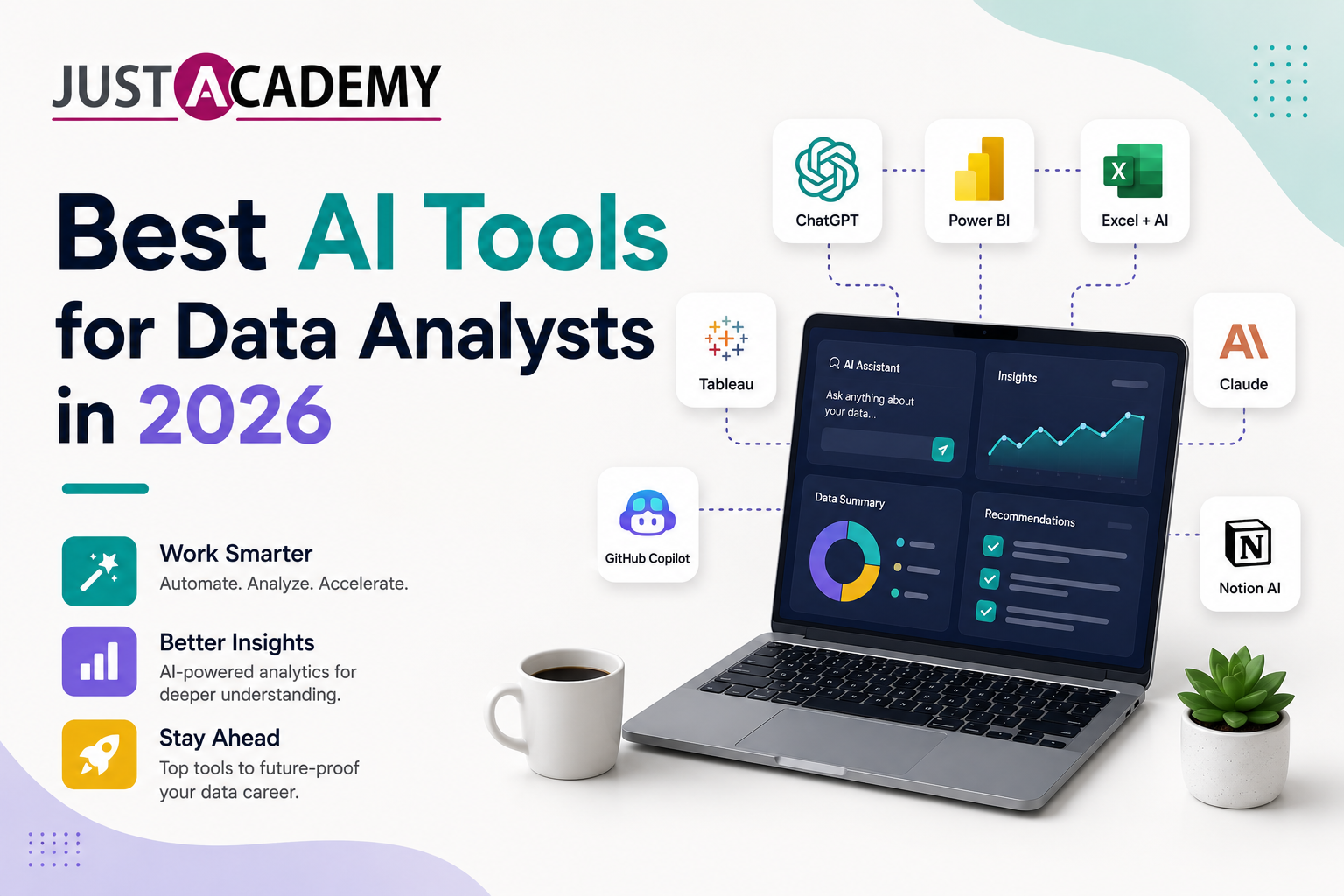
The data analyst's toolkit has changed more in the last two years than in the previous decade. AI tools for data analysts are no longer experimental add-ons reserved for large enterprises with dedicated data science teams. In 2026, they are standard components of everyday analytics workflows at companies of every size, across every industry. Analysts who know how to use these tools work faster, produce better outputs, and contribute more strategically to their organizations.
This blog covers the best AI tools for data analysts in 2026, how each one fits into an analyst's day-to-day workflow, and how to build an AI productivity stack that makes you significantly more effective in your role. Whether you are a fresher building your first skill set or an experienced analyst looking to modernize your toolkit, this guide gives you a practical, up-to-date picture of what to learn and why.
Why AI Tools Are Now Essential for Every Data Analyst
The Baseline Has Shifted
Two years ago, knowing SQL and Power BI was enough to be considered a competent junior analyst. In 2026, that baseline has shifted. Employers now expect analysts to demonstrate familiarity with AI-assisted workflows, prompt engineering for data tasks, and at least a working knowledge of how machine learning outputs are interpreted and validated. This is not about replacing traditional skills. It is about layering AI capability on top of them to produce faster, more accurate, and more insightful work.
AI Tools Multiply Analyst Productivity
The most immediate benefit of AI tools for data analysts is productivity. Tasks that previously took hours, including writing complex SQL queries, cleaning datasets, building visualizations, and drafting insight summaries, can now be completed in a fraction of the time with the right AI tools. This productivity gain is not a threat to analyst jobs. It is an opportunity for analysts to redirect their time toward higher-value activities including stakeholder engagement, strategic analysis, and business problem framing.
Companies Are Selecting for AI Tool Familiarity
A review of data analyst job postings in India in 2026 shows a clear pattern. Roles at mid to large organizations increasingly list AI tool familiarity as either a required or preferred qualification. This includes specific tools like Copilot, ChatGPT, and Tableau AI as well as broader competencies like prompt engineering and AutoML. Candidates who cannot demonstrate hands-on experience with at least two or three of these tools are at a growing disadvantage in competitive hiring processes.
The Learning Curve Is Lower Than Most People Expect
One of the most common misconceptions about AI tools is that they require deep technical knowledge to use effectively. In reality, most AI analytics tools are designed for accessibility. ChatGPT requires no coding knowledge to use for SQL generation or data summarization. Power BI Copilot works through natural language. AutoML platforms like PyCaret guide users through model building with minimal code. The barrier to entry is lower than ever and the return on a small time investment in learning these tools is immediate.
Best AI Tools for Data Analysts to Use in 2026
ChatGPT and Large Language Models for Analytics
ChatGPT remains one of the most widely used AI productivity tools for analysts in 2026. Its applications in analytics work are broad and practical. Analysts use it daily to write and debug SQL queries across different database dialects, generate Python code for data cleaning and transformation, explain statistical concepts and model outputs in plain language, draft executive summaries and data narratives, and create documentation for dashboards and data pipelines.
The key to using ChatGPT effectively as an analyst is prompt engineering. A well-structured prompt that provides context about the dataset, the business question, and the desired output format produces dramatically better results than a vague request. Analysts who invest time in learning how to write effective prompts for analytics tasks see immediate gains in the quality and speed of their work.
Google Gemini and Anthropic Claude are strong alternatives with similar capabilities and are increasingly integrated into enterprise tools like Google Workspace and various data platforms.
Microsoft Copilot for Power BI
Microsoft Copilot is deeply embedded in Power BI in 2026 and represents one of the most impactful AI reporting tools available to analysts working in the Microsoft ecosystem. Copilot can generate complete report pages from a natural language description, write DAX measures based on a plain English explanation of the calculation needed, summarize dashboard insights into written narratives, and suggest visualizations based on the data model structure.
Copilot does not replace the need for Power BI expertise. Analysts who understand data modeling, DAX logic, and report design principles get significantly more value from Copilot than those who use it without that foundation. The tool is most powerful in the hands of a skilled analyst, not as a substitute for analytical skill.
Tableau AI and Einstein Discovery
Tableau's AI features in 2026 include automated insight discovery that surfaces statistically significant patterns in datasets without manual exploration, natural language querying that allows business users and analysts to ask questions in plain English and receive visual answers, and predictive analytics integration that brings forecasting directly into the dashboard environment.
Einstein Discovery, Salesforce's AI analytics layer, extends these capabilities for organizations using the Salesforce ecosystem. It produces explainable predictions, recommends actions based on model outputs, and integrates directly with CRM data. Analysts working in sales, marketing, or customer success roles at Salesforce-heavy companies are expected to be familiar with these tools.
Python AI Libraries and AutoML Platforms
Python remains the most important programming language for data analysts who want to work with AI tools. The ecosystem of AI-focused libraries available in 2026 includes tools that make predictive modeling accessible to analysts without deep machine learning expertise.
PyCaret is an open-source AutoML library that automates the process of training, comparing, and tuning machine learning models. An analyst can go from a clean dataset to a trained classification or regression model in under twenty lines of code. H2O.ai offers similar functionality with enterprise-grade features. These tools do not replace data scientists but they allow analysts to build and deploy simple predictive models independently, expanding the scope of what an analyst can deliver.
The Pandas AI library is a newer addition that allows analysts to query Pandas DataFrames using natural language, making exploratory data analysis faster and more accessible. Combined with standard Pandas and NumPy, it forms a powerful Python-based AI productivity stack.
Google Looker and Looker Studio AI Features
Google Looker has evolved significantly with AI integration in 2026. Looker's AI features include automated anomaly detection that flags unusual patterns in business metrics, natural language generation that produces written summaries of dashboard data, and AI-assisted exploration that suggests relevant dimensions and measures when building new analyses. For analysts working in Google Cloud environments or organizations using BigQuery as their data warehouse, Looker is an essential tool to master.
Looker Studio, the free version accessible to all Google users, has also incorporated AI summarization features that make it useful for smaller teams and freelance analysts who need accessible AI reporting capabilities without enterprise licensing costs.
dbt with AI-Assisted Documentation
dbt has become a standard tool in modern analytics stacks and its integration with AI in 2026 makes it even more powerful. AI-assisted features within dbt allow analysts to automatically generate documentation for data models, suggest tests for data quality validation, and explain complex SQL transformations in plain language. For analysts transitioning into analytics engineering roles, learning dbt alongside AI documentation tools is one of the highest-leverage skill investments available.
Monte Carlo and AI-Powered Data Observability
Data quality is the foundation of reliable analytics and AI-powered observability tools like Monte Carlo have made automated data quality monitoring accessible to analytics teams of all sizes. Monte Carlo uses machine learning to establish baseline patterns in data pipelines and alerts analysts when anomalies are detected, before bad data reaches dashboards or decision makers. In 2026, familiarity with at least one data observability tool is becoming a standard expectation for senior analyst roles.
Notebook AI Tools: Jupyter AI and Google Colab
Jupyter AI brings large language model assistance directly into the Jupyter Notebook environment. Analysts can generate code cells, explain existing code, debug errors, and get suggestions for next analysis steps without leaving their notebook. Google Colab has integrated similar AI assistance features. For analysts who work primarily in Python notebooks for exploratory analysis, these tools provide immediate productivity benefits with no additional setup required.
Tool
Primary Use
Best For
ChatGPT and Gemini
SQL, Python, narratives
All analysts daily
Microsoft Copilot for Power BI
AI reporting and DAX
Power BI analysts
Tableau AI and Einstein
Insight discovery and forecasting
Tableau and Salesforce users
PyCaret and H2O.ai
AutoML and predictive modeling
Analysts building predictions
Google Looker AI
Automated anomaly detection
Google Cloud and BigQuery users
dbt with AI documentation
Pipeline documentation and testing
Analytics engineers
Monte Carlo
Data quality monitoring
Senior and lead analysts
Jupyter AI and Colab AI
Notebook coding assistance
Python-first analysts
How to Build Your AI Productivity Stack as a Data Analyst
Start With One Tool and Go Deep
The most common mistake analysts make when approaching AI tools is trying to learn too many at once. The better approach is to choose one tool that fits directly into your current workflow and spend two to four weeks using it daily for real work tasks. If you use Power BI, start with Copilot. If you work primarily in Python, start with ChatGPT for code generation and Pandas AI for exploration. Going deep on one tool before adding another builds genuine proficiency rather than surface-level familiarity.
Layer Tools Based on Your Role and Industry
Not every analyst needs every tool. Build your stack based on your specific role, the tools your current or target employer uses, and the types of analysis you perform most frequently. A financial analyst at a bank will build a different stack than a product analyst at a tech startup. The table below provides a starting point for different analyst profiles.
Analyst Profile
Recommended AI Stack
BI and Reporting Analyst
Copilot for Power BI, ChatGPT, Tableau AI
Python and Data Analyst
Jupyter AI, PyCaret, Pandas AI, ChatGPT
Analytics Engineer
dbt with AI docs, ChatGPT for SQL, Monte Carlo
Product Analyst
Looker AI, ChatGPT, Mixpanel AI features
Fresher Building Portfolio
ChatGPT, Jupyter AI, PyCaret, Google Colab AI
Practice Prompt Engineering Deliberately
Prompt engineering is the skill that determines how much value you extract from large language models like ChatGPT and Gemini. Effective prompts for analytics tasks share several characteristics. They provide context about the dataset and its structure. They specify the desired output format. They include constraints such as database dialect for SQL or library preferences for Python. They break complex requests into steps. Practicing this skill deliberately over a few weeks produces measurable improvements in output quality and reduces the back-and-forth required to get useful results.
Validate Every AI Output Before Using It
AI tools make mistakes. SQL queries generated by ChatGPT may contain logical errors or incorrect table references. AutoML models may overfit or use inappropriate algorithms for the problem. Copilot-generated DAX measures may produce incorrect aggregations. The analyst's role in an AI-assisted workflow includes validating every output before it is used in a decision or shared with a stakeholder. This validation responsibility is not going away. It is one of the core reasons skilled analysts remain essential even as AI tools become more capable.
Why Learning AI Tools Through Structured Training Pays Off
Self-Learning Has Real Limitations
YouTube tutorials and blog posts can introduce you to AI tools but they rarely provide the structured progression, real-world project context, and expert feedback needed to develop genuine proficiency. Self-learners often develop gaps in foundational knowledge, pick up bad habits, and struggle to connect individual tool skills into a coherent analytical workflow. Structured training programs address all of these limitations by providing a guided curriculum, hands-on assignments, and instructor-led doubt resolution.
The Mumbai Analytics Job Market Rewards Certified and Project-Ready Candidates
For analysts based in Maharashtra, the Mumbai job market is increasingly competitive and recruiters are screening more carefully than ever. Candidates who can demonstrate structured training, a portfolio of real projects, and hands-on experience with current AI tools consistently outperform self-taught candidates in hiring processes at banks, consulting firms, e-commerce companies, and technology organizations headquartered in Mumbai.
Enrolling in the best data analytics training in Mumbai gives you access to a curriculum that is actively updated to reflect the tools and skills that Mumbai-based employers are hiring for in 2026. It also gives you the in-person learning environment, peer network, and local industry connections that online self-study cannot replicate.
Online Training Provides the Same Quality for Global Learners
For learners outside Mumbai or outside India, JustAcademy's online bootcamp delivers the same curriculum quality, project depth, and placement support in a flexible format. Analytics roles are increasingly remote and global, and a strong online training credential combined with a project portfolio is recognized by employers across the US, UK, UAE, Singapore, Australia, and other major markets.
Real World Projects Are What Get You Hired
Across every analyst hiring process, the single most differentiating factor between candidates who receive offers and those who do not is a demonstrable portfolio of real projects. JustAcademy's bootcamp programs are structured around real-world project work from the first week, ensuring that every graduate has hands-on experience with actual business datasets, modern tools including AI platforms, and end-to-end analytical workflows that they can speak to confidently in any interview.
Related Courses to Expand Your Tech Profile
Building skills beyond data analytics increases your versatility and long-term career options. Explore these programs at JustAcademy:
The best AI tools for data analysts in 2026 are not just productivity boosters. They are career definers. The analysts who take the time to build genuine proficiency with tools like ChatGPT, Microsoft Copilot, Tableau AI, PyCaret, and dbt are operating at a level that was simply not possible for individual analysts five years ago. They are producing better work, faster, with deeper insight, and they are being recognized and rewarded for it in the job market.
If you are a fresher, now is the time to build this skill set from the ground up. Do not wait until these tools feel overwhelming or until the job market demands them even more strongly. Start learning them as part of your foundational training and graduate with a profile that reflects the realities of analytics in 2026.
If you are an experienced analyst, the message is equally clear. The gap between where your skills are today and where the market is heading is a gap you can close with focused effort and the right training program. Every week spent building AI tool proficiency is a week that compounds into a stronger salary position, a more senior role, and a more resilient career.
The tools are available. The demand is real. The opportunity is here right now.
Take the first step with JustAcademy. Register for a Free Demo and experience the curriculum firsthand, or Download the Brochure to review course details, batch schedules, and fees at your own pace. If you are based in Maharashtra and prefer in-person learning, the Data Analytics Bootcamp in Mumbai gives you hands-on classroom training with real-world projects and local industry connections. If you are learning from another city or country, the Data Analytics Bootcamp Online delivers the same depth and placement support from wherever you are in the world.
Why AI Tools Are Now Essential for Every Data Analyst
Best AI Tools for Data Analysts to Use in 2026
How to Build Your AI Productivity Stack as a Data Analyst
Why Learning AI Tools Through Structured Training Pays Off
A practical guide for Delhi learners covering react native app ideas for beginners, live mentor led practice, and a portfolio that actually gets interviews
A practical, honest walkthrough of Swift, Xcode, Windows workarounds, Flutter, React Native and the career paths that open up once you can build for Apple devices
A practical, no nonsense guide to software jobs for freshers, from picking a skill path to cracking interviews and aiming at the highest paying software engineering jobs
40 real questions and detailed answers on Kotlin, Jetpack, architecture, performance and security, so you walk into your next android technical interview ready to talk like a working developer.
From your first line of JavaScript to a react native app on the Play Store and App Store, here is the honest, practical route that beginners in India can actually follow.