I am learning flutter from JustAcademy, They provide very much great environment where people gather and work simultaneously. totally project based training institute.
MOHD ABU BAKAR ANSARI
Flutter Developer
Awesome Experience. I am a Front-end Web Designer working at Star India for 3 years now. I applied for Full-stack development and my experience has been phenomenal & they really do help with placements exceptionally. Thank you Roshan sir so much.
Java Full Stack development remains one of the most consistently in-demand technology career paths in India in 2026. But the skill set required to be genuinely competitive in the Java Full Stack developer job market has evolved substantially over the last three to four years. The baseline expectations have risen. The tools have changed. The architecture patterns have shifted toward cloud-native and microservices. And the gap between developers who meet the 2026 standard and those operating on a 2020 understanding of the role is visible and consequential in both hiring outcomes and salary positioning.
Understanding exactly which java full stack developer skills employers are hiring for in 2026, why each skill matters, how they work together, and what level of proficiency is expected at different career stages is essential information for any Java developer who wants to remain competitive. This blog covers the complete picture of in-demand java developer skills in 2026, organized from the most foundational technical capabilities through the advanced skills that differentiate senior developers. Whether you are a fresher building your initial skill set, a mid-level developer evaluating what to learn next, or an experienced professional ensuring your skills remain current, this guide gives you a clear, practical picture of where to invest your learning effort.
Why the Java Full Stack Developer Skill Set Has Evolved Significantly in 2026
The Architecture Has Shifted Toward Cloud-Native
Three years ago, the standard Java enterprise application was a Spring Boot monolith deployed on a virtual machine in a data center or on a cloud virtual machine. Today, the standard is a collection of Spring Boot microservices deployed in Docker containers orchestrated by Kubernetes on a cloud platform. This architectural shift has made container knowledge, cloud platform familiarity, and service mesh awareness required skills rather than advanced specializations. Developers who are fluent only in Spring Boot monolith development but have no exposure to containerized microservices deployment are increasingly filtered out at the mid-level hiring stage.
AI-Assisted Development Has Raised the Productivity Baseline
Tools like GitHub Copilot, IntelliJ AI Assistant, and ChatGPT have become standard parts of the Java developer workflow in 2026. The baseline productivity expectation has risen accordingly. Developers who use these tools effectively produce code faster, write better tests, and navigate unfamiliar APIs more quickly than those who do not. But the developers who get the most value from AI coding tools are those with the strongest foundational understanding of Java and Spring Boot, because they can evaluate the AI's suggestions critically rather than accepting incorrect code. The combination of strong fundamentals and effective AI tool usage defines the top tier of the 2026 Java developer skill set.
Frontend Expectations Have Increased for Full Stack Roles
Full stack Java developer roles in 2026 increasingly expect genuine frontend capability rather than token familiarity with HTML and CSS. Companies that describe roles as full stack expect developers who can build complete React or Angular interfaces, manage state effectively, handle API integration with JWT authentication, implement React Router for protected routes, and debug frontend issues independently. Developers whose frontend knowledge extends only to the ability to modify existing HTML files are finding that they are being hired for backend roles rather than the full stack roles with higher compensation.
The Fresher Hiring Bar Has Also Risen
Even for fresher and junior Java developer roles, the skill expectations in 2026 are meaningfully higher than they were three years ago. Entry-level postings that previously listed Core Java and basic Spring Boot as requirements now commonly add Spring Data JPA, Spring Security basics, REST API design, MySQL, React fundamentals, and Git. Freshers who invest in building genuine proficiency across this wider set are hiring into a much stronger position than those who know only the fundamentals.
Core Java and Backend Skills Every Java Full Stack Developer Must Master
Core Java Proficiency: The Foundation That Cannot Be Skipped
Object-Oriented Programming Depth
Core Java proficiency is the foundation that determines everything that comes after. Employers in 2026 do not just test whether candidates know Java syntax. They test whether candidates understand the principles that make Java enterprise code maintainable, extensible, and correct. Object-oriented programming depth means understanding encapsulation and why exposing private fields directly through public setters undermines it. It means understanding polymorphism and why coding to interfaces rather than implementations is a professional standard. It means understanding inheritance and when composition is a better design choice. And it means understanding abstraction and how abstract classes and interfaces serve different design purposes.
Interview questions for Java developers in 2026 regularly probe these principles through design discussions, code review scenarios, and SOLID principle applications. Developers who understand these concepts deeply can discuss their architectural decisions with the vocabulary and reasoning that senior interviewers expect.
Java 8 Through Java 21 Modern Features
Modern Java features are not optional knowledge for developers entering the job market in 2026. Lambda expressions replaced verbose anonymous inner class patterns throughout the Spring ecosystem. The Stream API is used extensively in service layer code for collection processing. Optional reduces NullPointerExceptions in domain logic. Method references provide concise callback patterns. The new Date and Time API is used for all temporal calculations in modern codebases.
Java 17 and 21 features including records for immutable data classes, sealed classes for algebraic type modeling, pattern matching for instanceof checks, text blocks for multi-line strings, and virtual threads from Project Loom are increasingly expected from developers applying to modern engineering teams. Staying current with Java version features demonstrates the continuous learning orientation that employers increasingly screen for explicitly.
Collections, Generics, and Data Structures
Deep collections framework knowledge separates developers who can write correct code from those who write correct but inefficient code. Understanding the performance characteristics of ArrayList versus LinkedList, HashMap versus TreeMap, and HashSet versus LinkedHashSet allows developers to choose the right data structure for each use case. Understanding how HashMap's collision handling and load factor affect performance, why ConcurrentHashMap is needed for thread-safe map operations, and how PriorityQueue implements a heap are all topics that senior Java developer interviews address. Generic type parameters, wildcards, and bounded type parameters are used extensively in Spring framework method signatures and need to be understood to work effectively with the framework.
Multithreading and Concurrency
Enterprise Java applications handle concurrent requests from thousands of simultaneous users. Understanding thread creation, the Runnable and Callable interfaces, the ExecutorService and thread pools, synchronization with synchronized blocks and the volatile keyword, the java.util.concurrent package including CountDownLatch, CyclicBarrier, and Semaphore, and the CompletableFuture API for non-blocking asynchronous operations is expected from mid-level and senior Java developers. With Java 21's virtual threads, understanding the new concurrency model and when to use virtual threads versus platform threads has been added to this requirement.
Exception Handling and Error Management
Professional exception handling goes well beyond wrapping code in try-catch blocks. It includes defining meaningful custom exception hierarchies that provide context-specific error information. Understanding when to use checked versus unchecked exceptions and why modern Java best practice favors unchecked exceptions for most application errors. Implementing global exception handling in Spring Boot using ControllerAdvice that returns appropriate HTTP status codes and structured error response bodies. And understanding how to log exceptions appropriately at different severity levels without leaking sensitive information in production error responses.
Spring Boot: The Non-Negotiable Skill for Enterprise Java
Spring Core and Dependency Injection
Spring Boot proficiency begins with genuine understanding of the Spring IoC container and dependency injection. Developers who understand only the syntax of Autowired without understanding why dependency injection improves testability, maintainability, and flexibility will be limited in their ability to design effective Spring Boot applications. Understanding the singleton, prototype, request, and session bean scopes. Understanding constructor injection versus field injection and why constructor injection is preferred for mandatory dependencies. Understanding how Spring resolves bean conflicts when multiple beans of the same type exist. And understanding how to use Profiles for environment-specific bean configuration are all topics that Spring Boot technical interviews probe.
Spring Boot Auto-Configuration and Customization
Spring Boot's auto-configuration is its most powerful feature and one of its most frequently misunderstood. Developers who treat auto-configuration as magic that works until it does not are perpetually confused by Spring Boot's behavior. Developers who understand how auto-configuration works, how to use application.properties and application.yaml for configuration, how to write custom auto-configuration, how to exclude specific auto-configurations, and how the Spring Boot starter mechanism bundles dependencies and configurations are far more effective when troubleshooting and extending the framework.
REST API Design and Implementation
Building well-designed REST APIs is a core daily skill for Java Full Stack developers. This goes beyond annotating methods with GetMapping and PostMapping. It includes understanding RESTful resource naming conventions and applying them consistently. Implementing proper HTTP status codes that communicate the outcome of each operation accurately. Designing request and response DTOs that expose only the information appropriate for each endpoint. Implementing comprehensive input validation using Bean Validation annotations. Applying API versioning strategies that allow evolution without breaking existing clients. Generating API documentation automatically using springdoc-openapi. And implementing HATEOAS links where the application architecture requires it.
Spring Data JPA and Hibernate
Database access through Spring Data JPA and Hibernate is one of the most technically nuanced areas of enterprise Java development. The apparent simplicity of extending JpaRepository hides significant complexity in production scenarios. Understanding entity relationship mapping for OneToOne, OneToMany, ManyToOne, and ManyToMany associations. The difference between unidirectional and bidirectional relationships and the implications for cascade operations. The N plus one query problem, how to identify it using SQL logging, and how to resolve it using JOIN FETCH or EntityGraph. FetchType.LAZY versus EAGER and why lazy loading is the recommended default. Optimistic locking using version annotations for concurrent update scenarios. And query optimization through custom JPQL, native SQL, and the Criteria API are all skills that distinguish competent JPA users from junior developers who only know basic CRUD.
Spring Security and Authentication
Spring Security is one of the most comprehensive and consequently one of the most complex security frameworks available for any language. The skills required from Java Full Stack developers have expanded beyond basic form login. JWT-based stateless authentication for REST APIs is now the baseline expectation. Understanding the Spring Security filter chain and how to add custom filters. Configuring role-based and permission-based access control using method-level security annotations. Implementing OAuth2 resource server configuration for integrating with identity providers. Password encoding with BCrypt and the Spring Security password encoding API. And CORS configuration for allowing cross-origin requests from React frontends are all expected from developers in mid-level and above roles.
Database Skills
Relational Database Design and SQL Proficiency
Java Full Stack developers who rely entirely on JPA to interact with the database without understanding the SQL it generates are consistently less effective than those who understand both layers. SQL proficiency covering all JOIN types, subqueries, CTEs, aggregate functions, window functions, indexing strategy, query execution plans, and transaction isolation levels is expected from mid-level Java developers. Database design skills including normalization to third normal form, appropriate use of foreign keys, composite primary keys, and index design for the application's query patterns are required for developers expected to contribute to schema design decisions.
MySQL and PostgreSQL are the most commonly required relational databases in Indian Java developer job postings. H2 is commonly used in development and testing through Spring Boot's auto-configuration for H2. MongoDB is increasingly expected as a secondary database skill for applications that combine relational and document-oriented data storage.
Caching with Redis
Redis has become a standard component of enterprise Java architectures in 2026 for session storage, result caching, and rate limiting implementations. Understanding how to integrate Spring Boot with Redis using Spring Data Redis. Implementing Spring's Caching abstraction with Redis as the cache provider. Using Redis for distributed session storage in horizontally scaled Spring Boot deployments. And understanding Redis data structures including strings, lists, sets, sorted sets, and hashes as the foundation for implementing specific caching patterns are expected from senior Java developers targeting cloud-deployed applications.
Microservices and Architecture Skills
Microservices Architecture Principles
Understanding microservices is no longer an advanced specialization for experienced Java developers. It is a baseline expectation for mid-level roles in 2026. The principles include service decomposition along bounded contexts and business capabilities. Independent deployability where each service can be deployed without coordinating with other services. API gateway patterns for providing a unified interface to clients while routing to appropriate services. Service discovery using Eureka or Kubernetes service discovery. Circuit breaker patterns using Resilience4j for graceful degradation when downstream services fail. Event-driven communication using Kafka or RabbitMQ for asynchronous inter-service communication. And distributed tracing using Zipkin or Jaeger for understanding request flows across service boundaries.
Spring Cloud for Java Microservices
Spring Cloud provides the Java ecosystem's standard implementation of microservices infrastructure patterns. Spring Cloud Gateway for API gateway routing and cross-cutting concern implementation. Spring Cloud Eureka for service discovery and registration. Spring Cloud Config Server for centralized configuration management. Spring Cloud OpenFeign for declarative HTTP clients for inter-service communication. Spring Cloud Sleuth for distributed request tracing. And Resilience4j integration for circuit breakers, rate limiters, and retry mechanisms are all skills that enterprise Java developer job postings for microservices roles specify directly.
Frontend Cloud and DevOps Skills That Complete the Java Full Stack Profile
React JS: The Standard Java Full Stack Frontend
React is the most commonly specified frontend framework in Java Full Stack developer job postings in India in 2026. The React skills expected from Java Full Stack developers cover the complete spectrum of building production-quality React frontends. Functional components with hooks replacing class component patterns entirely. State management using useState for local state, the Context API for application-level state, and Redux Toolkit for complex state management requirements in larger applications. React Query or TanStack Query for server state management including caching, background refetching, and loading state handling for API calls. React Router with protected routes that redirect unauthenticated users. Axios with interceptors for automatic JWT token injection in API requests. And component design patterns that produce reusable, maintainable UI code.
HTML, CSS, and Modern Frontend Fundamentals
Java Full Stack developers cannot escape the need for solid HTML and CSS fundamentals even when they use React. Understanding semantic HTML for accessibility and SEO. CSS Flexbox and Grid for responsive layout implementation. Tailwind CSS or Bootstrap for utility-first or component-based styling that accelerates development. Media queries for responsive design across different screen sizes. And basic JavaScript proficiency covering ES6 features, async/await, the fetch API, and DOM manipulation are all expected from developers applying for full stack roles.
TypeScript for Full Stack Development
TypeScript adoption in enterprise frontend development has accelerated dramatically in recent years and in 2026 many React and Angular codebases in enterprise environments are TypeScript-first. Understanding TypeScript's type system including basic types, interfaces, generics, enums, and union types. Typing React components with TypeScript for props and state. Typing Axios requests and responses for type-safe API integration. And using TypeScript with Redux Toolkit for type-safe state management are skills that differentiate candidates at full stack roles in more mature engineering organizations.
Docker and Container Skills
Docker containerization is now a standard part of the Java Full Stack developer skill set rather than a DevOps specialization. Writing Dockerfiles for Spring Boot applications including multi-stage builds that separate compilation from the final runtime image. Building and tagging Docker images. Using Docker Compose to define multi-container development environments that run the Spring Boot API, MySQL database, and React frontend together with a single command. Understanding Docker networking for container communication. And understanding environment variable injection for configuration management in containerized applications are all skills that hiring managers include in Java Full Stack developer requirements in 2026.
Kubernetes Fundamentals
Kubernetes knowledge is increasingly expected from senior Java developers and is growing as an expectation for mid-level roles. The foundational Kubernetes concepts expected from Java developers include understanding Pods, Deployments, Services, ConfigMaps, and Secrets as the building blocks of Kubernetes application deployment. Writing Kubernetes manifest YAML for deploying Spring Boot applications. Using kubectl for deployment management, log viewing, and debugging. Understanding health checks through liveness and readiness probes and why Spring Boot Actuator's health endpoints are used as probe targets. And understanding Horizontal Pod Autoscaler for scaling Java applications based on CPU and memory metrics are the core Kubernetes skills Java developers need in 2026.
Cloud Platform Skills
Cloud platform familiarity has become an expected component of the mid-level Java developer skill set. AWS is the most commonly encountered cloud platform in Indian enterprise Java development, with Azure second due to Microsoft's strong enterprise presence. The cloud skills most relevant to Java developers include deploying Spring Boot applications to EC2, Elastic Beanstalk, or ECS. Managing RDS instances for MySQL or PostgreSQL databases. Using S3 for file storage from Spring Boot applications. Understanding IAM roles and policies for application access to cloud services. And basic familiarity with cloud monitoring using CloudWatch or Azure Monitor for production application observability.
Git and Collaborative Development
Git proficiency is a professional baseline that every Java developer must have mastered completely before presenting themselves for any professional role. The skills include not just basic add, commit, and push but the complete professional workflow. Branching strategies including feature branching and GitFlow. Pull request workflows with code review practices. Rebasing feature branches onto updated main branches. Resolving merge conflicts confidently. Understanding Git history navigation with log, blame, and bisect. And GitHub or GitLab-specific features including Actions for CI/CD automation, branch protection rules, and code review workflows are all part of professional Git proficiency.
CI/CD Pipeline Awareness
Continuous integration and continuous delivery are professional standards in modern software development and Java developers are expected to understand and contribute to CI/CD pipelines. Understanding how GitHub Actions or Jenkins pipelines are configured to build, test, and deploy Java Spring Boot applications. Writing Maven and Gradle build configurations that support CI/CD execution. Understanding how Docker image builds are integrated into deployment pipelines. And knowing how to interpret CI/CD failures and diagnose whether they represent application bugs, test failures, or pipeline configuration issues are expected from developers contributing to modern engineering teams.
Soft Skills and Professional Capabilities
Communication and Technical Documentation
Java Full Stack developers who can communicate technical concepts clearly to both technical and non-technical stakeholders are significantly more valuable than those with equivalent technical skills but weak communication. Writing clear pull request descriptions that explain what changed and why. Documenting API endpoints using OpenAPI annotations. Writing architectural decision records that capture the reasoning behind technical choices. Communicating project status and technical risks accurately in team meetings. And asking precise questions that demonstrate understanding of the context when seeking help are all professional communication skills that employers screen for in behavioral interview rounds.
Problem-Solving and Debugging
Debugging complex Java and Spring Boot issues in production requires a systematic approach and deep platform knowledge. Understanding how to use Java profilers for heap analysis and thread dump analysis. Using Spring Boot Actuator endpoints for runtime application inspection. Reading and interpreting stack traces to identify the root cause of exceptions at multiple layers of the application. Using logging effectively at appropriate severity levels to support production diagnosis without creating excessive log volume. And understanding how to replicate production issues in development environments for systematic debugging are all skills that distinguish experienced Java developers from those who can only fix bugs that are obvious from the error message.
Agile and Team Practices
Professional Java development in 2026 is almost entirely practiced in Agile teams using Scrum or Kanban. Understanding sprint planning, daily standups, sprint reviews, and retrospectives as team practices rather than just processes imposed by management. Estimating work accurately enough to support sprint planning. Breaking down large features into independently deployable increments. Collaborating with QA engineers on test planning and defect resolution. Working with product managers to clarify requirements before development begins. And participating constructively in code reviews both as reviewer and reviewee are all professional capabilities that employers assess and that significantly affect career progression beyond the technical skills.
Java Full Stack Developer Skills by Experience Level
Skill Category
Junior 0 to 2 Years
Mid-Level 2 to 5 Years
Senior 5 Plus Years
Core Java
OOP, collections, Java 8 features
Concurrency, design patterns, Java 17 to 21
Advanced JVM, memory management, performance
Spring Boot
REST API, JPA basics, Spring Security basics
Microservices, Spring Cloud, advanced security
Architecture patterns, performance optimization
Database
SQL basics, JPA CRUD
Advanced SQL, query optimization, Redis
Database design, sharding, distributed data
Frontend
HTML, CSS, React basics
React with state management, TypeScript
Full React architecture, micro-frontends
DevOps
Git, Docker basics
Docker Compose, Kubernetes basics, CI/CD
Cloud architecture, Kubernetes advanced, IaC
Cloud
Awareness of AWS or Azure
Deploying to cloud, managed services
Cloud-native design, cost optimization
Soft Skills
Team communication, code review participation
Technical leadership, mentoring
Architecture leadership, stakeholder management
How to Build Java Full Stack Developer Skills With the Best Training in 2026
The Right Learning Sequence Matters Significantly
Building Java Full Stack skills in the right sequence prevents the confusion that comes from encountering advanced concepts before the foundational understanding that makes them comprehensible is in place. Core Java fundamentals must precede Spring Boot because Spring's behavior is inexplicable without understanding Java's type system, interfaces, annotations, and reflection. SQL and database design must precede Spring Data JPA because JPA is an abstraction over SQL and using it without understanding the SQL it generates produces invisible performance problems. JavaScript fundamentals must precede React because React component behavior and hooks depend on closures, promises, and the event loop. This sequencing is one of the most important services a quality training program provides.
Why Structured Training Produces Better Skill Outcomes Than Self-Study
The Java Full Stack skill set in 2026 spans multiple interconnected technologies that are significantly harder to develop systematically through self-directed tutorials than through structured instruction. Self-study produces gaps. Developers learn the happy path for each technology but miss the edge cases, failure modes, and architectural context that professional use requires. Structured training with live interactive sessions provides a progressive curriculum that covers each skill to professional depth, real project work that forces integration of multiple skills simultaneously, and instructor feedback that identifies and corrects misunderstandings before they compound into deeply embedded misconceptions.
For learners in Maharashtra who want the best Java Full Stack training in Mumbai with classroom-based learning and direct connections to the Mumbai enterprise Java job market, Core Java Training in Mumbai and Advance Java Training in Mumbai are the programs built for exactly that outcome. The curriculum covers every skill on this page in the right sequence with live interactive sessions, instructor code reviews, real enterprise project work, mock interview preparation, and placement support tailored to the Mumbai Java developer hiring market.
For learners anywhere in India or globally who want live interactive Java Full Stack training with the flexibility of remote learning, Core Java Online Training and Advance Java Online Training deliver the same curriculum quality, project depth, and placement support from any location.
For Java Full Stack developers who want to deepen specific skill areas, JustAcademy also offers dedicated programs:
Related Courses to Complete Your Technology Profile
Building skills beyond the core Java Full Stack stack opens additional career pathways and increases professional versatility. Explore these programs at JustAcademy:
The top skills required for Java Full Stack developers in 2026 span a broader and deeper range than they did even three years ago. Core Java mastery through modern language features, Spring Boot proficiency covering REST APIs, JPA, Security, and Cloud, React frontend development with state management and API integration, database design with SQL and NoSQL, Docker and Kubernetes for containerized deployment, cloud platform familiarity, Git and CI/CD for professional collaboration, and the soft skills of communication and Agile teamwork collectively define what it means to be a competitive Java Full Stack developer in the current market.
The gap between developers who have invested in building this complete skill set and those who know only a subset is visible in hiring outcomes and reflects clearly in compensation. Developers at the top of the range for their experience level have typically built genuine proficiency across all these dimensions rather than deep expertise in one area and superficial familiarity with the others. The horizontal breadth of the full stack skill set combined with vertical depth in the backend layer is what the market rewards most highly.
The most efficient path to building this complete skill set is through structured training that covers every skill in the right sequence, includes real project work that forces integration across the full stack, provides live interactive instruction from experienced practitioners, and connects your demonstrated skills to the specific employers and roles you are targeting.
Register for a Free Demo to experience the Java Full Stack curriculum firsthand and speak with an advisor about which skills to prioritize for your specific career goals, or Download the Brochure to review full course details, batch schedules, and fees before you decide. Build the skills that the 2026 Java Full Stack market is hiring for.
Why the Java Full Stack Developer Skill Set Has Evolved Significantly in 2026
Core Java and Backend Skills Every Java Full Stack Developer Must Master
Frontend Cloud and DevOps Skills That Complete the Java Full Stack Profile
How to Build Java Full Stack Developer Skills With the Best Training in 2026
A Delhi focused, mentor backed guide with 40 answered questions, live instructor led practice and a clear path from learner to hired meanstack developer
What Delhi learners and working developers can realistically earn at every stage, and the skills, stack choices and mentor led training that move the number
From your first notes app to a multi tenant SaaS build, here are the MERN stack projects Delhi learners can build with live interactive guidance and show with pride on a resume.
A practical, human guide for Delhi freshers and working professionals who want to walk into every technical, design and HR round with real confidence, backed by live interactive, instructor led and mentor led sessions.
A practical, honest guide to frontend developer skills, the roadmap that actually works, and how live instructor led and mentor led training can get you hired
A practical, no fluff guide to the front end developer skills Delhi employers test for, and how mentor led, live interactive training helps you build them.
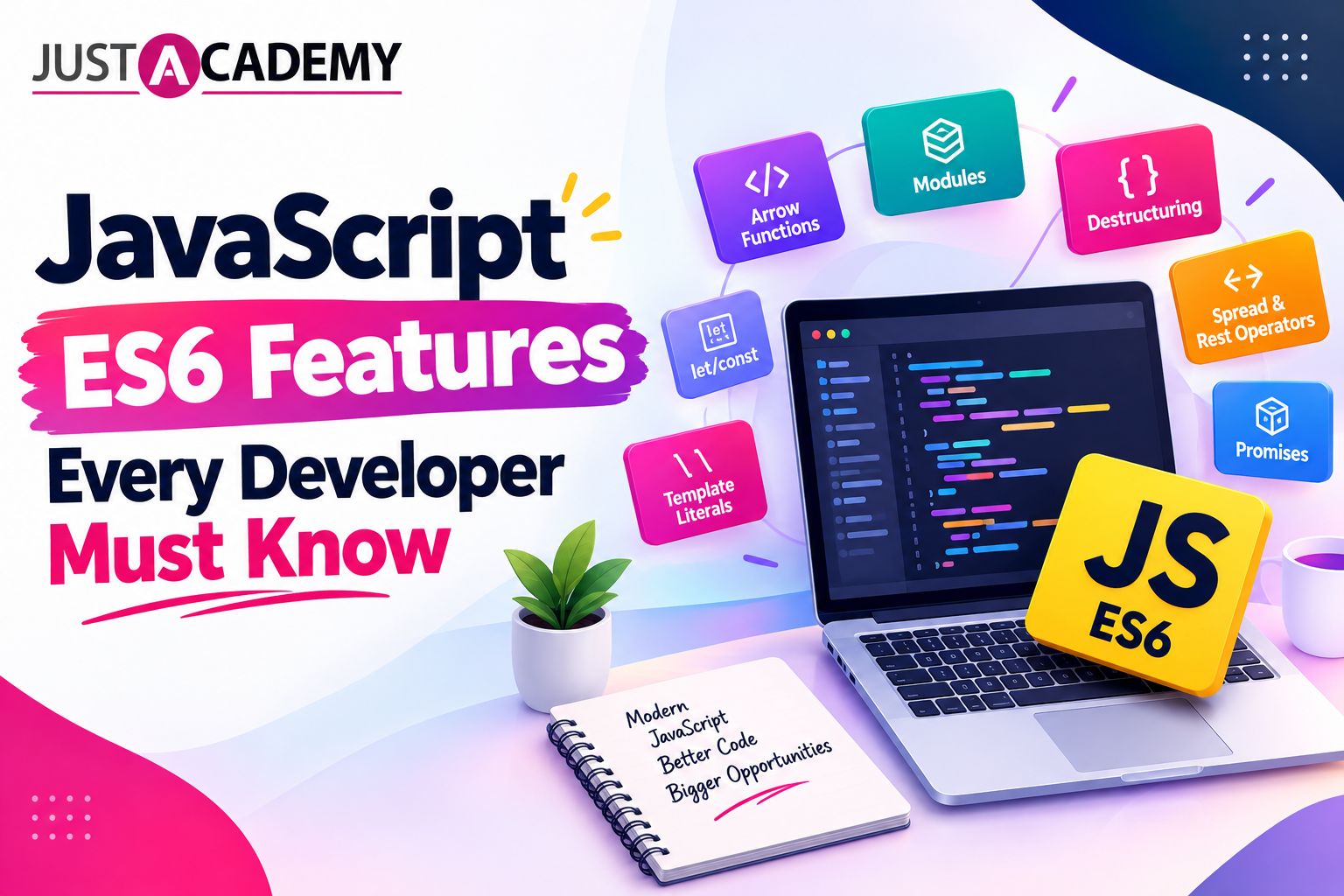
A practical, example driven guide to ES6 JavaScript for learners in Delhi who want to write modern code, think like a developer and get job ready with live instructor led and mentor led training
Drop us a Query
+91 99871 84296
Available 24x7 for your queries
Want To Connect with us
🚀 Kickstart Your IT Career
with JustAcademy
Learn Industry-Focused Courses with Live Projects & Placement Assistance
Full Stack Java(Java, Spring Boot, Hibernate, REST API, React JS)
Data Analytics(Excel, SQL, Power BI, Python, Tableau)