I am learning flutter from JustAcademy, They provide very much great environment where people gather and work simultaneously. totally project based training institute.
MOHD ABU BAKAR ANSARI
Flutter Developer
Awesome Experience. I am a Front-end Web Designer working at Star India for 3 years now. I applied for Full-stack development and my experience has been phenomenal & they really do help with placements exceptionally. Thank you Roshan sir so much.
A practical, honest guide to frontend developer skills, the roadmap that actually works, and how live instructor led and mentor led training can get you hired
Every website you have ever enjoyed using, from the food delivery app that remembers your usual order to the railway booking page that somehow survives festival season traffic, exists because a frontend developer made a hundred small decisions on your behalf. If you are in Delhi and wondering whether this is a career you could step into, the good news is that frontend developer skills are learnable, teachable and very much in demand. The better news is that you do not need a computer science degree, a Silicon Valley postcode or a decade of spare time to begin.
Here is where JustAcademy fits in. We are an ISO certified technology training institute with classroom branches in Mumbai and Pune, and our Delhi learners attend through live interactive sessions online, taught by working professionals. If you would like to see what that looks like before reading further, take a look at our frontend development course for Delhi learners and then book a free demo session to sit in on a real class. No pressure, no forms that take twenty minutes, just a chance to see whether the teaching style suits you.
This guide is long on purpose. It walks through the full frontend developer roadmap, the technical and human skills employers look for, the way careers actually progress from your first internship to a senior engineering role, and the learning format that gives beginners the best odds. Along the way we will be honest about what is hard, because pretending that learning to code is effortless helps nobody.
Who This Guide Is Really For
Maybe you are a final year student in Dwarka or Noida watching placement season approach with growing unease. Maybe you work in operations or sales in Gurugram and have started to wonder what it would feel like to build the tools you use every day. Maybe you took a break from work and want a way back in that does not feel like starting from zero. All three of you are welcome here, and the roadmap below works for each of you with small adjustments.
How to Read This Blog
You can read straight through or jump to the section that matches where you are today. If you are completely new, start with the roadmap. If you already know some HTML and CSS, skip ahead to the sections on skills and specialisation. If you are mostly here to decide how to learn, the sections on live learning and structured training are the ones to read closely.
Why Delhi Is Quietly Becoming a Frontend Hiring Powerhouse
Ask a Delhi student about tech jobs and the conversation often drifts toward Bengaluru, as if the capital region were only a place to study and then leave. The reality on the ground has shifted. Gurugram, Noida and Delhi proper now host product companies, fintech startups, edtech platforms, ecommerce players and the Indian offices of global brands, and nearly every one of them needs people who can turn designs into fast, accessible interfaces.
The Demand Behind the Front End Developer Vacancy Boards
Look at any major job platform on a given morning and you will see a steady stream of front end developer vacancy postings from the NCR. Some are for beginners, some for people with three to five years behind them, and plenty ask for React experience specifically. What stands out is how often small and mid sized companies are hiring too, not just the giants. A logistics startup in Noida needs a dashboard. A healthcare company in Gurugram needs a booking interface. A D2C brand in Delhi needs a storefront that loads quickly on a cheap phone. Each of those is a frontend job.
Remote Work Widened the Map
There is another shift worth naming. Since remote and hybrid work became normal, a Delhi based developer can apply for roles in Bengaluru, Pune, Hyderabad, Singapore or Dubai without relocating on day one. That means your search for a front end developer near me no longer ends at the Metro station closest to your house. The skills you build are portable, and your portfolio travels further than your CV ever could.
What This Means for a Beginner
The demand is real, but demand alone does not hand anyone a job. Companies are not short of people who completed a video course. They are short of people who can actually build, debug and explain their work. That distinction shapes everything else in this guide, and it is the reason we keep returning to live, mentored learning instead of passive consumption.
The Honest Frontend Developer Roadmap, Told in Stages
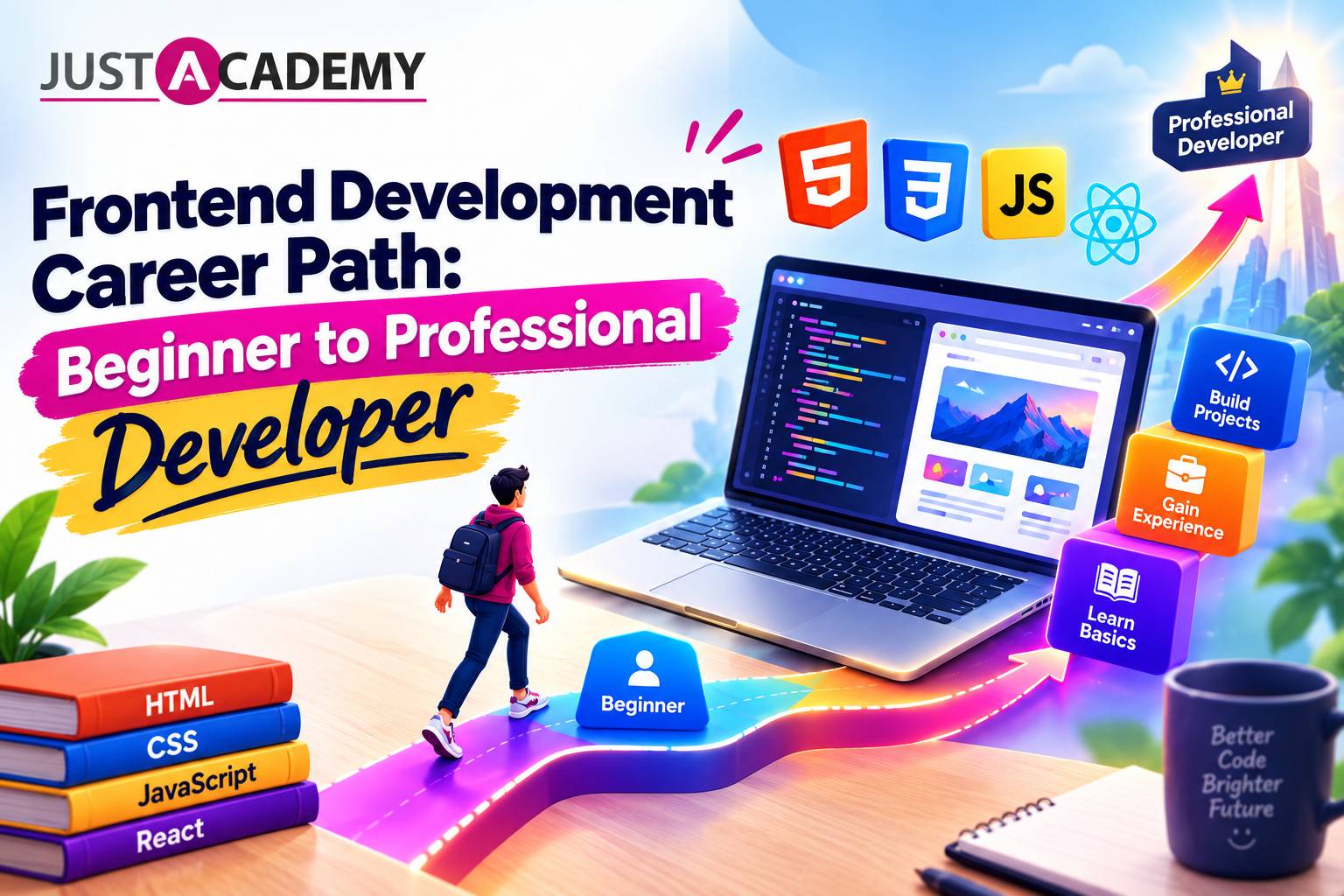
Most roadmaps look like subway maps designed by someone who has never been lost. Dozens of boxes, arrows going everywhere, and the unspoken suggestion that you should learn all of it before applying anywhere. The frontend developer roadmap below is deliberately simpler. It has stages, each stage has a purpose, and you do not move on until you can build something small with what you just learned.
Stage One: The Foundation Layer of HTML and CSS
Start with HTML, the structure of every webpage. Learn headings, paragraphs, lists, links, images, forms, tables and, importantly, semantic elements like header, main, nav and footer. Semantic HTML is not decoration. It affects accessibility, search visibility and how maintainable your code is six months from now.
Then move to CSS, which is where beginners either fall in love or quietly panic. Learn the box model until it is boring. Understand selectors and specificity. Spend real time on Flexbox and Grid, because modern layout depends on them. Practise responsive design by building pages that behave on a 360 pixel phone screen and a wide office monitor. A beginner who can recreate a clean landing page from a screenshot, with no framework help, is already ahead of many who rushed into libraries.
Our own HTML training and CSS training exist for learners who want to take this stage slowly and properly, though you will also pick it up inside the frontend bootcamp if you are going the full route.
Stage Two: JavaScript, the Language That Makes Pages Behave
JavaScript is the turning point of the whole journey. HTML and CSS describe a page. JavaScript lets it respond. Learn variables, data types, functions, arrays, objects, loops and conditionals. Then learn how to work with the DOM so that clicking a button changes something on screen. Then learn events, asynchronous code, promises, async and await, and how to fetch data from an API.
This is also the stage where many people stall, because JavaScript has quirks and the early errors feel personal. They are not. Everyone sees “undefined is not a function” more times than they would like to admit. A mentor who can look at your screen and point to the exact line saves days of frustration. If you want a structured path through the language itself, our JavaScript training in Delhi is built around exactly that kind of guided practice.
Stage Three: Tooling That Real Teams Use Every Day
Before frameworks, learn the tools around them. Get comfortable with the terminal, Git and GitHub, package managers like npm, and browser developer tools. Learn how to read a console error, inspect a network request and debug layout problems visually. None of this is glamorous, yet teams notice immediately when a new joiner knows how to create a branch, raise a pull request and resolve a merge conflict without panic.
Stage Four: A Framework, and for Most Learners That Means React
Once the fundamentals feel solid, pick a framework. React is the most common choice for good reason. Walk into any hiring conversation about front end developer react roles and you will find that component thinking, state management, props, hooks and routing are the shared vocabulary. Learning React front end development well means understanding why components exist, not only memorising syntax.
If you want a dedicated path for it, there is a standalone React JS training course, and the frontend bootcamp covers it as part of a longer journey.
Stage Five: Performance, Accessibility and Testing
The final stage separates hobbyists from professionals. Learn how to make pages load faster through image optimisation, code splitting and sensible caching. Learn accessibility basics so that people using screen readers or keyboards can use what you build. Learn how to write simple tests for components. These topics rarely appear in beginner tutorials, yet they are exactly what senior reviewers care about.
Frontend Developer Skills That Employers Actually Test
If you have ever scanned a job description and felt your confidence drain away, you are not alone. Postings often read like wish lists written by committee. The truth is that interviewers tend to test a smaller, more predictable set of frontend skills, and understanding that set lets you prepare with focus instead of dread.
What Is Needed to Become a Front End Developer in Practical Terms
If someone asked us what is needed to become a front end developer, we would answer in three layers. The first layer is technical: HTML, CSS, JavaScript, a framework, Git and basic debugging. The second layer is craft: responsive design, accessibility, performance awareness and a feel for clean, readable code. The third layer is behavioural: curiosity, patience, the ability to take feedback without flinching and the habit of explaining your decisions clearly.
Beginners often pour all their energy into the first layer and ignore the other two. Hiring managers do the opposite. They assume you can learn syntax and instead watch for how you think, how you communicate and whether you can finish what you start.
The Technical Skills Front End Developers Are Screened For
Here is how the technical screening usually plays out. Expect questions on how the browser renders a page, how CSS specificity resolves conflicts, how closures and the event loop work in JavaScript, how state flows through a React application and how you would handle an API call that fails. Expect a small live coding task as well, perhaps building a filterable list or a form with validation.
For a front end developer skill set to look convincing, it needs depth in a few places rather than shallow coverage of everything. Being very good at JavaScript fundamentals, React and layout is worth more than having a dozen logos on your CV.
Soft Skills That Quietly Decide Offers
Frontend work sits between design, backend engineering, product management and quality assurance. You will be asked to interpret vague requests, push back politely when a design cannot work on mobile and explain to a manager why a small change takes longer than it appears. Developers who can do this calmly get trusted with bigger work. That is why our live sessions include discussion, presentations and code reviews, not only lectures.
A Quick Reference Table for Frontend Skills
Skill Area
What Employers Look For
How You Can Show It
HTML and CSS
Semantic markup, responsive layouts, Flexbox and Grid
A pixel accurate landing page built without a framework
JavaScript
Closures, async code, DOM handling, modern syntax
A small app that fetches and displays live API data
React
Components, state, hooks, routing
A multi page project with authentication and routing
Git and tooling
Branching, pull requests, debugging
A GitHub profile with clean commit history
Design sense
Spacing, hierarchy, consistency
A Figma to code case study
Communication
Clear explanations, receptive to review
Project walkthroughs and mock interviews
Writing Modern JavaScript Without Fear
JavaScript deserves its own section because it is where roadmaps succeed or fail. A learner who understands the language properly can pick up React, Vue or Angular in weeks. A learner who skimmed it will keep hitting walls.
Why ES6 Changed Everything
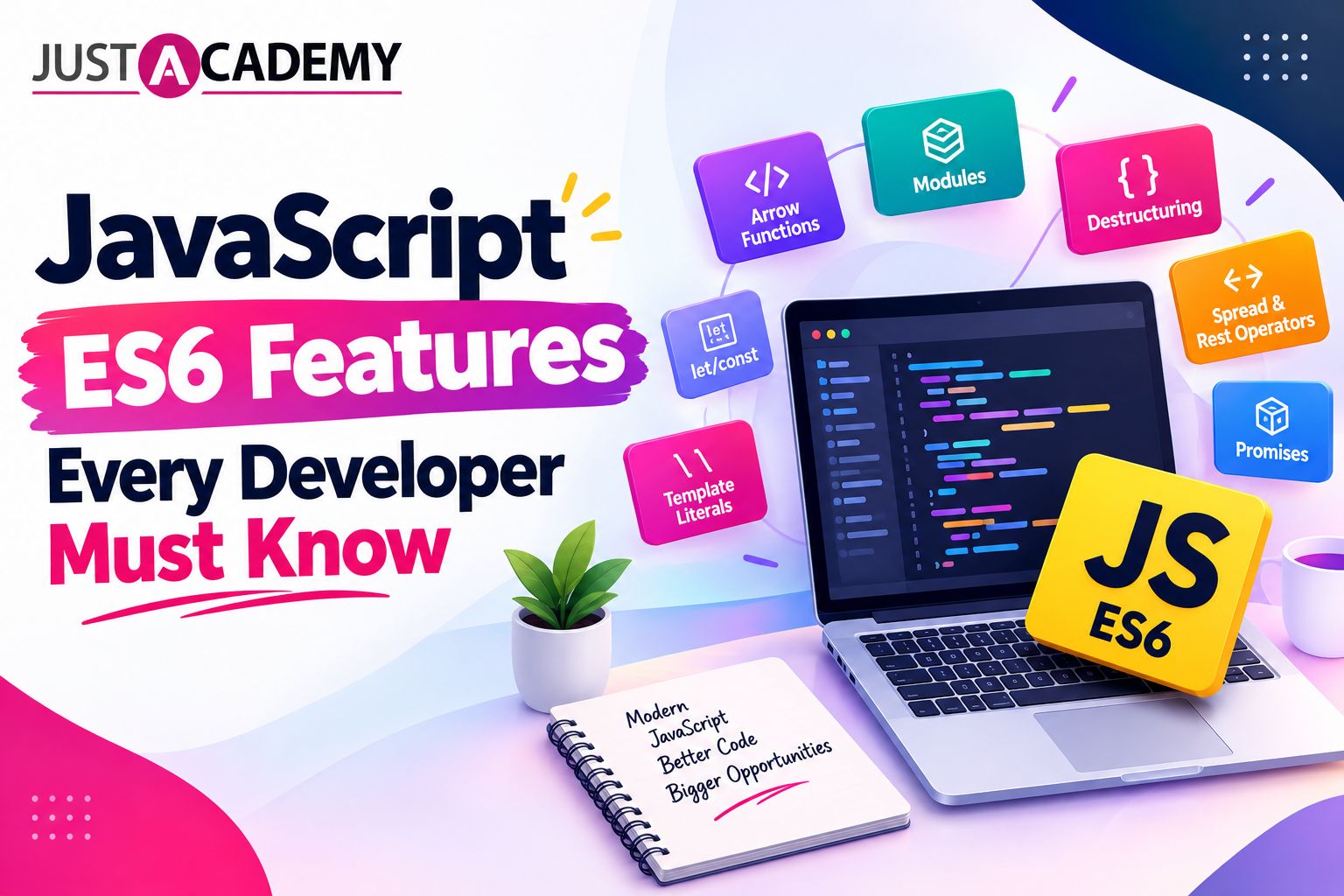
Modern JavaScript, usually referred to as ES6 and beyond, introduced features that make code shorter, safer and far more readable. Arrow functions, template literals, destructuring, spread and rest operators, modules and promises appear in nearly every professional codebase today. If these still feel mysterious, our breakdown of ES6 features every developer must know is a friendly place to catch up before your next interview.
Learning by Breaking Things
The fastest way to understand JavaScript is to write small programs, break them on purpose and then repair them. Build a to do list. Build a quiz. Build a weather widget. When something fails, resist the urge to paste the error into a search box immediately. Spend ten minutes forming your own theory first. That habit, building a mental model before looking for answers, is what separates people who grow into strong engineers from people who copy and hope.
Asynchronous Thinking
Asynchronous behaviour confuses almost everyone at first. Why does the line that runs later print first? Why does the data not appear when you expect it to? Take your time here. Draw the event loop on paper. Trace a fetch call from request to response. A good mentor will make you narrate what the code is doing in plain language, and that exercise alone fixes many misunderstandings that hours of solo reading cannot.
Design Sense: The Skill Nobody Warns You About
Many beginners imagine that frontend development is entirely about code. Then they join a team and discover that half of their daily conversations involve spacing, colour contrast, typography and why a button looks slightly off.
Why Frontend Developers Need to Speak Design
You do not need to become a designer, but you do need to understand one. When a designer hands over a layout, you should be able to read the spacing system, spot inconsistencies and suggest sensible adjustments when something breaks at a smaller screen size. Developers who do this earn quiet respect, and they also ship better products.
Figma as the Shared Language
Figma has become the common workspace between designers and developers. Learning to inspect a design file, extract spacing and colour values, understand components and variants and follow auto layout makes your handoff far smoother. Even a basic working knowledge saves hours of back and forth. If you would like structured guidance, the Figma training in Delhi program covers the tool from a practical, project driven angle.
Where Design and Code Meet in Your Career
Some developers discover that they enjoy the visual side so much that they drift toward UI engineering or even product design. Others stay firmly on the code side but collaborate better because of what they learned. Either path is healthy. If you are curious about the design route in particular, this UI UX designer career roadmap using Figma in 2026 is worth a read and will help you decide how much design depth you want.
Live and Interactive Learning Versus Watching Videos Alone
Recorded tutorials are wonderful for what they are. They are cheap, flexible and available at two in the morning. They also have a ceiling, and most beginners hit it somewhere around the second month.
What Actually Happens in a Live Interactive Session
A live interactive session is not a lecture broadcast. It is a room, even if the room is on a screen, where you can interrupt, ask a half formed question and watch the instructor respond to the confusion on your face. You write code during the class, not after it. Someone reads your work. Someone says, “Try it again, but think about why the parent element is collapsing.” That moment of correction, delivered within seconds of your mistake, is worth more than another hour of videos.
The Accountability Effect
Videos wait for you. Live classes do not. When you know that a session starts at a fixed time, with classmates and a mentor waiting, you show up. Consistency is the single biggest predictor of whether a beginner finishes a learning journey, and fixed schedules create consistency in a way that good intentions rarely do.
Comparing the Two Approaches Honestly
Factor
Recorded Courses
Live Interactive Training
Feedback speed
Hours or days, if at all
Within seconds, during the session
Doubt clearing
Forums and guesswork
Direct conversation with the instructor
Accountability
Depends entirely on you
Built into the schedule
Peer learning
Minimal
Daily, through shared problems and reviews
Project guidance
Self directed
Reviewed by mentors at each stage
Placement preparation
Rarely included
Mock interviews and resume support
For Delhi learners who cannot travel, this format delivers most of what a classroom offers. For anyone willing to travel or relocate, our Mumbai classroom branch offers the same curriculum in person, and many people in the city regard it as the best course in Mumbai for hands on frontend training.
Instructor Led and Mentor Led: Why the Pairing Works
The phrases instructor led session and mentor led session sound similar, and in many institutes they blur together. In practice they do different jobs, and learners benefit most when both are present.
What an Instructor Brings
An instructor owns the curriculum. They explain concepts in a logical order, demonstrate techniques live and make sure no important topic is skipped. When you are learning something genuinely new, like how React reconciles its virtual DOM, you need someone who can teach it clearly, with analogies, diagrams and patience for repeated questions.
What a Mentor Brings
A mentor owns your journey. They have usually walked the road recently, often in a working job, and they can tell you which skills matter in interviews this quarter, how to structure a portfolio and why your last project feels unfinished. A mentor reviews your code with a professional eye, nudges you when you plateau and tells you the truth about your readiness. That honesty can feel uncomfortable, and it is precisely what keeps learners from walking into interviews unprepared.
Why the Pairing Works Better Than Either Alone
Instructors without mentors can leave learners with knowledge but no direction. Mentors without structured instruction can leave learners with direction but gaps. Together, they cover both the what and the how. In our live interactive training, instructors lead the sessions and mentors support you between them with code reviews, project feedback and career guidance. That combination is what we mean by a complete learning experience.
A Typical Week in a Mentored Programme
Imagine your week. Monday and Tuesday are instructor led sessions on a new topic, say React hooks. Wednesday you build a small feature using what you learned, and a mentor reviews it that evening. Thursday brings a live doubt session where classmates share their blockers. Friday is a mini project demo. Saturday you refactor based on feedback. This rhythm of learning, building, reviewing and refining is where growth actually happens.
From Entry Level to Senior: How a Frontend Career Actually Unfolds
Roadmaps tend to stop the moment you land a job, as if employment were the finish line. It is only the first checkpoint. Understanding where the road leads helps you make smarter choices early.
Your First Role: Entry Level and Junior Positions
Most people begin with front end developer entry level jobs, titles like Junior Frontend Developer, Associate Software Engineer or UI Developer. The expectation at this stage is not mastery. It is that you can handle well defined tasks, ask good questions and improve steadily. Plenty of beginner front end developer jobs also appear as paid internships, which are an excellent way in if your portfolio is still growing.
Mid Level and Senior Growth
After two or three years you typically move into mid level roles, owning features end to end, mentoring newer teammates and making architectural suggestions. Senior engineers handle performance strategy, design systems, code quality and cross team decisions. A front end engineer career path beyond that branches into engineering management, staff level technical leadership, UI architecture or product focused roles.
How Titles and Responsibilities Compare
Level
Typical Title
Core Responsibility
Skills That Grow
Entry
Junior Frontend Developer
Build components and fix bugs under guidance
Core JavaScript, React basics, Git
Mid
Frontend Developer
Own features from design to release
State management, testing, performance
Senior
Senior Frontend Engineer
Guide architecture and mentor others
System design, accessibility, leadership
Lead
Frontend Lead or Staff Engineer
Shape team direction and standards
Strategy, communication, cross team planning
Where Companies Hire From
The list of front end developer companies in the NCR is longer than most students expect. Product startups, fintech firms, edtech platforms, ecommerce brands, consulting companies and digital agencies all hire. Agencies in particular offer variety, because you may work on a retail site one month and a healthcare portal the next. Product companies offer depth, since you can live with one codebase and watch it mature. Neither is better, and many developers try both before choosing.
Choosing Your Specialisation: Frontend, Full Stack or Quality Focused
At some point, usually after your first year, you will face a choice. Do you go deeper into frontend, broaden into the backend or move toward testing and quality? There is no single right answer, but there are good questions to ask yourself.
Staying Pure Frontend
Pure frontend suits people who love interfaces, interaction and polish. You might specialise in animation, accessibility, design systems or performance. Companies value these specialists highly, particularly those building consumer products where experience quality directly affects revenue. A well chosen frontend specialism can be a rewarding long term career.
Growing into Full Stack
A full stack front end developer understands both sides of the application, from the screen to the server. This route widens your options, makes you more useful in smaller teams and often accelerates promotions. If it appeals to you, a program like our MERN stack developer course in Delhi teaches MongoDB, Express, React and Node together, so you build complete products rather than isolated screens. To see what hiring managers want from MERN developers right now, this overview of MERN stack developer skills companies look for in 2026 is a helpful companion.
Some learners also wonder about the difference between a full stack front end developer and a full stack backend developer. The difference is mostly emphasis. One leans toward interface and user experience, the other toward data, services and infrastructure. Good full stack engineers are comfortable in both territories even if they prefer one.
Moving Toward Testing and Quality
There is a third door that surprises many beginners: quality engineering. Frontend developers who understand testing, automation and release discipline are valuable, and some choose to build careers around quality rather than feature work. If that sounds interesting, our Selenium training in Pune is where automation testing is taught in depth. Delhi learners can attend through our live online format and explore the same material.
A Simple Way to Decide
Ask yourself which part of a project you enjoyed most. If you loved the visual details, lean frontend. If you loved making data flow, lean full stack. If you loved finding what breaks, consider quality. You do not need to decide today. Your first role will teach you a lot about what suits you.
Building a Portfolio That Gets Calls Back
Here is something nobody likes to hear: your certificate matters less than your portfolio. A hiring manager reviewing forty applications will spend perhaps ninety seconds on yours. What they remember afterward is whether they saw something real.
What a Strong Portfolio Contains
Aim for three to five projects that show range. One should be a pixel accurate, responsive marketing site. One should be an interactive application using JavaScript and an API. One should be a React project with routing and state management. If possible, add a project built from a Figma design to prove you can work with designers. Each project needs a live link, a clean GitHub repository and a short written explanation of what problem it solves and what you learned.
What to Avoid
Avoid tutorial clones that look identical to everyone else’s. Avoid projects with broken links. Avoid repositories with a single giant commit that says “final”. Reviewers can tell instantly when a project was copied rather than built, and they notice just as quickly when a candidate cannot explain their own code in an interview.
Telling the Story Behind Your Work
A short case study beside each project does a surprising amount of work. Explain the goal, the decisions you made, the problems you hit and how you solved them. This is where your communication skill becomes visible. A paragraph that says “I chose CSS Grid for the dashboard because the layout needed to rearrange itself across screen sizes without extra markup” tells a reviewer more about your thinking than a hundred lines of code.
Where Placement Support Fits In
A portfolio and a CV only help if someone sees them. That is where placement support becomes valuable. Resume reviews, mock interviews, LinkedIn guidance and introductions to hiring partners turn your preparation into actual interviews. At JustAcademy, placement support runs alongside the training, not as an afterthought at the end, so you are building interview readiness from the first month.
Cracking Frontend Interviews Without Panic
Interviews feel mysterious until you have sat through a few. Then they start to feel like conversations with predictable shapes.
The Usual Structure
Most processes begin with a screening call, followed by a technical round, a practical or take home task and a final discussion with a manager. The technical round tests fundamentals. The practical round tests how you build. The final discussion tests whether people want to work with you.
Questions You Should Be Able to Answer Aloud
Practise explaining, in plain language, how the browser turns HTML and CSS into pixels, what the difference is between var, let and const, how event bubbling works, what happens when you call setState, why keys matter in lists and how you would improve the performance of a slow page. Saying these out loud, ideally to a mentor or a patient friend, exposes gaps that silent reading hides.
Handling Questions You Cannot Answer
You will meet a question you cannot answer. Everyone does. Strong candidates stay calm, say what they do know, reason through the problem aloud and admit where they would look it up. Interviewers often care more about that composure than about the specific answer. Mock interviews with mentors are valuable precisely because they let you rehearse this feeling in a safe space.
A Realistic Twelve Month Plan for Delhi Learners
People love asking how long it takes. The honest answer is that it depends on your starting point, the hours you can commit and the quality of guidance. Still, a rough shape helps.
Months One to Three: Foundations
Spend the first quarter on HTML, CSS and the basics of JavaScript. Build three or four small static and interactive projects. Learn Git. Aim for comfort, not speed. By the end of month three you should be able to build a responsive page and a simple interactive tool without copying a tutorial.
Months Four to Six: Frameworks and Real Projects
Move into React, APIs and state management. Start your larger portfolio projects. Begin working with Figma designs. Join code reviews. This is the stage where live mentorship pays for itself, because your questions become more specific and the cost of getting stuck rises.
Months Seven to Nine: Polish and Preparation
Work on performance, accessibility and testing basics. Finish your portfolio. Prepare your CV and LinkedIn profile. Begin mock interviews. Start applying selectively and treat every rejection as feedback you can use.
Months Ten to Twelve: Interviews and First Role
By now you should be interviewing regularly. Keep building small things between rounds. Many learners land their first offers during this window, particularly those who combined steady practice with structured guidance and placement support. Some take longer, which is perfectly fine. Consistency matters more than speed.
Why Structured Training Makes the Difference
You can absolutely teach yourself frontend development. Plenty of excellent developers did. But most people who try discover that the hardest part is not the material. It is the sequencing, the feedback and the persistence.
A Curriculum Built Around Hiring Reality
At JustAcademy, India’s trusted ISO certified training institute with branches in Mumbai and Pune and live online courses available worldwide, the curriculum is shaped around what employers actually test. Topics arrive in an order that builds confidence rather than confusion. Projects mirror real work. Assessments mimic interviews.
Live Interactive Sessions That Feel Human
Our live interactive sessions are small enough for you to be seen and heard. Instructors lead the teaching, mentors guide your projects and your classmates become a community you can lean on. Delhi learners join online from home or office, while those who prefer a classroom can train with us in Mumbai. In both formats, the same standards apply.
Placement Support from Day One
Training only matters if it leads somewhere. Our placement support includes resume building, portfolio reviews, mock interviews, soft skill sessions and connections with hiring partners. We cannot promise outcomes, because anyone who does is not being honest, but we can promise that you will be prepared and supported at every step.
A Community That Keeps You Going
Learning to code can feel lonely at midnight when a bug refuses to die. A community of peers and mentors changes that. You share breakthroughs, ask for help without embarrassment and celebrate first offers together. That sense of belonging is not a bonus feature. For many learners it is the reason they finish.
Conclusion
The path from curious beginner to professional frontend developer is not mysterious, and it is not instant. It is a sequence of stages: foundations, JavaScript, tooling, a framework, polish and then real world practice. Along the way you build frontend developer skills that employers genuinely test, a portfolio that proves your ability and the confidence that comes from explaining your own work.
Delhi is full of opportunity for people willing to do this properly, and you do not have to walk the road alone. With live interactive, instructor led and mentor led training, a curriculum shaped around hiring reality and placement support from the start, you can move from “I think I might like this” to “I build interfaces for a living” with real guidance beside you. Whether you join our live online batches from Delhi or visit our Mumbai classroom, the commitment is the same: practical teaching, honest feedback and a genuine investment in your career.
A practical, honest guide to frontend developer skills, the roadmap that actually works, and how live instructor led and mentor led training can get you hired
A practical, no fluff guide to the front end developer skills Delhi employers test for, and how mentor led, live interactive training helps you build them.
A practical, example driven guide to ES6 JavaScript for learners in Delhi who want to write modern code, think like a developer and get job ready with live instructor led and mentor led training
From your first Angular app to real time dashboards, here is a practical, mentor backed list of angular projects for practice, with source code thinking, live interactive sessions and placement support.
From a humble to do list to a Node JS backend, here are the javascript project ideas that actually teach you something and give recruiters a reason to click your GitHub link.
A straight talking guide for Delhi freshers, career switchers and non tech graduates on choosing the right IT certification, and why live interactive, instructor led and mentor led training makes the difference
A grounded, honest guide for Delhi learners on skills, salaries, jobs and the learning path behind each IT career, backed by live, instructor led and mentor led training
A straight talking guide for Delhi learners on what mobile app developers really earn, which skills raise the number, and how live, mentor led training can shorten the road from beginner to hired.
A practical guide for Delhi learners covering react native app ideas for beginners, live mentor led practice, and a portfolio that actually gets interviews
Drop us a Query
+91 99871 84296
Available 24x7 for your queries
Want To Connect with us
🚀 Kickstart Your IT Career
with JustAcademy
Learn Industry-Focused Courses with Live Projects & Placement Assistance
Full Stack Java(Java, Spring Boot, Hibernate, REST API, React JS)
Data Analytics(Excel, SQL, Power BI, Python, Tableau)