I am learning flutter from JustAcademy, They provide very much great environment where people gather and work simultaneously. totally project based training institute.
MOHD ABU BAKAR ANSARI
Flutter Developer
Awesome Experience. I am a Front-end Web Designer working at Star India for 3 years now. I applied for Full-stack development and my experience has been phenomenal & they really do help with placements exceptionally. Thank you Roshan sir so much.
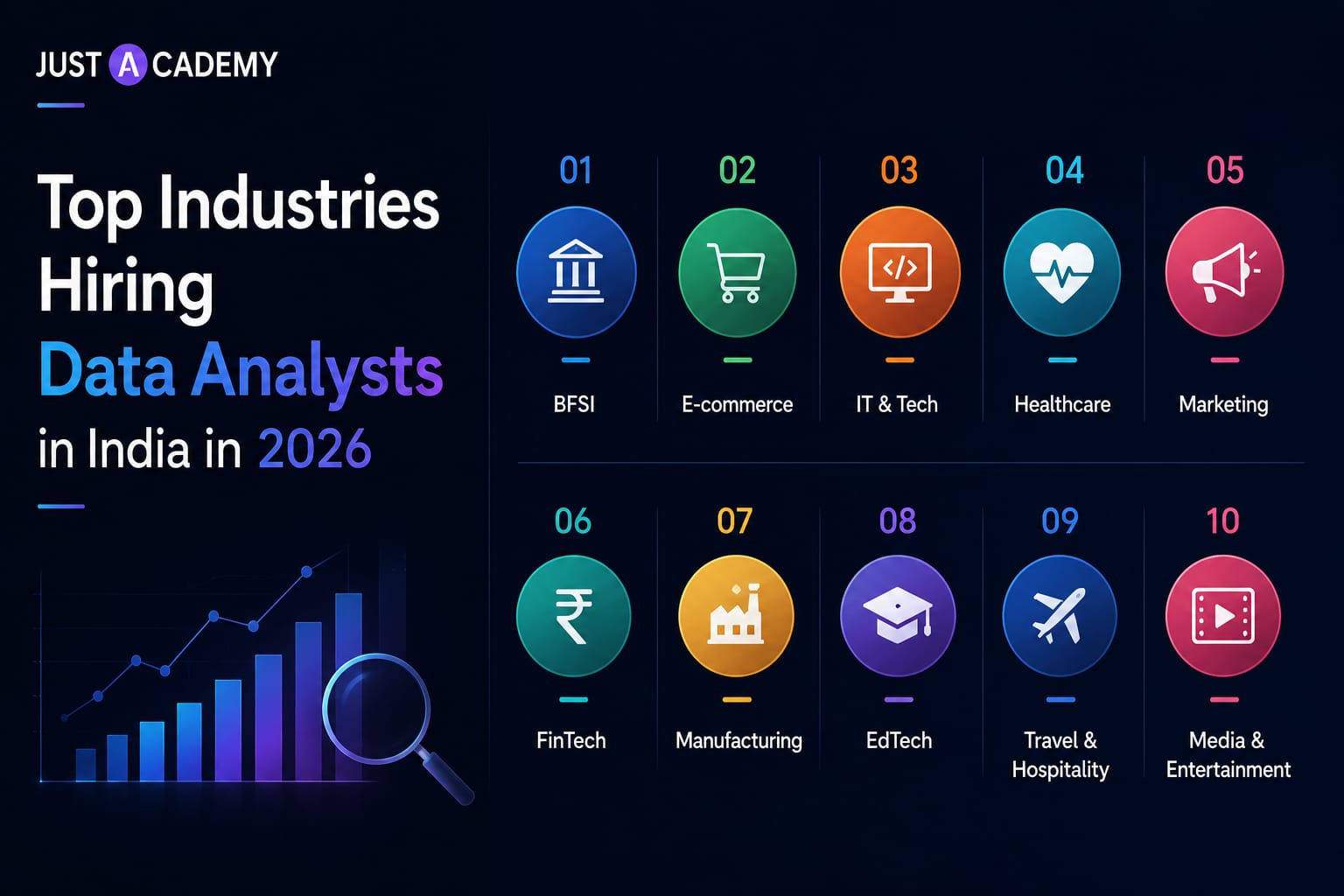
Data analytics is no longer a skill set confined to technology companies and research institutions. In 2026, virtually every industry in India is actively hiring data analysts to drive smarter decisions, improve operational efficiency, and stay competitive in increasingly data-driven markets. From banking and fintech to healthcare, e-commerce, and manufacturing, the demand for analytics professionals is expanding across sectors at a pace that continues to outstrip the supply of qualified candidates.
Understanding which industries are hiring data analysts, what those roles involve, and how salaries and growth trajectories differ across sectors is one of the most important pieces of research any analytics job seeker can do. The industry you choose to work in shapes your day-to-day work, your earning potential, your long-term career trajectory, and the type of skills you need to prioritize. This blog gives you a complete, practical picture of the top industries for data analyst jobs in India in 2026 so you can make an informed decision about where to focus your job search and how to position your skills for the opportunities that match your goals.
Why Industry Choice Matters for Your Data Analyst Career in India
The Same Title Means Very Different Work
A data analyst at a bank in Mumbai spends their days analyzing loan default patterns, regulatory reporting data, and customer segmentation models. A data analyst at an e-commerce company in Bangalore spends their days optimizing recommendation algorithms, analyzing funnel conversion rates, and measuring the impact of promotional campaigns. A data analyst at a hospital chain analyzes patient outcomes, resource utilization, and clinical trial data. The title is the same but the problems, the tools, the domain knowledge required, and the career growth paths are significantly different.
Choosing an industry that genuinely interests you is one of the most important career decisions you will make as an analyst. Domain expertise compounds over time. An analyst who is deeply knowledgeable about fintech metrics after three years in the banking sector is significantly more valuable and harder to replace than a generalist who has moved across industries every year. Industry depth is one of the primary drivers of salary growth beyond the entry level.
Industry Determines Your Salary Ceiling
Salary ranges for data analysts vary significantly by industry in India. Technology and product companies at the top of the range pay senior analysts salaries that banking and consulting struggle to match. Healthcare and manufacturing organizations at the lower end of the range offer slower salary growth but often greater job stability and work-life balance. Understanding where each industry sits on the salary spectrum helps you set realistic expectations and make deliberate career choices that align with both your financial goals and your professional interests.
Industry Shapes the Skills You Need to Prioritize
Different industries have different tool preferences, data types, and analytical priorities. Banking and financial services organizations rely heavily on SQL, Excel, and Python for quantitative analysis and risk modeling. E-commerce companies expect strong Python skills, A/B testing expertise, and familiarity with product analytics tools. Healthcare organizations require understanding of clinical data standards and statistical analysis. Knowing which industry you are targeting helps you prioritize the right skills and frame your portfolio projects in the most relevant domain context.
Top Industries Hiring Data Analysts in India in 2026
Banking and Financial Services
Why This Industry Is a Top Employer of Data Analysts
Banking and financial services is one of the largest and most consistent employers of data analysts in India. Mumbai is the financial capital of India and home to the headquarters of major public and private sector banks, insurance companies, non-banking financial companies, and asset management firms. Every financial institution generates enormous volumes of transactional data daily and relies on analysts to extract actionable insights from it.
What Data Analysts Do in Banking and Financial Services
Data analysts in banking work on credit risk modeling and loan default prediction, customer segmentation and lifetime value analysis, fraud detection and anomaly identification in transaction data, regulatory compliance reporting including RBI filings, investment performance analysis and portfolio reporting, cross-sell and upsell opportunity identification, and branch and ATM network optimization. The work is highly data-intensive, often involves large relational databases, and requires a strong foundation in SQL, Python, and statistical analysis.
Skills in Demand in This Industry
SQL at an advanced level is non-negotiable. Python with Pandas and statistical libraries is increasingly expected. Power BI and Tableau are widely used for reporting. Knowledge of financial metrics like NPA, CAGR, ROE, and credit scoring concepts gives analysts significant domain credibility. Risk management frameworks and basic understanding of RBI regulations are valued at mid to senior levels.
Salary Range and Growth Trajectory
Level
Salary Range Mumbai 2026
Junior Data Analyst
5 to 8 LPA
Mid-Level Data Analyst
10 to 18 LPA
Senior Data Analyst
18 to 28 LPA
Analytics Manager
28 to 42 LPA
Technology and Product Companies
Why This Industry Leads on Compensation and Innovation
Technology companies, including SaaS products, tech startups, and global technology firms with India offices, offer the highest salaries for data analysts in India and provide the most technically advanced analytics environments. Companies like Flipkart, Swiggy, Zepto, CRED, Razorpay, and the India offices of global tech firms like Google, Microsoft, and Amazon are among the most competitive employers in the analytics talent market.
What Data Analysts Do in Technology Companies
Analysts at tech companies work on product analytics measuring feature adoption, retention, and engagement, A/B testing and experimentation to validate product decisions, growth analytics tracking user acquisition and conversion funnels, revenue analytics across pricing models and subscription tiers, operational efficiency analysis for engineering and support teams, and machine learning model performance monitoring. The work is fast-paced, data-first, and closely tied to product strategy.
Skills in Demand in This Industry
Python is effectively mandatory in most technology companies. SQL at an advanced level is the daily working tool. Product analytics tools like Mixpanel, Amplitude, or Heap are commonly used. A/B testing and statistical significance concepts are expected at mid-level. Exposure to cloud platforms like AWS or GCP is increasingly standard. Strong data visualization skills in Tableau or Looker are valued.
Salary Range and Growth Trajectory
Level
Salary Range India 2026
Junior Data Analyst
6 to 10 LPA
Mid-Level Data Analyst
12 to 20 LPA
Senior Data Analyst
20 to 32 LPA
Analytics Lead or Manager
30 to 50 LPA
E-Commerce and Retail
Why E-Commerce Is One of the Fastest-Growing Sectors for Analytics
India's e-commerce market is one of the largest and fastest-growing in the world. Companies like Meesho, Nykaa, Myntra, Amazon India, and a rapidly expanding universe of D2C brands are building dedicated analytics teams to optimize every aspect of their customer journey, supply chain, and marketing spend. The volume and variety of data generated by e-commerce operations makes it one of the richest environments for data analysts to work in.
What Data Analysts Do in E-Commerce and Retail
Analysts in this sector work on customer behavior analysis and segmentation, product recommendation optimization, pricing and discount strategy analysis, supply chain and inventory analytics, marketing attribution and campaign performance measurement, return rate analysis and fraud detection, and seller or vendor performance management on marketplace platforms. The work combines customer analytics, operational analytics, and marketing analytics in a fast-moving, hypothesis-driven environment.
Skills in Demand in This Industry
Python is strongly preferred. SQL is essential for querying large transactional databases. A/B testing expertise is highly valued for campaign and feature optimization. Knowledge of marketing analytics tools like Google Analytics and Meta Ads Manager is useful. Data visualization in Power BI or Tableau is expected. Understanding of e-commerce metrics like GMV, AOV, CAC, LTV, and NPS adds significant domain value.
Salary Range and Growth Trajectory
Level
Salary Range India 2026
Junior Data Analyst
5 to 8 LPA
Mid-Level Data Analyst
9 to 16 LPA
Senior Data Analyst
16 to 26 LPA
Analytics Manager
25 to 40 LPA
Healthcare and Pharmaceuticals
Why Healthcare Is a High-Growth Opportunity for Analytics Professionals
Healthcare is one of the most rapidly evolving sectors for data analytics in India in 2026. The digitization of patient records through electronic health record systems, the expansion of health insurance, the growth of telemedicine platforms, and the increasing use of data in clinical trials and drug development have created substantial and growing demand for analytics talent. Companies like Apollo Hospitals, Manipal Health Enterprises, PharmEasy, Practo, and major pharmaceutical companies like Sun Pharma and Dr. Reddy's are actively building analytics capabilities.
What Data Analysts Do in Healthcare and Pharmaceuticals
Analysts in healthcare work on patient outcome analysis and readmission prediction, hospital resource utilization and capacity planning, insurance claims analysis and fraud detection, clinical trial data management and statistical analysis, drug sales performance and market access analysis, telemedicine platform engagement and retention analytics, and public health surveillance and epidemiological trend analysis. The work requires attention to data quality and privacy compliance given the sensitivity of health data.
Skills in Demand in This Industry
SQL and Python are the primary technical tools. Statistical analysis skills including regression, survival analysis, and significance testing are highly valued. Knowledge of healthcare data standards like HL7 and ICD codes is advantageous. Experience with clinical data management tools or SAS is valued in pharmaceutical roles. Power BI and Tableau for clinical dashboards are commonly required.
Salary Range and Growth Trajectory
Level
Salary Range India 2026
Junior Data Analyst
4 to 7 LPA
Mid-Level Data Analyst
8 to 14 LPA
Senior Data Analyst
14 to 22 LPA
Analytics Manager
22 to 35 LPA
Consulting and Professional Services
Why Consulting Offers Unique Career Acceleration
Management consulting and IT services firms including McKinsey, BCG, Deloitte, PwC, EY, Accenture, and TCS Analytics offer data analyst roles that provide rapid cross-industry exposure. An analyst at a consulting firm may work on a banking analytics project in one quarter and a retail supply chain optimization project the next. This breadth of experience accelerates domain knowledge development and builds a versatile skill set that is highly valued in the job market.
What Data Analysts Do in Consulting
Consulting analysts work on client-facing data analysis projects spanning multiple industries, building analytical models and dashboards for client presentations, conducting market research and competitive benchmarking using data, supporting data strategy and digital transformation engagements, and developing reusable analytical frameworks and tools. The pace is fast, the work is varied, and the expectation for clear communication of findings to senior client stakeholders is high.
Skills in Demand in This Industry
Excel and PowerPoint are still fundamental in consulting environments. SQL and Python are increasingly expected. Power BI and Tableau for client-ready dashboards are standard. Strong data storytelling and presentation skills are essential. Project management and client communication skills are valued alongside technical capabilities.
Salary Range and Growth Trajectory
Level
Salary Range India 2026
Junior Data Analyst
6 to 9 LPA
Mid-Level Data Analyst
10 to 18 LPA
Senior Data Analyst
18 to 28 LPA
Analytics Manager
26 to 42 LPA
Telecommunications
Why Telecom Is a Data-Rich Environment for Analysts
India's telecommunications sector, led by Jio, Airtel, and Vi, generates some of the largest volumes of data of any industry in the country. Billions of daily transactions, hundreds of millions of active subscribers, and complex network infrastructure create enormous analytical challenges and opportunities. Telecom companies invest heavily in analytics to reduce churn, optimize network performance, personalize offers, and detect fraud.
What Data Analysts Do in Telecommunications
Telecom analysts work on customer churn prediction and retention modeling, network performance analysis and capacity planning, revenue assurance and fraud detection, customer lifetime value modeling, marketing campaign effectiveness measurement, and pricing and tariff optimization. The data volumes are extremely large, making SQL performance and big data tool familiarity particularly valuable in this sector.
Skills in Demand in This Industry
Advanced SQL for querying very large databases. Python for data manipulation and modeling. Power BI or Tableau for operational dashboards. Knowledge of big data tools like Hadoop or Spark is advantageous for roles dealing with network data at scale. Statistical modeling skills for churn and LTV prediction are highly valued.
Salary Range and Growth Trajectory
Level
Salary Range India 2026
Junior Data Analyst
4.5 to 7 LPA
Mid-Level Data Analyst
8 to 15 LPA
Senior Data Analyst
14 to 22 LPA
Analytics Manager
22 to 35 LPA
Media, Entertainment, and OTT Platforms
Why OTT and Digital Media Is a Growing Analytics Employer
The explosive growth of streaming platforms including JioCinema, Hotstar, Netflix India, and SonyLIV alongside digital news platforms and social media companies has created significant demand for data analysts who understand content performance, audience behavior, and subscription economics. This is one of the most interesting and fastest-growing sectors for analytics professionals in India in 2026.
What Data Analysts Do in Media and OTT
Analysts in this sector work on content performance analytics measuring viewership, completion rates, and engagement, subscriber acquisition and retention funnel analysis, content recommendation algorithm optimization, advertising revenue analytics and audience monetization, social media performance measurement, and live sports and event streaming analytics. The work is fast-paced and deeply tied to real-time data.
Skills in Demand in This Industry
Python and SQL are core requirements. Real-time data analytics tools and streaming data concepts are increasingly valued. A/B testing for content and UX decisions is expected. Tableau or Looker for content performance dashboards. Knowledge of digital advertising metrics like CPM, CPC, and ROAS is useful for roles at ad-supported platforms.
Salary Range and Growth Trajectory
Level
Salary Range India 2026
Junior Data Analyst
5 to 8 LPA
Mid-Level Data Analyst
9 to 16 LPA
Senior Data Analyst
15 to 24 LPA
Analytics Manager
24 to 38 LPA
Manufacturing and Supply Chain
Why Manufacturing Is an Underrated Analytics Opportunity
Manufacturing is one of the most underappreciated industries for data analytics careers in India. The government's push through initiatives like Make in India, the growth of automotive and electronics manufacturing, and the increasing adoption of Industry 4.0 technologies including IoT sensors and smart factory systems are creating substantial demand for analysts who can work with operational and sensor data to improve efficiency and reduce costs.
What Data Analysts Do in Manufacturing
Manufacturing analysts work on production efficiency analysis and yield optimization, predictive maintenance using sensor data to prevent equipment failures, supply chain optimization and demand forecasting, quality control and defect rate analysis, energy consumption analysis and cost reduction, and vendor performance management. The work is operationally focused and requires understanding of manufacturing processes alongside data skills.
Skills in Demand in This Industry
SQL and Python are the core tools. Power BI for operational dashboards is widely used. Knowledge of ERP systems like SAP is advantageous. Statistical process control concepts are valued in quality-focused roles. IoT data processing skills are emerging as a premium skill in smart factory environments.
Salary Range and Growth Trajectory
Level
Salary Range India 2026
Junior Data Analyst
4 to 6.5 LPA
Mid-Level Data Analyst
7 to 13 LPA
Senior Data Analyst
12 to 20 LPA
Analytics Manager
20 to 32 LPA
Education Technology
Why EdTech Is a Significant Analytics Employer in India
India's EdTech sector, which includes platforms like BYJU'S, Unacademy, upGrad, PhysicsWallah, and Vedantu, has built large analytics teams to optimize learning outcomes, improve student engagement, and manage the economics of online education at scale. The combination of large user bases, digital-first operations, and subscription business models creates rich analytical challenges.
What Data Analysts Do in EdTech
EdTech analysts work on student engagement and learning outcome analysis, course completion and dropout prediction, marketing campaign attribution and lead conversion optimization, subscription renewal and churn analysis, content performance measurement, and pricing optimization for different student segments. The work combines product analytics, marketing analytics, and educational outcome measurement.
Skills in Demand in This Industry
Python and SQL are standard requirements. Power BI or Tableau for learning analytics dashboards. A/B testing for product and marketing optimization. Knowledge of funnel analytics and cohort analysis is highly valued. Strong visualization and data storytelling skills for presenting findings to product and academic teams.
Industry Salary Comparison Summary(INR)
Industry
Entry Level
Mid Level
Senior Level
Technology and Product
6 to 10 LPA
12 to 20 LPA
20 to 32 LPA
Banking and Financial Services
5 to 8 LPA
10 to 18 LPA
18 to 28 LPA
Consulting
6 to 9 LPA
10 to 18 LPA
18 to 28 LPA
E-Commerce and Retail
5 to 8 LPA
9 to 16 LPA
16 to 26 LPA
Media and OTT
5 to 8 LPA
9 to 16 LPA
15 to 24 LPA
Telecommunications
4.5 to 7 LPA
8 to 15 LPA
14 to 22 LPA
Healthcare and Pharma
4 to 7 LPA
8 to 14 LPA
14 to 22 LPA
Manufacturing
4 to 6.5 LPA
7 to 13 LPA
12 to 20 LPA
EdTech
4 to 7 LPA
8 to 14 LPA
13 to 20 LPA
Which Industries Pay Data Analysts the Most in India
Technology Leads but the Gap Is Narrowing
Technology and product companies consistently offer the highest base salaries for data analysts in India. The combination of venture-backed funding, intense competition for analytics talent, and the central importance of data to product decisions creates a compensation environment that other industries struggle to match at the entry and mid levels. However, the gap between tech and financial services is narrowing at the senior level where domain expertise in banking and consulting commands increasingly competitive packages.
Mumbai Versus Bangalore for Analyst Salaries
Mumbai leads for banking, financial services, insurance, and consulting analytics roles. Bangalore leads for technology, e-commerce, and SaaS product analytics roles. Hyderabad and Pune are strong markets for both technology and manufacturing analytics roles. For freshers in Maharashtra, Mumbai's financial services and consulting sectors offer strong starting salaries and rapid career growth that make them compelling first-industry choices.
Total Compensation Beyond Base Salary
In technology companies and startups, total compensation including Employee Stock Options, performance bonuses, and variable pay can significantly exceed base salary. Senior analysts at growth-stage startups with ESOPs have seen total compensation well above 40 LPA even at base salaries of 22 to 25 LPA when the company has performed well. Banking and consulting roles offer more stable and predictable compensation without the variability of equity.
How to Position Yourself for the Best Data Analyst Jobs by Industry
Build Domain Knowledge Deliberately
The fastest way to become attractive to a specific industry is to build domain knowledge alongside your technical skills. For banking, read about credit risk, regulatory frameworks, and banking metrics. For healthcare, understand clinical data concepts and health outcomes measurement. For e-commerce, study funnel analytics, customer lifetime value, and marketing attribution. Build at least one portfolio project that solves a problem specific to your target industry using a relevant public dataset. This combination of technical skill and domain relevance dramatically increases your interview callback rate.
Tailor Your Portfolio to Your Target Industry
A generic SQL project does not signal industry fit the way a customer churn analysis using telecom data does. Or a loan default prediction model using banking data. Or a product funnel analysis using e-commerce event data. Use publicly available industry-specific datasets from Kaggle, government portals, and industry research organizations to build projects that speak directly to the problems employers in your target sector are trying to solve.
Target the Right Companies in Mumbai
For freshers and professionals based in Maharashtra, Mumbai offers concentrated demand across banking, financial services, insurance, consulting, and media analytics roles. Companies headquartered in Mumbai's Bandra Kurla Complex, Lower Parel, and Nariman Point financial districts are actively hiring analysts at every experience level. Having verifiable, structured training from a recognized institution in Mumbai, combined with a portfolio of domain-relevant projects, is the most effective way to access this market.
JustAcademy's Data Analytics Bootcamp in Mumbai is built around the real-world project work and industry-relevant curriculum that Mumbai employers are hiring for. The program covers SQL, Python, Power BI, Excel, statistics, and AI tools with projects designed to demonstrate the skills that the top industries on this list are actively assessing in 2026.
For learners anywhere in India or globally, the Data Analytics Bootcamp Online delivers the same live interactive curriculum with placement support that connects your skills to opportunities across all the industries covered in this blog.
Related Courses to Strengthen Your Analytics Profile for Specific Industries
Depending on the industry you are targeting, specific tool expertise can significantly increase your competitiveness. Explore these programs at JustAcademy:
The demand for data analysts across industries in India in 2026 is broad, deep, and still growing. Technology and product companies offer the highest salaries and the most technically advanced environments. Banking and financial services in Mumbai provide excellent entry points with strong domain depth and career stability. E-commerce and consulting offer rapid skill development and cross-functional exposure. Healthcare, manufacturing, telecom, media, and EdTech each present compelling opportunities for analysts who develop relevant domain knowledge alongside strong technical skills.
The industry you choose shapes not just your first role but your entire analytics career trajectory. The right decision combines your genuine interests, your target salary range, your preferred working environment, and the domain knowledge you are willing to invest in building over time. Whichever industry you target, the foundational skills of SQL, Python, Power BI, and statistics combined with industry-relevant project work and a structured training background are what will get you through the door and accelerate your growth once you are inside.
Take the first step toward the analytics career and industry that is right for you. Register for a Free Demo at JustAcademy to experience the curriculum and speak with an advisor about which industry pathway aligns best with your goals, or Download the Brochure to review course content, batch schedules, and fees at your own pace. Join the Data Analytics Bootcamp in Mumbai for hands-on classroom training with local industry connections, or enroll in the Data Analytics Bootcamp Online and start building the skills that India's top hiring industries are looking for today.
Why Industry Choice Matters for Your Data Analyst Career in India
Top Industries Hiring Data Analysts in India in 2026
Which Industries Pay Data Analysts the Most in India
How to Position Yourself for the Best Data Analyst Jobs by Industry
From a humble to do list to a Node JS backend, here are the javascript project ideas that actually teach you something and give recruiters a reason to click your GitHub link.
A straight talking guide for Delhi freshers, career switchers and non tech graduates on choosing the right IT certification, and why live interactive, instructor led and mentor led training makes the difference
A grounded, honest guide for Delhi learners on skills, salaries, jobs and the learning path behind each IT career, backed by live, instructor led and mentor led training
A straight talking guide for Delhi learners on what mobile app developers really earn, which skills raise the number, and how live, mentor led training can shorten the road from beginner to hired.
A practical guide for Delhi learners covering react native app ideas for beginners, live mentor led practice, and a portfolio that actually gets interviews
A practical, honest walkthrough of Swift, Xcode, Windows workarounds, Flutter, React Native and the career paths that open up once you can build for Apple devices
A practical, no nonsense guide to software jobs for freshers, from picking a skill path to cracking interviews and aiming at the highest paying software engineering jobs
40 real questions and detailed answers on Kotlin, Jetpack, architecture, performance and security, so you walk into your next android technical interview ready to talk like a working developer.
Drop us a Query
+91 99871 84296
Available 24x7 for your queries
Want To Connect with us
🚀 Kickstart Your IT Career
with JustAcademy
Learn Industry-Focused Courses with Live Projects & Placement Assistance
Full Stack Java(Java, Spring Boot, Hibernate, REST API, React JS)
Data Analytics(Excel, SQL, Power BI, Python, Tableau)