I am learning flutter from JustAcademy, They provide very much great environment where people gather and work simultaneously. totally project based training institute.
MOHD ABU BAKAR ANSARI
Flutter Developer
Awesome Experience. I am a Front-end Web Designer working at Star India for 3 years now. I applied for Full-stack development and my experience has been phenomenal & they really do help with placements exceptionally. Thank you Roshan sir so much.
A Pune learner's roadmap to picking the right tools for Selenium, building a framework from scratch, and understanding where BDD, Cypress, Playwright and Appium fit into the bigger QA picture
If you have spent even a week scrolling through QA job postings, you already know that "experience with Selenium" shows up almost as often as "good communication skills." But here is the part nobody tells beginners clearly enough: knowing the tools for Selenium is only step one. The real skill that gets you hired is knowing how to think like a framework designer, someone who can look at a messy application and decide which pieces of selenium for software testing, which assertions, which data layers and which reporting tools need to come together so the whole thing runs reliably every single night without a human babysitting it.
This guide is written specifically with Pune based learners in mind, because a lot of you have asked the same question in different words: can I actually build real automation skills without moving to Mumbai for classroom training? The honest answer is yes, and it is exactly why so many learners from Pune now join JustAcademy through Selenium training in Pune, delivered live and interactive rather than as recorded lectures you watch alone at midnight. If you want to see how a live session actually feels before committing your evenings to it, you can register for a free demo class and sit in on a real mentor led session first.
Why Selenium Still Anchors Every QA Career in 2026
There is a reason experienced testers keep coming back to Selenium even as newer names enter the conversation. It is open source, it works across every major browser, and the community around it is enormous, which means when something breaks at two in the morning before a release, someone else has probably already solved that exact problem on a forum. Selenium for software testing remains the backbone that most qa testing tools and qa testing software tools are still measured against, and recruiters use it as shorthand for "this person understands automation fundamentals," not just "this person can write a script."
What Recruiters Actually Mean When They Say Tools For Selenium
When a job description lists tools for selenium, they rarely mean Selenium in isolation. They mean the whole ecosystem around it, things like TestNG or JUnit for test execution, Maven or Gradle for dependency management, Git for version control, Jenkins or GitHub Actions for continuous integration, and Extent Reports or Allure for readable output. Understanding how these pieces talk to each other is what separates someone who can run a script from someone who can own a test automation platform.
How Selenium Compares With The Rest Of The QA Automation Toolbox
It also helps to see Selenium next to the other names you will hear constantly once you start job hunting, because interviewers love asking beginners to compare them on the spot.
Tool
Best For
Language Support
Learning Curve
Selenium
Cross browser web automation testing, large legacy suites
Java, Python, C sharp, JavaScript, Ruby
Moderate
Cypress
Fast frontend test feedback inside modern JavaScript apps, cypress automation
JavaScript, TypeScript
Easy to moderate
Playwright
Playwright automated testing across browsers with built in auto waiting
JavaScript, Python, Java, C sharp
Moderate
Appium
Appium testing for native and hybrid mobile apps, test on real devices
Same as Selenium bindings
Moderate to advanced
Understanding the Core Tools for Selenium Testing
Before you write a single automated test, it genuinely pays to slow down and understand what each layer of the toolbox is doing, because most beginners jump straight into coding and end up with scripts that break every time a developer changes a button color.
The Building Blocks Every QA Automation Tools Stack Needs
A working stack usually includes a driver layer to talk to the browser, a locator strategy to find elements reliably, an assertion library to check results, and a reporting layer so anyone on the team can glance at output without reading raw logs. Ui testing tools like Selenium WebDriver handle the first two, while your choice of TestNG or a BDD layer handles structure and reporting.
Application Testing Tools That Pair Well With Selenium
Selenium rarely works alone in a real project. Teams often bring in application testing tools like Postman or Rest Assured for backend checks, because a green UI test means nothing if the online rest api for testing behind it is quietly returning the wrong data. Many pipelines also add sast dast tools for security scanning and accelq automation tool style low code layers for business teams who need to build simple checks without deep coding knowledge.
Building Your First Selenium Framework From Scratch
This is the section most beginners bookmark, because everyone eventually asks the same thing during interviews and college placement drives: how to create a selenium framework from scratch, and can you actually explain your design choices out loud.
How To Create A Selenium Framework From Scratch Step By Step
Start with a clean project structure separated into pages, tests, utilities and configuration. Add a Page Object Model layer so your locators live in one place instead of scattered across test files. Wire in TestNG or JUnit for execution control, connect a reporting tool, and only then start writing your first actual test case. Rushing this order is exactly why so many student projects collapse the moment a real application changes its layout.
Common Mistakes When Learning How To Create A Selenium Framework From Scratch
The biggest mistake is hardcoding test data directly inside test methods, which quietly turns your framework into something that only works for one specific login and breaks the moment a tester wants to run it with different credentials. The second most common mistake is ignoring waits entirely and relying on fixed sleep statements, which makes suites painfully slow and still flaky on slower connections.
Data Driven and Key Driven Framework Design
Once your basic framework runs reliably, the next real skill is making it flexible enough to run the same logic against many different inputs, and this is where data driven testing and the key driven framework approach come in.
Data Driven Testing Explained For Beginners
Data driven testing means your test logic stays fixed while the input values, usernames, prices, form fields, come from an external source like an Excel sheet, a CSV file or a database. Test data driven testing done well means adding a new scenario is as simple as adding a new row, not writing a new method.
Where A Key Driven Framework Fits In
A key driven framework takes this one step further by mapping keywords in a spreadsheet, such as click, type or verify, to actual code actions, which lets non coders describe a test flow in plain words while your framework does the technical translation behind the scenes.
BDD With Cucumber and Gherkin Explained
If there is one topic that trips up beginners in interviews more than anything else, it is explaining behavior driven development clearly without sounding like you memorized a definition.
Understanding The Selenium Cucumber Framework And Gherkin Syntax
A selenium cucumber framework pairs Selenium's browser automation with Cucumber's ability to describe tests in plain English using gherkin syntax, the familiar given, when, then structure. Cucumber and selenium together mean a product manager who has never written a line of code can still read the scenario file and understand exactly what is being tested, which is the entire point of bdd in software testing.
Cucumber With Selenium: A Practical Bdd Framework In Selenium Walkthrough
In a typical cucumber framework selenium setup, you write a feature file describing the behavior, a step definition file translating each line into Selenium code, and a runner class tying it together. This layered approach is what makes a bdd selenium framework so popular for teams doing behaviour driven development testing across large, cross functional squads where not everyone comes from an engineering background.
Behavior Driven Development Cucumber Versus Traditional Scripting
A behavior driven framework trades a bit of extra setup time for long term readability. Traditional scripts are faster to write initially but become harder to maintain as the suite grows, while a behavior driven development bdd approach keeps documentation and automation living in the same file, which matters enormously once your suite crosses a few hundred test cases.
Selenium Beyond the Browser: Appium, Mobile and Real Device Testing
Web automation testing is only half the job in most companies now, because almost every product also ships a mobile app that needs its own coverage.
What An Appium Tester Actually Does Day To Day
An appium tester uses the same WebDriver protocol philosophy as Selenium but points it at mobile apps instead of browsers, which is why appium testing feels familiar to anyone who already understands Selenium's structure. This overlap is exactly why so many of the tools used for mobile testing borrow concepts straight from web automation tools.
Why You Should Test On Real Devices, Not Just Emulators
Emulators are useful for early development, but you eventually need to test on real devices because screen fragmentation, network variability and OEM specific quirks simply do not show up the same way in a simulated environment. Teams serious about quality build a small device lab or lean on cloud platforms that let you test on different browsers and real hardware simultaneously.
Where Selenium Fits Among Cypress, Playwright and Modern Web Automation Tools
A fair number of learners from Pune ask whether they should skip Selenium entirely and just learn something newer, and the honest answer is that understanding both makes you far more employable than betting everything on one tool.
Cypress Automation And Frontend Test Speed
Cypress automation is loved by frontend teams because it runs inside the browser itself, giving near instant feedback for frontend test cycles on modern JavaScript heavy applications built with frameworks like React or Angular. If you want to build genuine strength here, our JavaScript training in Pune covers exactly the fundamentals these frameworks are built on, taught live rather than through recorded videos.
Playwright Automated Testing And Cross Browser Reliability
Playwright automation framework has gained serious ground because it handles multiple browser engines out of the box with strong built in waiting logic, which cuts down on the flaky failures that used to plague older Selenium suites. Many teams now run a hybrid test automation platform, keeping Selenium for legacy coverage while adopting playwright automated testing for newer modules.
Functional, Regression, Visual and Load Testing Layered on Selenium
A framework is not complete once it can log in and click a button. Real projects expect coverage across several different testing disciplines layered on top of your core automation.
Functional Testing, Test Case Design And Functional Test Planning
Good functional testing starts long before code is written, with proper test case design and functional test planning that maps out expected behavior against every requirement. Functional testing tools built on Selenium simply execute what a careful test plan already defined, which is why functional testing software is only as good as the planning behind it.
Regression Testing And The Manual Testing Vs Automation Testing Debate
Regression testing is where automation earns its keep, running the same checks night after night to catch anything a new code change might have broken. The manual testing vs automation testing debate is not really a competition though, manual testing tools qa teams still use for exploratory checks and automation and manual testing simply cover different jobs within the same quality process.
Visual Regression Testing, Load Testing And Ai In Software Testing
Visual regression testing catches layout shifts and broken styling that functional checks miss entirely, while software load testing tools and load testing tools verify your application holds up under real traffic. Increasingly, artificial intelligence in software testing is being layered on top of all of this, using models to suggest self healing locators or flag likely flaky tests before they waste a team's time. Older approaches like uft testing are steadily giving way to these more flexible, open ecosystem tools.
Setting Up A Selenium Environment That Survives Real Projects
A framework that only works on the machine it was built on is not really a framework, it is a demo. Once you move past personal practice and start contributing to a shared repository, the setup itself becomes part of the skill you are being tested on, and this is where a lot of otherwise capable beginners quietly fall behind.
Dependency Management And Driver Handling
Modern Selenium projects lean on tools like Maven or Gradle for Java, or virtual environments and requirements files for Python, so that anyone on the team can clone the repository and run the exact same versions of every library without a long setup conversation. Driver management used to be a constant headache, manually downloading a new ChromeDriver every time the browser updated, but newer approaches like Selenium Manager handle this automatically now, which removes one of the most common reasons student projects used to break the moment they moved to a new laptop.
Connecting Selenium To A Continuous Integration Pipeline
A test suite that only runs when a human remembers to run it is not delivering much value. Wiring your framework into Jenkins, GitHub Actions or GitLab CI so that tests fire automatically on every code push is what turns a personal project into something that actually resembles a real test automation platform. This is also where reporting tools earn their keep, because a pipeline that fails silently helps nobody, while a pipeline that emails a clear Extent or Allure report the moment something breaks saves an entire team hours of guessing.
Debugging Flaky Tests And Handling Dynamic Web Elements
If there is one phrase that makes experienced QA engineers wince, it is flaky test, a test that passes sometimes and fails other times with no code change in between. Learning to hunt these down is one of the most valuable, and most underrated, skills you can build while learning Selenium.
Why Dynamic Elements Break Beginner Scripts
Modern web applications rarely render everything at once. Elements load asynchronously, animations shift positions slightly, and IDs sometimes get regenerated on every page load by the underlying framework. A script written against a static snapshot of the page will work perfectly in a demo and then fail unpredictably the moment real network latency enters the picture, which is exactly why relying on fixed pauses instead of proper explicit waits causes so much frustration for beginners.
Building Resilient Locators And Wait Strategies
Strong frameworks favor stable attributes, such as data test id tags added specifically for automation, over brittle CSS paths that break the moment a designer tweaks a layout. Pairing this with explicit waits tied to actual page conditions, rather than arbitrary sleep timers, is what separates a suite that runs reliably in a pipeline from one that needs constant babysitting. Some teams now also bring artificial intelligence in software testing into this exact problem, using self healing locators that adjust automatically when a minor attribute changes, cutting down maintenance time significantly on large suites.
Logging And Screenshot Capture For Faster Debugging
When a test does fail, the difference between a five minute fix and a two hour investigation usually comes down to logging. Capturing a screenshot at the exact moment of failure, along with the relevant browser console output, turns a vague red failure marker into something you can actually diagnose without rerunning the entire suite locally. This habit alone tends to separate junior automation engineers from mid level ones far faster than any single tool choice does.
Career Growth Beyond Your First Selenium Framework
Once you can confidently talk through tools for selenium, explain a bdd framework in selenium, and describe how you would test on different browsers and real devices, the natural next question is where this actually leads professionally, and the answer tends to surprise people who assumed QA was a narrow, dead end track.
From Manual Tester To Automation Specialist
Plenty of engineers start out firmly on the manual testing side, comfortable with exploratory checks and test case design, before gradually adding automation skills once they see how much repetitive regression testing eats into their week. The manual testing vs automation testing framing that beginners worry about early on tends to dissolve once you realize most senior QA roles expect comfort with both, not a choice between them.
Specializing Into Performance, Security Or Mobile
Some testers branch toward software load testing tools and performance engineering, spending their time on load testing tools that simulate thousands of concurrent users rather than functional flows. Others move toward sast dast tools and security focused testing, while a growing number specialize entirely in appium testing and mobile quality, becoming the appium tester every product team fights to hire once their app store ratings start slipping. None of these paths require starting over, they build directly on the same Selenium fundamentals covered in this guide.
Why Structured, Live Instructor Led Training Works Better Than Self Study
You can absolutely learn pieces of this from scattered YouTube videos, but building an actual test automation platform end to end is genuinely difficult to do alone, mainly because the mistakes that teach you the most only surface when someone experienced is watching your code and asking why you made a particular choice.
What Live Interactive Sessions Actually Add
Live interactive sessions mean you can stop a mentor mid explanation and ask why a locator strategy failed on your machine specifically, something a recorded video simply cannot answer. This mentor led format is also why JustAcademy is regularly described as the best course in mumbai for hands on QA training, and the same live structure is streamed to learners across Pune without anyone needing to relocate.
From Selenium Basics To A Full Career Path
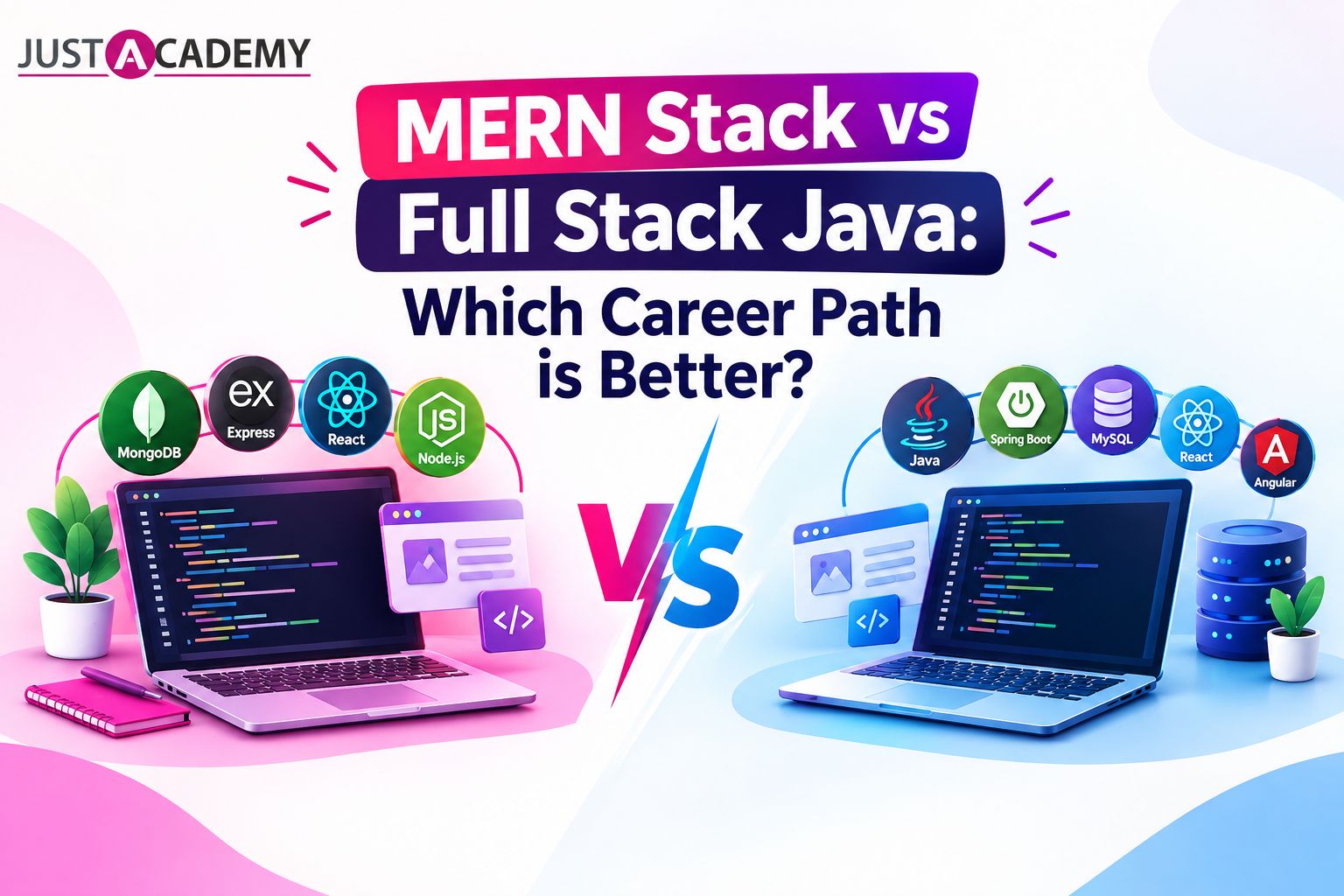
A lot of learners eventually branch out from pure QA into broader development roles, and it helps to understand how that comparison plays out, something we unpack more fully in this piece on MERN stack versus full stack Java career paths. If you are curious about the longer QA specific journey instead, our Selenium automation testing roadmap for 2026 lays out the skills hiring managers are actually screening for this year. And if you eventually want to move toward full stack product building rather than staying purely in QA, Pune learners have also been joining our MERN stack developer bootcamp in Pune, which leans heavily on real startup style product work.
Placement Support And What Structured Training Covers That Tutorials Skip
Beyond the technical syllabus, structured programs include placement support, mock interviews, and resume reviews built specifically around how QA and automation roles are actually screened, something scattered free tutorials rarely address. Whether you eventually specialize in web automation testing, appium testing, or move into a hybrid role touching both, having someone check your framework decisions early saves months of self taught trial and error.
A good number of testers also branch into scripting and API level checks once they get comfortable, and that is usually where a solid grip on Python pays off. If you want that foundation alongside your automation skills, our Python training in Pune runs on the same live, mentor led format and pairs naturally with everything covered in this guide.
Conclusion
Selenium is not going anywhere, and neither is the demand for testers who understand it deeply enough to design a framework, not just run one someone else built. The tools for selenium you choose, whether that means pairing it with TestNG, layering in a bdd framework in selenium, extending into appium testing for mobile, or eventually exploring playwright automated testing alongside it, matter far less than understanding why each piece exists. That understanding is exactly what structured, live, mentor led training is built to give you, and it is available to you in Pune without ever stepping into a physical classroom.
Ready to see a live Selenium session for yourself?
A Pune learner's roadmap to picking the right tools for Selenium, building a framework from scratch, and understanding where BDD, Cypress, Playwright and Appium fit into the bigger QA picture
A practical, no fluff guide to what it actually takes to build a career as a PHP Laravel developer, written for learners in Pune who want a real answer, not a recycled one.
A practical comparison for Pune based learners choosing between MERN and Java full stack development, covering salary, learning curve, job roles, and long term career growth.