I am learning flutter from JustAcademy, They provide very much great environment where people gather and work simultaneously. totally project based training institute.
MOHD ABU BAKAR ANSARI
Flutter Developer
Awesome Experience. I am a Front-end Web Designer working at Star India for 3 years now. I applied for Full-stack development and my experience has been phenomenal & they really do help with placements exceptionally. Thank you Roshan sir so much.
A complete guide to becoming a job ready MERN stack developer, from JavaScript fundamentals to landing your first offer in India
If you have spent even a week scrolling through job portals in India, you already know that the phrase mern stack developer shows up in almost every full stack opening worth applying for. Companies are not asking for four separate specialists anymore. They want one person who can build a database, write server logic, design an interface, and ship the whole thing without waiting on three different teams. That expectation can feel intimidating when you are just starting out, but the truth is that mern stack development has a fairly logical learning order once someone actually breaks it down for you instead of throwing a wall of buzzwords your way.
This guide is exactly that breakdown. Before we get into the roadmap itself, it is worth mentioning that if you would rather learn this stack with an instructor correcting your code in real time instead of piecing it together from scattered tutorials, JustAcademy runs a full stack web development classroom bootcamp in Mumbai built around real projects, and you can book a seat in the free demo class to see how the sessions actually run before committing to anything. With that out of the way, let us get into what mern stack development really involves and how a beginner in 2026 should approach it.
MERN Full Form Explained
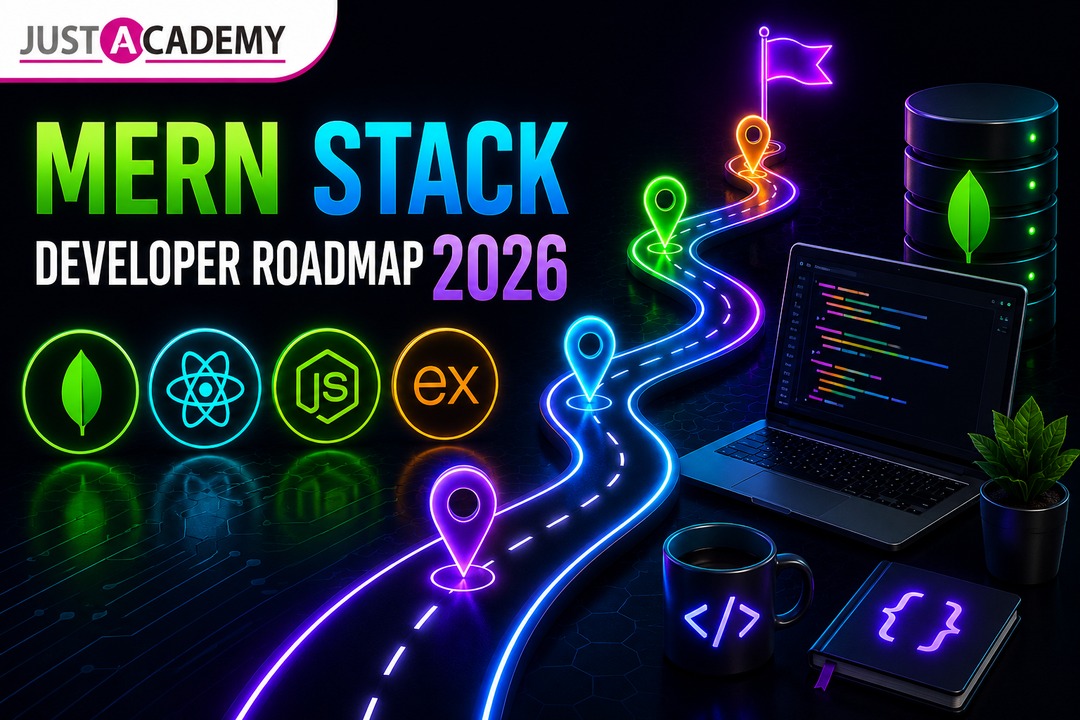
The mern stack full form is MongoDB, Express, React, and Node, and each letter represents a layer of a working web application rather than a random collection of tools. MongoDB is the database where your data lives. Express is the framework that runs on top of Node and handles requests coming from the browser. React is what the user actually sees and interacts with. Node is the engine that lets JavaScript run outside the browser so the same language can power your entire application from front to back. Once you understand that these four pieces map directly to database, server, framework, and client, the whole concept of mern stack stops feeling abstract and starts feeling like four jobs that need to talk to each other properly.
Why This Combination Works So Well
The biggest reason mern stack web development became the default choice for so many startups and product companies is that everything runs on JavaScript. A developer does not need to context switch between Python on the backend and JavaScript on the frontend, which used to be a genuine source of slowdown for teams. About mern stack, what makes it particularly attractive to hiring managers is the speed at which a small team can move from idea to a working prototype, since there is no translation layer between how data is shaped in the database and how it eventually gets rendered on screen.
The Architecture Behind Every MERN Application
Before touching any code, it helps to actually picture how a request travels through a mern stack architecture. A user clicks a button in the React interface, that click triggers a call to an Express route, Express asks Node to process it, and depending on what is needed, Node either talks to MongoDB to fetch or store data, then sends a response all the way back to the browser. Seeing this flow before writing your first line of code saves weeks of confusion later.
How MongoDB Stores Your Data
MongoDB is a document based database, which means instead of rigid tables and rows like traditional relational databases, your data is stored as flexible JSON like documents. This matters a lot for beginners because it mirrors how JavaScript objects already work, so there is very little mental translation needed between what you see in your code and what actually sits in the database.
Express and the Server Layer
Express sits directly on top of Node and gives you a clean way to define routes, handle incoming requests, and send responses. Without a framework like Express, you would be writing raw Node server code for every single endpoint, which gets messy fast. Express is what most job descriptions mean when they list express js for mern stack as a required skill.
React on the Front End
React handles everything the user sees, breaking the interface into reusable components. This is the part of mern stack development that most beginners find the most enjoyable because progress is visible almost instantly on screen.
Node.js Holding It All Together
Node is what allows JavaScript to run on a server rather than only inside a browser tab. It is event driven and non blocking, which is a fancy way of saying it can handle many requests at once without getting stuck waiting on one slow task before starting the next. This single trait is why so many high traffic applications, from chat platforms to live dashboards, are built on Node in the first place. Understanding this behaviour early also helps explain why certain mern stack development patterns, like using async and await instead of nested callbacks, exist the way they do. A developer who understands why Node behaves the way it does will write cleaner backend code than one who simply memorizes syntax without knowing the reasoning underneath it.
It also helps to understand npm, the package manager that ships with Node, since almost every mern stack project depends on third party packages for things like authentication, file uploads, or environment variable management. Getting comfortable installing, updating, and occasionally troubleshooting package conflicts is a small but very real part of daily life as a mern stack developer, and it is one of those practical skills that rarely gets mentioned in beginner tutorials but comes up constantly in actual project work.
Skills You Need Before You Start Coding
A lot of beginners try to jump straight into building a mern stack project and end up frustrated because they skipped the groundwork. There is a specific order that actually works, and it starts well before you touch React or Node.
JavaScript Fundamentals for Beginners
Every single layer of the mern stack runs on JavaScript, so javascript fundamentals for beginners are non negotiable. You need to be genuinely comfortable with variables, functions, arrays, objects, loops, and asynchronous code before any of the frameworks will make sense. Skipping this step is the single biggest reason people stall out halfway through a mern stack learning path. If you want structured guidance here rather than piecing it together from random videos, JustAcademy's JavaScript training in Mumbai covers exactly this foundation with hands on practice.
ES6 JavaScript Concepts That Matter
Once the basics feel natural, move on to es6 javascript features like arrow functions, destructuring, template literals, promises, and the spread operator. React code in particular leans heavily on these patterns, so trying to learn React before ES6 is a bit like trying to read a new dialect without knowing the base language first.
Version Control and Development Tools
Git and GitHub are not optional extras. Every mern stack developer job description assumes you already know how to commit code, create branches, and collaborate without overwriting a teammate's work. Pair this with a comfortable code editor setup and you have the tooling side sorted before you even start the roadmap proper.
Beyond Git, spend a little time getting comfortable with your browser's developer tools, since you will be reading network requests, inspecting console errors, and checking component state through them almost daily once you start building real mern stack projects. A command line interface should also stop feeling foreign fairly early on, since running scripts, installing dependencies, and starting local servers all happen through the terminal rather than a graphical interface. None of these tools take long to learn individually, but skipping them tends to slow beginners down far more than skipping an actual coding concept would.
The Complete MERN Stack Developer Roadmap for 2026
Here is the actual sequence, broken into three practical phases rather than an overwhelming single list.
Phase One: Frontend Foundations
Start with HTML and CSS to understand structure and styling, move into JavaScript fundamentals, and then dedicate real time to React. Learn components, props, state, and hooks in that order, and build at least two or three small projects before moving forward. This phase alone can take six to eight weeks of consistent practice if you are learning from scratch.
Phase Two: Backend and Database
Once the frontend feels solid, shift focus to Node and Express, learning how to build REST APIs, handle authentication, and manage errors properly. Alongside this, pick up mongodb for mern stack fundamentals including schema design and basic queries. This is usually where mern coding starts to click, because you finally see your React interface actually talking to a real database instead of dummy data.
Phase Three: Full Integration and Deployment
The final phase is where a lot of beginners fall short, simply because they never connect the dots end to end. Build a complete project where your React frontend calls your Express backend, which reads and writes to MongoDB, then deploy it somewhere live like Render or Vercel so you have something you can actually show in an interview rather than just describe. Add proper environment variable handling, basic error pages, and a working authentication flow with JSON Web Tokens, since these three things separate a tutorial project from something that actually resembles production code.
It is worth being honest about timelines here as well. Most learners moving through this mern stack learning path at a steady, consistent pace can expect the full journey, from absolute beginner to a deployable project, to take somewhere between four and six months of regular practice. Rushing through any single phase to reach React or Node faster almost always shows up later as gaps that become obvious the moment an interviewer asks a slightly deeper question, so resist the urge to skip ahead before a phase genuinely feels solid.
MongoDB for MERN Stack: Database Fundamentals Explained
Databases intimidate a lot of beginners more than they should, mostly because relational database concepts get taught first in most college courses and MongoDB works differently enough to cause confusion.
Schema Design in a Schema-less World
MongoDB technically does not enforce a rigid schema, but that does not mean you should design your data randomly. Good mern stack developers still plan out their document structure carefully, deciding what gets embedded directly inside a document versus what gets referenced separately, because this decision affects how fast your application runs later.
Working with Mongoose
Most real world mern stack development projects use Mongoose, a library that adds structure and validation on top of MongoDB. Learning Mongoose schemas, models, and basic validation rules early will save you from a lot of messy, inconsistent data down the line.
It is also worth spending time on indexes and query performance once your basic CRUD operations feel comfortable. A lot of beginner projects work fine with a handful of test records and then slow down noticeably once real data volume enters the picture, purely because nobody thought about which fields actually needed an index. Understanding this early, even at a surface level, tends to separate candidates who can only build a demo from those who can genuinely maintain a live application.
Express JS for MERN Stack: Building the Server Layer
Routing and Middleware Basics
Express routing lets you define what happens when a specific URL and method combination is hit, while middleware functions let you run logic before a request reaches its final destination, such as checking authentication or logging requests. These two concepts together form the backbone of almost every backend feature you will ever build.
Connecting Express to MongoDB
Once routing feels comfortable, the next step is wiring Express up to MongoDB so your API actually persists data instead of resetting every time the server restarts. This is usually the point where a mern stack project starts feeling like a real application rather than a coding exercise.
Authentication and Error Handling
No serious express js for mern stack project ships without proper authentication, and this is usually where beginners either build genuine confidence or get stuck for weeks. Learn how to hash passwords, issue tokens, and protect specific routes so only logged in users can access them. Alongside this, build the habit of centralizing your error handling instead of wrapping every single route in its own try and catch block, since consistent error responses make debugging dramatically easier once your application grows past a handful of endpoints.
React JS Roadmap: From Components to Complete Applications
React Developer Skills You Must Master
A solid react js roadmap covers component structure, props and state management, conditional rendering, and handling forms, before moving into more advanced react developer skills like context API and custom hooks. Many developers also pick up basic UI design sense along the way, since a functional interface still needs to look and feel usable. Some students strengthen this side by picking up Figma training in Mumbai alongside their coding practice, which makes it far easier to collaborate with designers or simply build cleaner interfaces on your own.
Full Stack Developer MERN Specialization: What Employers Look For
When recruiters search for a full stack developer mern specialization, they are typically not just checking whether you know the four technologies individually. They want to see that you can reason about state flowing between the frontend and backend, handle authentication properly, and debug issues that span multiple layers of the application rather than staying stuck inside just one.
React Projects That Actually Teach You MERN Coding
Reading about react js skills only gets you so far. Real progress comes from building things that force you to solve problems you have not seen in a tutorial.
Beginner Friendly Build Ideas
A task manager with user authentication, a simple blog platform with a comment system, or a basic e commerce product listing page are all excellent react projects for beginners because each one touches a different part of the mern stack without being overwhelming.
Projects That Mirror Real Hiring Tests
As you get more comfortable, build something closer to what companies actually ask for in assignments, such as a booking system with date conflict handling or a dashboard that pulls and visualizes data from your own API. These projects double as strong portfolio pieces when you start applying for roles.
Do not underestimate how much a well documented project matters either. A short README explaining what the project does, how to run it locally, and what technical decisions you made says more to a recruiter than the code itself in the first thirty seconds of them looking at your GitHub profile. Many mern stack developer roadmap guides skip this detail entirely, yet it is often the difference between a resume that gets a callback and one that gets scrolled past.
Essential Tools and Ecosystem for MERN Developers
Beyond the four core technologies, a working mern stack developer also relies on a handful of supporting tools that rarely get top billing but show up in almost every real project.
Testing and Debugging Practices
Writing even basic tests for your Express routes using a tool like Jest or Supertest will put you ahead of a large share of self taught developers, since testing is one of those skills people plan to learn later and often never actually get to. On the frontend, learning to read React error boundaries and using browser extensions built specifically for inspecting component state will save you significant debugging time once your applications grow past a few screens.
Deployment and DevOps Basics
You do not need to become a full DevOps engineer, but understanding how to deploy a Node backend, connect it to a hosted MongoDB instance such as Atlas, and deploy a React frontend separately is now considered a baseline expectation rather than an advanced skill. Get comfortable with environment variables, basic CORS configuration, and reading deployment logs when something breaks after going live, since these small operational details come up constantly in real mern stack development work.
MERN vs Other Full Stack Combinations
It helps to see how mern stack architecture compares against other popular combinations before committing your learning time.
Stack
Frontend
Backend
Database
Best Fit For
MERN
React
Express and Node
MongoDB
Startups and product teams wanting a single JavaScript codebase
MEAN
Angular
Express and Node
MongoDB
Teams that prefer Angular's structured framework approach
Java Full Stack
React or Angular
Spring Boot
MySQL or Oracle
Enterprise systems needing strict typing and heavy scalability
Django Stack
React or plain templates
Django
PostgreSQL
Data heavy applications where Python's ecosystem adds value
MEAN vs MERN
The core difference comes down to React versus Angular on the frontend. React's component model tends to have a gentler learning curve for beginners, which is part of why mern stack web development has pulled ahead in popularity among newer developers entering the job market.
MERN vs Java or Django Based Stacks
Enterprise companies still lean on Java or Django for certain systems, but for fast moving product companies and startups, mern stack development remains the faster path from idea to deployed application, which is exactly why so many job postings specifically call out full stack web development mern experience.
None of this means one stack is objectively superior to another, and a genuinely strong mern stack developer should still understand why other stacks exist and where they fit. What the comparison really shows is fit for purpose. A banking system handling millions of regulated transactions has very different priorities than a startup trying to validate an idea with real users within a few months, and mern stack architecture consistently wins in that second scenario because of how quickly a small team can iterate using a single shared language across the entire codebase.
MERN Stack Developer Jobs, Salary and Career Opportunities in India
MERN Stack Developer Salary in India 2026
Pay naturally varies by city, company size, and experience, but broadly speaking, mern stack developer salary in india for freshers tends to sit in a healthy entry level range, with clear jumps as you cross the two and three year experience marks. Mern stack developer salary 2026 figures continue trending upward as more companies standardize on this stack for their product teams, particularly in Mumbai, Pune, Bangalore, and Hyderabad.
Why a Full Stack Developer MERN Specialization Pays Off in 2026
Companies consistently pay a premium for a full stack developer mern specialization over someone who only knows the frontend or only knows the backend, simply because one hire can cover more ground. This is also why mern stack developer jobs in india often list a wider salary band than single stack roles, since the ceiling depends heavily on how much of the stack you can genuinely own.
City Wise and Company Wise Variation
Mern stack developer jobs in india are not distributed evenly, and it helps to know this before assuming a single national average tells the whole story. Product based companies and well funded startups in Mumbai, Pune, and Bangalore typically offer stronger packages than service based companies handling outsourced projects, mainly because product teams value developers who can own a feature end to end rather than just execute assigned tickets. Remote and hybrid roles have also widened the playing field considerably, since a mern stack developer based in a smaller city can now realistically apply to and land roles that were once concentrated only in major metros.
Internship and Entry Level Pathways
A mern stack internship remains one of the most reliable ways to move from tutorials to a real resume line. Mern stack developer internship openings are common at product startups precisely because a single intern can contribute across the stack without needing a large team around them. If you are exploring how internships fit into a broader mern stack developer career, our earlier posts on the MERN stack development course and the MERN stack developer course go into more detail on how a structured learning path connects directly to these opportunities.
Long Term Career Growth and Cross Skilling
Mern stack career opportunities do not stop at developer roles. Many professionals eventually move into technical lead or product engineering positions, and some choose to broaden their profile further by picking up quality assurance skills through Selenium training in Mumbai, which pairs well with development experience if you are aiming for a full product engineering role rather than a pure coding position.
Why Structured Training Makes the Difference
Self teaching mern stack development is absolutely possible, and plenty of developers have done it. But there is a real cost to learning alone, mainly in the form of time lost debugging problems that an instructor would have flagged in minutes. This is where live interactive sessions genuinely change the outcome. Sitting in a live interactive training environment where you can ask a question the moment you get stuck, rather than searching forums for hours, compresses months of trial and error into weeks.
JustAcademy is an ISO certified training institute with classroom batches running out of Mumbai and Pune, alongside live interactive online courses available to students anywhere in the world, which is part of why it is often mentioned as the best course in mumbai for anyone serious about full stack web development. Every batch is built around real projects rather than isolated exercises, and placement support is built into the program so the learning does not stop the moment the course ends. Whether you attend in person or join the live interactive sessions online, the structure stays the same, which matters far more than the format when you are trying to build genuine job ready skills.
There is also a psychological benefit to structured training that rarely gets discussed. Learning alongside a batch of peers who are hitting the same roadblocks at roughly the same time keeps motivation intact during the weeks when progress feels slow, which happens to every single person learning mern stack development regardless of background. A mentor who has already guided dozens of students through the exact same sticking points, whether that is understanding asynchronous JavaScript or debugging a broken API connection, can usually resolve in one conversation what might otherwise take days of frustrated searching alone. That combination of accountability and expert guidance is ultimately what live interactive training offers over solo learning, and it is a large part of why so many JustAcademy students move from their first line of code to an actual job offer within a realistic, well defined timeline.
Conclusion
Becoming a mern stack developer in 2026 is less about memorizing four technology names and far more about understanding how a request actually moves from a browser click all the way down to a database and back. Start with javascript fundamentals, move through React, Express, and MongoDB in that order, build real projects instead of following along passively, and the mern stack developer roadmap laid out here will take you from complete beginner to someone who can genuinely hold their own in a full stack interview. If you would rather not figure all of this out alone, JustAcademy's classroom and live interactive online batches are built specifically to shorten that journey.
From a humble to do list to a Node JS backend, here are the javascript project ideas that actually teach you something and give recruiters a reason to click your GitHub link.
A straight talking guide for Delhi freshers, career switchers and non tech graduates on choosing the right IT certification, and why live interactive, instructor led and mentor led training makes the difference
A grounded, honest guide for Delhi learners on skills, salaries, jobs and the learning path behind each IT career, backed by live, instructor led and mentor led training
A straight talking guide for Delhi learners on what mobile app developers really earn, which skills raise the number, and how live, mentor led training can shorten the road from beginner to hired.
A practical guide for Delhi learners covering react native app ideas for beginners, live mentor led practice, and a portfolio that actually gets interviews
A practical, honest walkthrough of Swift, Xcode, Windows workarounds, Flutter, React Native and the career paths that open up once you can build for Apple devices
A practical, no nonsense guide to software jobs for freshers, from picking a skill path to cracking interviews and aiming at the highest paying software engineering jobs
40 real questions and detailed answers on Kotlin, Jetpack, architecture, performance and security, so you walk into your next android technical interview ready to talk like a working developer.
Drop us a Query
+91 99871 84296
Available 24x7 for your queries
Want To Connect with us
🚀 Kickstart Your IT Career
with JustAcademy
Learn Industry-Focused Courses with Live Projects & Placement Assistance
Full Stack Java(Java, Spring Boot, Hibernate, REST API, React JS)
Data Analytics(Excel, SQL, Power BI, Python, Tableau)