I am learning flutter from JustAcademy, They provide very much great environment where people gather and work simultaneously. totally project based training institute.
MOHD ABU BAKAR ANSARI
Flutter Developer
Awesome Experience. I am a Front-end Web Designer working at Star India for 3 years now. I applied for Full-stack development and my experience has been phenomenal & they really do help with placements exceptionally. Thank you Roshan sir so much.
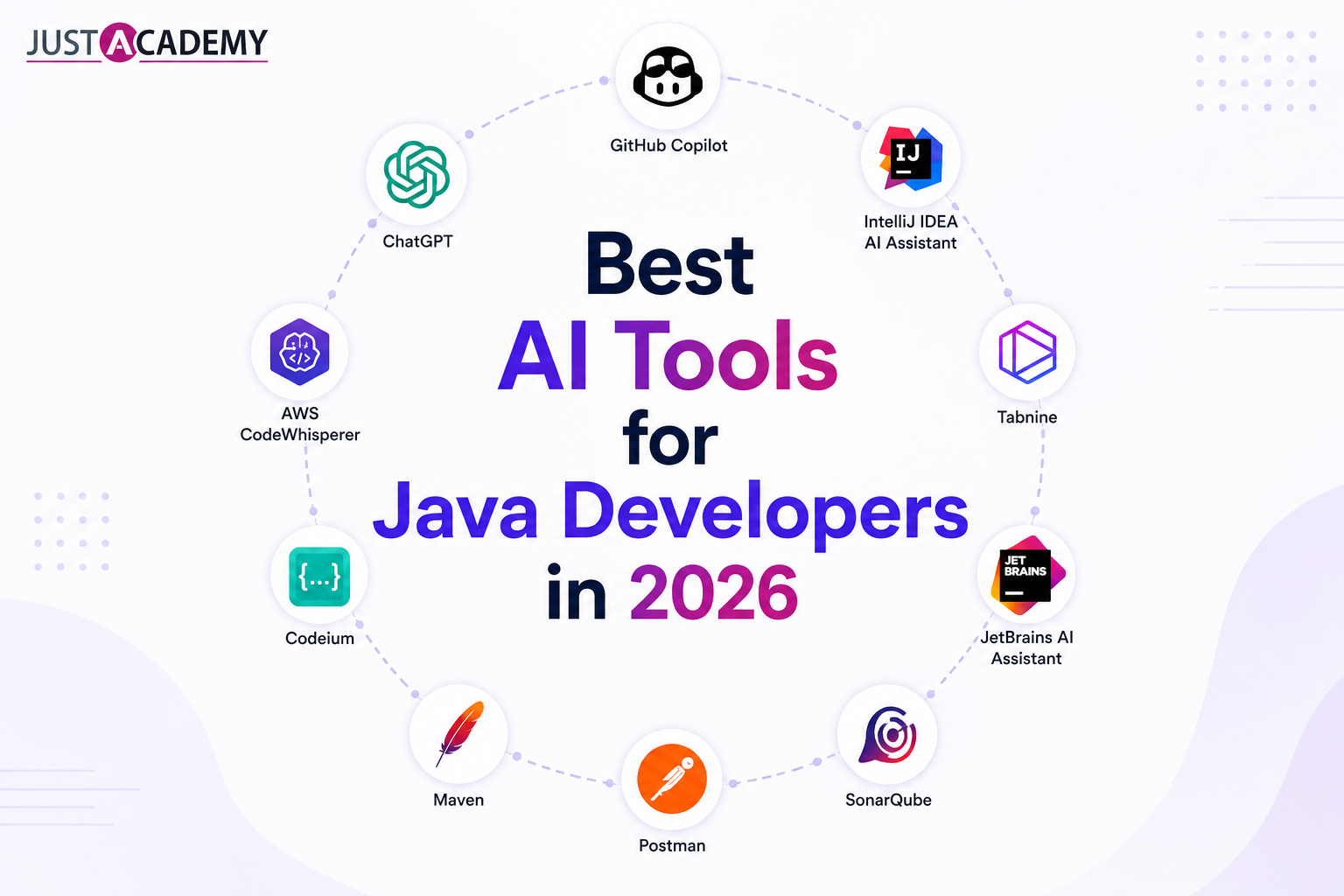
Artificial intelligence has moved from a peripheral curiosity to a central productivity force in software development in 2026. For Java developers specifically, the range of AI tools available for code completion, test generation, code review, debugging, documentation, and architecture assistance has expanded significantly over the past two years, and the developers who have integrated these tools into their daily workflow are measurably more productive than those who have not. Understanding which AI tools for Java developers are worth adopting, how each one fits into a professional Java development workflow, and what limitations to watch for is now a relevant part of every Java developer's professional knowledge.
This complete guide covers the best AI productivity tools for Java developers in 2026, from GitHub Copilot and Tabnine for intelligent code completion to AI-powered testing, debugging, code review, and architectural assistance tools. Whether you are a fresher building Java skills through live interactive sessions or an experienced developer looking to accelerate your workflow, this guide covers what you need to know to integrate AI tools effectively into professional Java development.
Why Java Developers Should Embrace AI Tools in 2026
The Productivity Gap Between AI-Augmented and Traditional Developers
The productivity gap between Java developers who use AI coding tools and those who do not has become clearly measurable in 2026. Research across development teams consistently shows that developers using AI code completion tools write working code faster, spend less time on boilerplate, complete test coverage more consistently, and onboard to new codebases more quickly. For Java specifically, where enterprise projects involve substantial boilerplate code for Spring Boot configurations, JPA entity definitions, REST controller setup, and unit test scaffolding, AI tools provide compounding productivity benefits because the volume of repetitive structured code is higher than in many other languages.
In the Indian technology industry, where Java developers at product companies, global capability centers, and service firms are expected to deliver quality code at increasing velocity, the ability to use AI tools effectively has moved from a nice-to-have skill to a professional expectation. Interviewers at forward-thinking companies now ask about AI tool usage as part of understanding a candidate's development workflow. Training programs that include live interactive sessions on AI tool integration alongside core Java curriculum are producing graduates better prepared for 2026's professional development environment.
What AI Tools Can and Cannot Do for Java Developers
Understanding the realistic capabilities and limitations of AI coding tools prevents both underuse through skepticism and overuse through misplaced trust. AI tools for Java developers excel at generating boilerplate code from patterns they have learned from massive training datasets, suggesting method completions based on context, generating unit test skeletons for existing code, explaining unfamiliar code, suggesting fixes for common errors, and accelerating documentation writing. They struggle with deeply domain-specific business logic that requires understanding the organization's specific context, complex architectural decisions that involve trade-offs specific to the team's constraints, security-sensitive code where subtle errors have serious consequences, and novel algorithmic problems that require genuine reasoning beyond pattern matching.
The most effective AI-augmented Java developers use AI for acceleration of the well-understood parts of their work while applying their own judgment to architectural decisions, security implementations, and complex business logic. Treating AI suggestions as drafts to be reviewed rather than correct solutions to be accepted blindly produces the best outcomes and avoids introducing the subtle bugs and anti-patterns that uncritically accepted AI code can produce.
GitHub Copilot for Java Developers
What GitHub Copilot Does and How It Works
GitHub Copilot is the most widely adopted AI coding assistant for Java developers in 2026 and the tool that most established the category. It is developed by GitHub in collaboration with OpenAI and integrates directly into IntelliJ IDEA, Eclipse, VS Code, and other major Java IDEs as a plugin. Copilot uses a large language model trained on a vast corpus of code from public repositories to predict and suggest code completions based on the current file context including the code written so far, comments describing intent, method signatures, and the patterns of nearby code.
For Java development specifically, Copilot is most effective at generating complete method implementations from a method signature and a Javadoc comment describing the intent, generating Spring Boot REST controller methods from the class context and endpoint method signatures, creating JPA entity classes from a brief description, writing unit tests for existing methods using JUnit and Mockito patterns, generating SQL query strings for Spring Data JPA repository methods, and completing repetitive patterns like builder methods, getters and setters, and equals and hashCode implementations. The quality of suggestions improves significantly when the developer writes clear, descriptive method names and Javadoc comments before generating the implementation, because the natural language description gives Copilot the context it needs to generate code aligned with the intent.
GitHub Copilot Chat for Java Problem Solving
GitHub Copilot Chat is the conversational interface of Copilot that allows developers to ask questions, request explanations, and get assistance with specific problems in natural language without leaving the IDE. For Java developers, Copilot Chat is particularly valuable for explaining unfamiliar code from legacy codebases or third-party libraries, asking why a specific error is occurring and what the fix should be, requesting a refactoring of a specific method to follow a particular design pattern, asking for the best way to implement a specific feature in Spring Boot, and getting an explanation of what a complex SQL query or JPA specification is doing. The chat interface maintains context from the current file and selected code, making its suggestions more relevant than a general-purpose chatbot that lacks the codebase context.
Limitations of GitHub Copilot for Java Enterprise Development
Copilot has specific limitations that Java enterprise developers must be aware of. It does not have access to the organization's proprietary codebase or internal documentation, so suggestions are based on public code patterns rather than the team's specific architecture conventions. Generated Spring Boot code sometimes uses outdated APIs or patterns from older Spring versions that do not align with the team's current standards. Security-sensitive code including authentication logic, encryption, and SQL query construction should never be accepted from Copilot without careful security review because subtle vulnerabilities can appear in otherwise functional-looking code. Complex business logic with domain-specific rules that have no parallel in public code produces lower-quality suggestions. For these areas, Copilot's suggestions should be treated as a starting point for editing rather than a complete solution.
Tabnine for Java Development
How Tabnine Differs From GitHub Copilot for Java Teams
Tabnine is an AI code completion tool that differs from GitHub Copilot in several ways that make it the preferred choice for specific Java development contexts. Tabnine offers a local model option that runs entirely on the developer's machine without sending code to external servers, which is critical for Java development in regulated industries like banking, insurance, and healthcare where source code cannot leave the organizational boundary. It also offers a team-trained model where Tabnine learns from the organization's own codebase, producing suggestions that follow the team's specific coding patterns, naming conventions, and architectural decisions rather than generic public code patterns. For large enterprise Java teams with established coding standards, team-trained Tabnine produces more consistently relevant suggestions than general-purpose models trained on public code.
Tabnine integrates with IntelliJ IDEA, Eclipse, and other Java IDEs and provides line and whole-function completions similar to Copilot. The suggestion quality for standard Spring Boot and Java patterns is competitive with Copilot, and for teams that have invested in training Tabnine on their own codebase, the architectural alignment of suggestions is significantly stronger. The data privacy advantage makes Tabnine the AI completion tool of choice for Java development teams at banks, insurance companies, and government technology organizations in India where code confidentiality is a compliance requirement.
Configuring Tabnine for Java Spring Boot Projects
Getting the most from Tabnine in a Java Spring Boot project requires some configuration investment. Connecting Tabnine to the team's private repository for team model training produces the biggest quality improvement. Configuring the accepted completion length to match the team's preference for how much code to accept in one suggestion prevents accepting too much AI-generated code at once. Setting up Tabnine to respect the project's code style configuration ensures that accepted suggestions follow the formatting rules defined in the project's Checkstyle or EditorConfig configuration. Documenting team conventions for the Java classes and packages that should be prioritized in training helps the team model learn the most important patterns first.
IntelliJ IDEA AI Assistant for Java Development
Built-In AI Features in IntelliJ IDEA 2026
JetBrains has deeply integrated AI assistance directly into IntelliJ IDEA, the dominant IDE for Java development in India in 2026, through its AI Assistant feature. Unlike third-party plugins, IntelliJ's AI Assistant has direct access to the full project structure, the dependency graph, the build configuration, and the complete codebase context, which produces more accurate and contextually appropriate suggestions than tools that access only the currently open file. The AI Assistant in IntelliJ IDEA provides inline code completion similar to Copilot, a chat interface for asking questions about the codebase, automated code review that identifies style violations and potential bugs as code is written, intelligent refactoring suggestions that go beyond mechanical renaming and extraction, and test generation that creates unit tests covering the identified paths through a method.
For Java developers working in IntelliJ, the AI Assistant's deep IDE integration produces a more seamless experience than activating an external plugin. It can explain the full call hierarchy of a method, suggest which existing utility classes in the project are relevant to a problem being solved, identify duplicated code patterns across the project and suggest consolidation, and provide context-aware documentation generation that references the correct class names, method signatures, and parameter types from the actual codebase.
AI-Powered Refactoring and Code Quality in IntelliJ
IntelliJ IDEA's AI-enhanced refactoring tools go significantly beyond traditional automated refactoring. The AI can identify code smells and suggest the specific refactoring patterns that would address them, explain why a specific refactoring improves the code, generate the refactored version for review before applying, and check that the refactoring does not change the code's observable behavior. For Java developers working on legacy codebases, which is a common situation in India's large enterprise Java market, AI-assisted refactoring provides a practical path to modernizing code quality without the risk of introducing bugs through manual restructuring. The combination of IntelliJ's static analysis with AI understanding of code intent produces refactoring suggestions that are both syntactically correct and semantically appropriate.
AI Tools for Java Testing
What Is Amazon CodeWhisperer and How Does It Help Java Testing
Amazon CodeWhisperer is Amazon Web Services' AI coding assistant that provides code completion and security scanning for Java and other languages. It integrates with IntelliJ IDEA and VS Code and is particularly well-suited for Java developers working in AWS-heavy environments because its suggestions are informed by AWS SDK usage patterns and AWS service integration code. CodeWhisperer's security scanning feature automatically checks generated and existing Java code for security vulnerabilities including SQL injection risks, insecure random number generation, path traversal vulnerabilities, and improper input validation, flagging issues in real time as code is written rather than requiring a separate security scan. For Java developers building AWS-integrated applications, CodeWhisperer's combination of code completion and security scanning in a single free tool makes it a strong addition to the AI tool stack.
AI-Powered Test Generation With Diffblue Cover
Diffblue Cover is a specialized AI tool that generates Java unit tests automatically by analyzing the bytecode of compiled Java classes and generating JUnit test cases that exercise the code paths found within each method. Unlike general-purpose code generation tools that generate tests based on code patterns, Diffblue analyzes the actual compiled behavior of the code and generates tests that assert on the specific values and behaviors the code currently exhibits. This approach produces working tests immediately rather than test skeletons that still require manual completion of assertions. For Java development teams that need to add test coverage to legacy codebases quickly, Diffblue Cover can generate hundreds of test cases in the time it would take a developer to write a handful manually. The generated tests serve as a regression safety net that catches when future changes break existing behavior, even for code that was written without tests.
Using ChatGPT and Claude for Java Test Strategy
Conversational AI tools including ChatGPT and Claude are effective partners for Java test strategy development even when they are not used directly for code generation. Asking a conversational AI to review a method's implementation and identify the edge cases and boundary conditions that unit tests should cover produces a comprehensive list of test scenarios that a developer might not identify through individual inspection. Asking for an explanation of how to test a specific Spring Boot component in isolation with Mockito, how to write integration tests for a specific database interaction, or how to structure a test for a specific concurrency scenario produces detailed guidance that accelerates learning and problem solving. Conversational AI tools are also effective for generating test data, creating realistic mock response objects for Mockito setups, and understanding how to use specific JUnit 5 or Mockito features that the developer has not used before.
AI Tools for Java Code Review and Documentation
SonarQube With AI-Enhanced Analysis
SonarQube is the industry standard code quality and security analysis platform for Java enterprise development, and its AI-enhanced analysis capabilities in 2026 go significantly beyond traditional static analysis. SonarQube's AI features identify complex code quality issues that require understanding code intent rather than just pattern matching, provide natural language explanations of why specific issues matter and how to fix them, prioritize findings by actual risk rather than mechanical severity classification, and learn from the team's historical fix patterns to provide more relevant suggestions over time. For Java development teams in India's enterprise sector where SonarQube is already part of the CI/CD pipeline, the AI enhancements add value without requiring tool migration. The combination of SonarQube's established Java rule set with AI-powered contextual analysis provides the most comprehensive automated code review available for Java in 2026.
AI-Assisted Javadoc and API Documentation Generation
Writing comprehensive Javadoc documentation for Java APIs has historically been one of the most time-consuming and neglected aspects of Java development. AI tools in 2026 make documentation generation fast enough that there is no longer a reasonable excuse for undocumented public APIs. GitHub Copilot, IntelliJ AI Assistant, and dedicated documentation tools can generate complete Javadoc comments including parameter descriptions, return value explanations, thrown exception documentation, and usage examples from the method signature and implementation. The developer's role shifts from writing documentation from scratch to reviewing and editing AI-generated documentation for accuracy and completeness, which takes a fraction of the time. For Java teams maintaining public APIs or internal libraries consumed by multiple teams, AI-assisted documentation generation dramatically improves the quality and completeness of API documentation.
Mintlify and Readme AI for Java Project Documentation
Beyond inline code documentation, Java projects require higher-level documentation including architecture overviews, getting started guides, API reference documentation, and deployment guides. Mintlify and similar AI documentation tools can analyze a Java project's structure, dependencies, and code to generate initial drafts of project documentation that developers then edit and refine rather than write from scratch. These tools are particularly useful for open-source Java projects and internal platform teams whose libraries are consumed by many other teams who need clear documentation to integrate effectively. For Java development teams at Indian product companies that have historically deprioritized documentation due to time pressure, AI documentation tools provide a practical path to improving documentation quality without a proportional increase in documentation effort.
AI Tools for Java Debugging and Error Analysis
Using AI for Stack Trace Analysis and Error Explanation
Stack traces in Java enterprise applications, particularly those involving Spring Boot, Hibernate, and distributed systems, can be long, nested, and difficult to parse quickly. AI tools in 2026 provide significant help with stack trace analysis. Pasting a Java stack trace into Copilot Chat, Claude, or ChatGPT and asking for an explanation of what caused the error, where in the code the root cause is located, and what the most likely fix is produces actionable diagnostic information in seconds rather than requiring manual trace-through of the call stack. For NoClassDefFoundError, NullPointerException in complex object graphs, Hibernate LazyInitializationException, and Spring circular dependency errors, AI tools can immediately identify the likely cause and suggest the appropriate fix, which is particularly valuable for junior developers and for errors in unfamiliar parts of a codebase.
AI-Enhanced Logging and Observability Analysis
Modern Java applications generate enormous volumes of logs, and identifying the specific log entries relevant to debugging a specific issue manually is time-consuming. AI-powered log analysis tools can analyze application logs, identify patterns of errors and anomalies, correlate log entries across multiple services in a microservices architecture, and summarize what happened in a specific time window around an incident. For Java developers working on distributed Spring Boot microservices, AI log analysis tools significantly reduce the time required to diagnose production issues. Tools that integrate with the application's logging infrastructure such as Elastic and Datadog have AI features that surface relevant log patterns and generate summaries of anomalous behavior, reducing the manual analysis burden on Java developers responsible for production system health.
Debugging With AI Code Explanation for Legacy Java Systems
One of the most valuable applications of AI tools for Java developers in India's large enterprise and services sector is understanding legacy code. Decades-old Java enterprise applications with minimal documentation, cryptic variable names, and complex business logic encoded in deeply nested conditionals are common in banking, insurance, and government technology. AI tools that can read and explain complex legacy Java code provide enormous value for developers tasked with maintaining or migrating these systems. Selecting a block of legacy code and asking Copilot Chat or a conversational AI to explain what it does, what business logic it implements, and what the side effects of modifying it might be compresses hours of reverse engineering into minutes. This capability is increasingly valued in the Indian enterprise Java market where legacy modernization projects are a major category of technology investment in 2026.
AI Tools for Java Architecture and Design
Using AI for Spring Boot Architecture Decisions
AI conversational tools are effective partners for Java architecture discussions, particularly for developers who are newer to Spring Boot microservices architecture or who are working through a novel design problem. Describing a specific architecture requirement to Claude or ChatGPT and asking for an analysis of the trade-offs between different approaches, which Spring Boot components are most appropriate for a specific concern, how to structure the service boundaries in a microservices decomposition, or what the performance implications of a specific design choice are produces nuanced technical analysis that accelerates decision-making. For complex concerns like distributed transaction management, event-driven architecture with Kafka, and service mesh configuration, AI tools can explain the options and their trade-offs clearly enough to inform a decision even when the developer lacks prior experience with the specific technology.
AI-Assisted Code Review With Pull Request Integration
AI-powered pull request review tools that integrate with GitHub, GitLab, and Azure DevOps analyze incoming pull requests and provide automated feedback before human reviewers see the code. For Java pull requests, these tools identify potential null pointer exceptions, resource leaks, thread safety issues, missing transaction boundaries, inefficient database queries, and deviations from the team's coding conventions. The AI feedback arrives immediately when the pull request is opened, giving the developer the opportunity to address issues before the human review, which makes the human review more focused on higher-level design concerns and reduces the total review cycle time. Tools including CodeRabbit, Bito, and PR-Agent provide AI pull request review for Java projects and integrate with standard Git hosting platforms used by Indian development teams.
AI Productivity Tools That Complement Java Development
Cursor IDE as an AI-First Java Development Environment
Cursor is an AI-first code editor built on VS Code's foundation that integrates AI assistance more deeply than traditional IDEs with AI plugins. Its Composer feature allows developers to describe a feature or modification in natural language and have the AI generate the code changes across multiple files simultaneously, which is useful for cross-cutting changes in Java projects such as adding a new field to an entity and all the corresponding service, controller, repository, and test layers. For Java developers who work primarily in VS Code rather than IntelliJ, Cursor provides the deepest AI integration available in a VS Code-based environment. The Cursor chat with codebase context feature allows asking questions that require understanding the entire project structure rather than just the open file, making it effective for onboarding to new Java codebases quickly.
AI Tools for Java Interview Preparation
AI tools are also transforming how Java developers prepare for technical interviews. Using conversational AI to generate practice problems for Java data structures and algorithms, to explain concepts that are unclear after reading documentation, to review solutions and identify improvements, and to simulate interview question explanations where the developer explains a concept and the AI evaluates the clarity and completeness of the explanation are all effective preparation strategies. For developers preparing for Java full stack interviews at product companies and GCCs in Mumbai and other Indian cities, AI-assisted practice sessions that cover Core Java concepts, Spring Boot design questions, and system design scenarios produce more focused preparation than general reading. JustAcademy's live interactive sessions specifically incorporate AI tool usage into Java training, preparing students to use these productivity tools professionally from day one rather than discovering them after joining their first role.
How to Integrate AI Tools Into a Professional Java Development Workflow
Starting With AI Code Completion and Building From There
The most practical approach to AI tool adoption for Java developers is to start with AI code completion as the foundation and add additional tools progressively as comfort with AI-assisted development grows. Installing GitHub Copilot or Tabnine in IntelliJ IDEA and spending two to three weeks using it consistently for Spring Boot development, paying attention to when its suggestions are accurate and helpful versus when they require significant correction, builds the judgment needed to use AI completion tools productively. The most important habit to develop early is reviewing every AI suggestion critically rather than accepting it without reading, which prevents the accumulation of subtle bugs from unchecked AI code.
Once AI completion is comfortable, adding Copilot Chat or a conversational AI integration for error explanation and code understanding, then adding AI-powered testing support, and finally adding AI code review to the workflow produces a comprehensive AI-augmented Java development practice that compounds productivity benefits across the full development lifecycle.
Evaluating AI Tool Quality for Java Specifically
Not all AI coding tools perform equally well for Java, and evaluating a tool specifically for Java quality rather than accepting general benchmarks is important. Testing a tool's ability to generate correct Spring Boot REST controller code including proper exception handling and response types, generate working JUnit 5 tests with Mockito for a Spring service method, correctly use Java generics in a collection processing context, and generate appropriate SQL for a Spring Data JPA repository query provides a practical quality assessment. Tools that consistently produce code requiring significant correction for standard Java patterns are not providing a net productivity benefit. The best AI tools for Java developers in 2026 produce suggestions that require minimal correction for standard patterns and acknowledge their limitations clearly rather than generating confidently incorrect code for edge cases.
Why Structured Java Training With AI Tool Integration Produces Better Developers
Learning Java in 2026 without learning how to use AI tools effectively alongside it produces developers who are behind the professional standard before they have taken their first job. The most effective Java training programs integrate AI tool usage into the curriculum from the beginning, teaching students when to use AI assistance, how to evaluate the quality of AI suggestions, and how to use AI as a learning accelerator rather than a replacement for understanding.
JustAcademy's Java training programs cover both the deep Java fundamentals and the AI tool integration skills that professional Java development in 2026 requires, through live interactive sessions with real-time instructor guidance, project-based learning that applies both Java skills and AI tools to real development scenarios, and placement support that prepares students for the professional environments where AI-augmented development is the standard.
For professionals and freshers in Maharashtra who prefer hands-on classroom learning with live interactive sessions, Core Java Training in Mumbai and Advance Java Training in Mumbai are widely recognized as the best courses in Mumbai for building complete, interview-ready Java skills with real project experience. For learners anywhere in India or globally, Core Java Online Training and Advance Java Online Training deliver the same fully live and interactive curriculum with placement support from any location.
For learners targeting complete full-stack Java roles:
The best AI tools for Java developers in 2026 span the complete development lifecycle from code completion and test generation through code review, debugging, documentation, and architecture assistance. GitHub Copilot and IntelliJ AI Assistant lead the category for daily code completion and IDE-integrated assistance. Tabnine provides the privacy-first alternative for enterprise and regulated industry Java teams. Diffblue Cover addresses the specific pain of legacy Java test coverage. SonarQube with AI enhancement provides the most comprehensive code quality and security analysis for enterprise Java pipelines. And conversational AI tools including ChatGPT and Claude serve as always-available technical partners for the architecture discussions, error analysis, and learning acceleration that accelerate both junior and experienced Java developers.
The Java developers who will be most competitive in India's technology job market over the next five years are not those who resist AI tools out of concern about dependency, but those who develop genuine proficiency with the best AI productivity tools for Java developers and the judgment to use them where they add value while applying their own expertise where AI falls short. Building both the Java fundamentals and the AI tool proficiency simultaneously through structured training with live interactive sessions produces the complete professional profile that 2026's Java development roles require.
Register for a Free Demo to experience JustAcademy's Java training firsthand and discuss how the curriculum integrates AI tool proficiency with core Java skills, or Download the Brochure to review full course details, batch schedules, and fees before you enroll.
Top AI Coding Assistants for Java Development
How AI Improves Testing, Debugging, and Code Quality
Why Java Developers Are Adopting AI Tools in 2026
Choosing the Right AI Tool for Your Java Development Workflow
From your very first Laravel build to client ready applications, a Delhi learner’s guide to growing real backend skills through live interactive, instructor led and mentor led practice.
A Delhi focused, mentor backed guide with 40 answered questions, live instructor led practice and a clear path from learner to hired meanstack developer
What Delhi learners and working developers can realistically earn at every stage, and the skills, stack choices and mentor led training that move the number
From your first notes app to a multi tenant SaaS build, here are the MERN stack projects Delhi learners can build with live interactive guidance and show with pride on a resume.
A practical, human guide for Delhi freshers and working professionals who want to walk into every technical, design and HR round with real confidence, backed by live interactive, instructor led and mentor led sessions.
A practical, honest guide to frontend developer skills, the roadmap that actually works, and how live instructor led and mentor led training can get you hired
A practical, no fluff guide to the front end developer skills Delhi employers test for, and how mentor led, live interactive training helps you build them.
Drop us a Query
+91 99871 84296
Available 24x7 for your queries
Want To Connect with us
🚀 Kickstart Your IT Career
with JustAcademy
Learn Industry-Focused Courses with Live Projects & Placement Assistance
Full Stack Java(Java, Spring Boot, Hibernate, REST API, React JS)
Data Analytics(Excel, SQL, Power BI, Python, Tableau)