I am learning flutter from JustAcademy, They provide very much great environment where people gather and work simultaneously. totally project based training institute.
MOHD ABU BAKAR ANSARI
Flutter Developer
Awesome Experience. I am a Front-end Web Designer working at Star India for 3 years now. I applied for Full-stack development and my experience has been phenomenal & they really do help with placements exceptionally. Thank you Roshan sir so much.
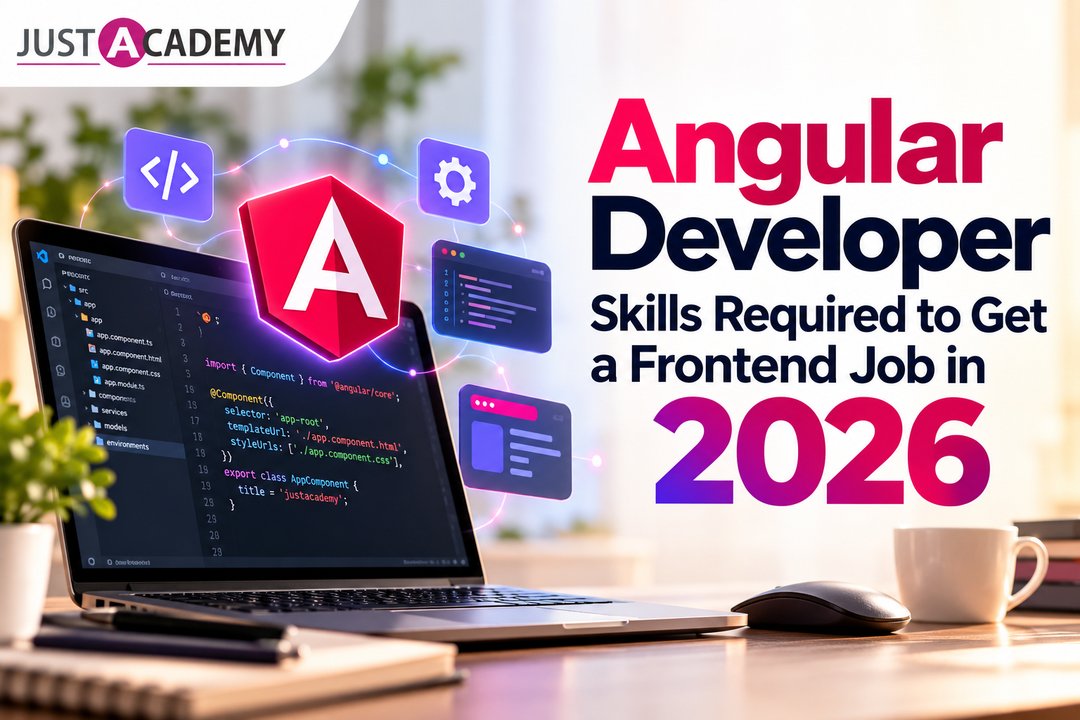
A practical, no fluff guide to the skills, tools and habits that actually turn an Angular learner into a hired front end developer
Let me start with something most blogs will not say plainly: knowing Angular syntax does not get you hired. Thousands of people finish a tutorial, build a to do list, and then wonder why recruiters never call back. The truth is that the angular developer skills companies pay for go far beyond memorising decorators. Hiring managers look for people who can read someone else's code, fix a broken build at 6 PM, explain a design decision in a stand up meeting, and ship features that do not fall apart on a slow phone in a crowded train.
This guide is written for the person standing at that gap. Maybe you are a fresher, a Python or Java developer thinking of a switch, a designer who wants to code, or a junior who feels stuck. We will walk through the exact skills employers expect for Angular roles in 2026, in the order that makes sense to learn them, along with the reasoning behind each one. For more information visit Angular JS Training in Mumbai Along the way you will see how the wider frontend development market is shaping hiring, where Angular sits next to React, and what a realistic path to your first offer looks like.
If you prefer a week by week learning plan first, our Angular developer roadmap for 2026 with skills and projects is a good companion to keep open in another tab. This article focuses on the skills themselves and why they matter to an employer.
What Hiring Managers Really Mean by Angular Developer Skills
The Frontend Job Market in 2026 and Where Angular Fits
Frontend development has quietly grown up. A few years ago, a front end web developer could get by with HTML, CSS and a sprinkle of jQuery. Today the same role often involves component architecture, API integration, automated testing, accessibility audits, performance budgets and close work with backend teams. Job posts for front end development jobs regularly list twelve or fifteen requirements, and candidates who understand how those pieces connect stand out immediately.
Angular holds a very specific place in this market. It is the framework of choice for large enterprises, banks, insurance companies, healthcare platforms, telecom firms and government portals. These organisations value structure, long term maintainability and a single opinionated way of doing things. When a company runs a dashboard with hundreds of screens and dozens of developers touching it every week, a framework with strong conventions saves real money. That is why front end developer needed postings from large service and product companies in Mumbai, Pune, Bengaluru and Hyderabad keep naming Angular so often.
Why Companies Still Bet on the Angular Framework
The Angular framework ships with almost everything a serious application needs: routing, forms, HTTP client, dependency injection, testing utilities, a command line tool and a build system. Teams do not have to debate which router or which form library to use. Google backs it, releases follow a predictable schedule, and upgrade tooling helps teams move between versions without rewriting everything.
Recent versions have also modernised the developer experience. Standalone components reduce boilerplate, signals bring a simpler reactive model, the new template control flow reads more naturally, and server side rendering with hydration has improved both speed and search visibility. A candidate who knows these newer features signals that they are current, not stuck in 2018 habits.
AngularJS Knowledge Versus Modern Angular Skills
A quick clarification, because it confuses many beginners. Angular js, also called AngularJS, is the original 1.x framework released in 2010. Modern Angular is a complete rewrite built on TypeScript and components. They share a name and a philosophy, but the code looks very different. Some legacy projects still run on the old version, and occasionally a company needs someone who can maintain them, so angularjs developer skills do have a small niche market. Still, when someone asks about skills required for angular developer roles in 2026, they mean the modern framework. If you are starting out, skip the old one unless a specific employer asks for it.
Related to that, you will sometimes see the phrase net angular in job posts. It usually points to full stack teams where the backend runs on ASP.NET Core and the frontend is Angular. Knowing how to consume a .NET API, handle JWT tokens and work with Swagger documentation makes you an easy fit for these roles even if you never write a line of C#.
The Web Foundations You Cannot Skip
HTML That Means Something
Every frontend skills list starts here, and every interviewer still checks it. Semantic HTML is not about knowing tags, it is about choosing the right one. A button should be a button, not a styled div. A navigation area should use the nav element. Forms need labels connected to inputs. When you write markup this way, screen readers work, search engines understand your page, and Angular templates stay clean.
Candidates who struggle with basic markup tend to struggle later with accessibility and testing, because everything built on top inherits the mess. If your fundamentals feel shaky, our HTML training is a sensible place to tighten them before moving on.
CSS, Bootstrap and Responsive Layouts
Here is a pattern I see constantly: a learner builds a beautiful Angular app on a laptop and then opens it on a phone and finds everything broken. Responsive design is a core part of front end programming, not an extra. You should be comfortable with flexbox, grid, media queries, relative units, custom properties and basic animation. You should also know how to debug layout problems using browser developer tools instead of guessing.
Component libraries are part of daily work too. Bootstrap remains common for quick builds and internal tools, while Angular Material is the official option for teams that want a polished, accessible set of components. Learn one properly and understand how to override its styles without fighting it. Understanding how utility classes, theming tokens and scoped component styles interact is a skill many mid level developers still lack.
JavaScript Depth Before You Touch a Framework
Angular is TypeScript, and TypeScript is JavaScript with types. So there is no shortcut around the language itself. Before you get comfortable with any web front end framework, you should understand closures, scope, the this keyword, prototypes, array methods such as map, filter and reduce, destructuring, spread and rest, modules, promises, async and await, and how the event loop decides what runs when.
Interviewers love asking about these because they reveal whether you understand what the framework is doing on your behalf. If you can explain why a callback fired late or why a variable held a stale value, you will debug faster than someone who only knows Angular syntax. A structured JavaScript course in Mumbai can help you build this base properly instead of collecting half understood tricks from random videos.
TypeScript, the Quiet Backbone of Every Angular App
Types, Interfaces and Generics
TypeScript is where Angular developer skills start to look different from general JavaScript skills. You need to be comfortable declaring types for variables and function parameters, writing interfaces that describe API responses, using union types, optional properties, enums and type guards, and applying generics to build reusable services and helpers.
Why does it matter for hiring? Because large codebases rely on types to stay understandable. When an interviewer sees that you model your data before writing components, they assume you will write safer code on their team too. Strict mode is now the norm in new projects, so practise with it turned on from day one.
Classes, Decorators and Organising Code
Angular uses classes and decorators heavily. A component, a service, a directive and a pipe are all classes with metadata attached. Understanding what a decorator does, how access modifiers work, and how to structure code into small, focused files is essential. Good Angular programmers keep components thin, move logic into services, and avoid dumping everything into one giant file.
Another helpful habit is naming things well. It sounds trivial, but a code review with a senior colleague often revolves around whether a function name explains its purpose. Clear naming is one of the cheapest ways to look experienced.
Writing TypeScript That Survives Code Review
Avoid the any type unless you truly have no choice. Use readonly where data should not change. Prefer narrow types over broad ones. Handle null and undefined explicitly. Reviewers notice these things quickly, and teams remember developers who make their lives easier. If you want your practice projects to show this discipline, publish the front end source code on GitHub with a clean structure and readable commit messages, because recruiters do open those repositories.
Core Angular Skills Every Junior Must Show
Components, Templates and Data Binding
Angular components are the building blocks of every screen you will ever ship. A component combines a class, a template and styles, and you should be able to create one from scratch, pass data into it using inputs, send events out using outputs, and explain how change detection reacts when values change.
Data binding comes in a few forms: interpolation, property binding, event binding and two way binding. Interviewers often ask when to use each and what problems appear when they are misused. Practise building small reusable pieces such as a card, a modal, a paginated table or a search box, then compose them into larger screens. This habit of thinking in components is what separates someone who has watched tutorials from someone who has built an Angular app.
Directives, Pipes and the New Control Flow
Structural directives used to be the standard way to show or hide parts of a template. Newer versions introduced a built in control flow syntax for conditions and loops, which reads more like ordinary code and performs better. You should understand both, because production codebases usually contain a mix of old and new styles during migration.
Pipes transform values in templates, for example formatting dates, currency or text. You should know the built in ones and be able to write a custom pipe. Attribute directives let you attach behaviour to elements, such as highlighting on hover or trimming input. These are small topics, yet they show up in almost every technical round.
Services, Dependency Injection and Routing
Dependency injection is one of the things people find intimidating at first, and then cannot live without. A service holds logic or data that multiple components need, and Angular's injector hands it to whoever asks. Once you understand this, testing becomes easier, code gets shorter and your architecture starts to make sense. Be ready to explain providers, injection scope and why services are usually singletons.
Routing is the second half of this section. You need to configure routes, use route parameters and query parameters, protect pages with guards, load data with resolvers, and lazy load feature areas so the initial bundle stays small. If you can describe how a user moves through your app and how the router supports that journey, you are already ahead of many applicants.
Forms and Validation
Business applications are mostly forms. Login, signup, checkout, KYC, onboarding, settings, search filters, admin panels. Angular offers template driven forms and reactive forms, and most teams prefer reactive forms for anything serious. You should be able to build a form with nested groups, dynamic fields, custom validators, async validators and clear error messages.
A quick tip from experience: build one complex form as a portfolio piece, such as a multi step registration with conditional sections. It demonstrates patience with details, which employers value more than flashy animations.
Advanced Angular Skills That Separate Mid Level From Senior
RxJS and Reactive Thinking
RxJS is the part that makes many learners nervous. It treats data as streams over time, which is a different mental model from simple variables. Angular uses it in HTTP calls, router events, form value changes and more, so you cannot avoid it for long.
Focus on the operators you will use constantly: map, filter, switchMap, mergeMap, concatMap, debounceTime, distinctUntilChanged, combineLatest, catchError and takeUntil. Understand the difference between cold and hot observables, why unsubscribing matters, and how the async pipe saves you from memory leaks. A classic interview scenario is building a search box that waits for the user to stop typing, cancels stale requests and shows loading and error states. If you can talk through that flow, you will impress most interviewers.
Signals and State Management
Signals have changed how Angular developers think about reactivity. They offer a simpler way to hold state, derive values and update the view without always reaching for observables. A modern Angular dev should know when signals are enough and when RxJS is still the better tool, for example for asynchronous event streams.
For larger applications, state management becomes a real question. Options include simple services with signals or subjects, and libraries such as NgRx or NGXS for complex, shared state. You do not need to master every library, but you should understand the problem they solve: predictable updates, a single source of truth and easier debugging. Senior front end developer interviews often include a design discussion on how you would manage state for a large dashboard.
Performance, Lazy Loading and Server Side Rendering
Performance is a feature. Users abandon slow pages, and search engines reward fast ones. As an Angular developer you should know how to use lazy loaded routes, deferrable views, OnPush change detection, trackBy style optimisations in loops, image optimisation and bundle analysis. You should also be able to read a Lighthouse report and explain what the numbers mean.
Server side rendering and hydration deserve special mention. Public facing sites, marketing pages and content heavy products need good search visibility, and rendering on the server helps with that. Knowing how to enable it, what pitfalls exist with browser only APIs, and how to measure the improvement puts you in a smaller and better paid pool of candidates.
If you are aiming for a role that goes beyond a single framework, the wider picture of in demand technology skills is worth a look, and our post on the top IT skills to learn in 2026 for high paying jobs explains how frontend skills sit alongside data, cloud and AI in the current market.
A Level by Level Skills Map From Fresher to Senior
Angular Developer Skills Required for Frontend Job Entry Roles
If you are applying for your first job, companies do not expect mastery. They expect a solid base and visible effort. For an entry level or developer front end junior role, the expected skill set usually includes HTML, CSS and responsive design, strong JavaScript fundamentals, TypeScript basics, Angular components, routing, services, template driven and reactive forms, HTTP calls with error handling, Git basics, and a couple of finished projects you can explain confidently.
What tips a decision in your favour is not a perfect answer to every question, it is how you think. If you do not know something, say how you would find out. Interviewers hire people they can teach, and honesty about gaps combined with clear reasoning goes a long way.
Angular Developer Skills Required for Frontend Job Promotions to Senior Level
Moving from mid level to senior is less about learning new syntax and more about widening your influence. Senior front end developer roles usually expect deep RxJS and signals knowledge, architecture decisions across modules, performance profiling, testing strategy, code review leadership, mentoring juniors, working with product managers on scope, and understanding how the frontend connects to APIs, authentication, caching and deployment.
Seniors are also expected to say no thoughtfully. They push back on risky shortcuts, suggest simpler solutions and document decisions so the team does not repeat old mistakes. If you want to grow in that direction, start practising these habits early, even on personal projects.
Two or three working projects with clean front end source code
Mid level
RxJS, state management, testing, performance basics, API design awareness, CI pipelines
A production style app with tests, lazy loading and role based routes
Senior
Architecture, SSR, advanced performance, mentoring, cross team communication, design systems
Case studies of decisions, migrations or systems you led
Tools, Testing and the Workflow Skills Job Posts Rarely Spell Out
Git, the Angular CLI and Browser Developer Tools
Nobody writes "must know how to resolve merge conflicts" in a job description, yet everyone expects it. Learn branching, pull requests, rebasing basics and how to write commit messages that explain why a change was made. Learn the Angular CLI well enough to generate components, run builds, serve with proxies and update dependencies.
Then get friendly with browser developer tools. Network tab for API calls, performance tab for slow rendering, application tab for storage, and the Angular DevTools extension for inspecting component trees. Developers who can diagnose problems quickly are worth more to a team than developers who type quickly.
Unit Testing and End to End Testing
Testing used to be an optional extra. In 2026 it is a hiring filter. For unit tests, understand the testing utilities Angular provides, and be comfortable with whichever runner your target company uses, whether that is Jasmine with Karma or a newer setup such as Jest or Vitest. Learn to test components, services, pipes and guards, and mock HTTP calls properly.
For end to end tests, tools like Cypress and Playwright are popular, and Selenium is still widely used in enterprise QA pipelines. Even if you never plan to become a tester, understanding how automated checks interact with your UI helps you write more testable components. If this interests you, our Selenium training in Mumbai shows how automation works from the QA side, which is surprisingly useful knowledge for a developer.
CI, CD and Working with Backend APIs
Most teams deploy through automated pipelines. You do not need to become a DevOps engineer, but you should understand what happens after you push code: linting, tests, build, deployment to a staging environment and then production. Knowing how environment files, feature flags and build configurations work will save you from embarrassing mistakes.
You also need to work comfortably with backend APIs. Read Swagger or Postman collections, understand status codes, handle authentication with tokens, deal with pagination and rate limits, and write interceptors for headers and errors. Some developers even pick up a bit of Python to write quick mock servers or automation scripts, and a Python course in Mumbai is a friendly way to add that skill without a steep learning curve.
Angular Compared With React and Other Options
Angular Versus React in Plain Language
People ask this all the time: should I learn Angular or React? The honest answer depends on the jobs you want. Angular gives you a full framework with strong conventions. React gives you a flexible library and lets you choose the surrounding tools. Neither is better in every situation.
Feature
Angular
React
Type
Full framework
UI library with a large ecosystem
Language
TypeScript by default
JavaScript or TypeScript
Learning curve
Steeper at first, more consistent later
Gentle start, decisions pile up later
Built in tools
Router, forms, HTTP, DI, testing
Chosen from third party options
Typical employers
Enterprises, banks, large product teams
Startups, product companies, agencies
Structure
Opinionated
Flexible
When Front End React Developer Roles Make Sense
If you want to work with startups, agencies or product teams that move fast and experiment often, a front end react developer path can be a strong choice. Many teams also use frontend with react alongside Node.js backends, which leads naturally into full stack work. If that sounds like your direction, the MERN Stack Developer Bootcamp in Mumbai covers React together with Node, Express and MongoDB, and our article on MERN stack developer skills companies look for in 2026 explains what employers expect on that side.
Can You Learn Both Without Getting Confused?
Yes, and many good developers do. The concepts transfer: components, state, props or inputs, routing, lifecycle, API calls. The trick is to learn one deeply first and pick up the second by mapping ideas across. Someone strong in Angular can start reading React code within a few weeks, and the reverse is also true. Being able to say in an interview that you understand both makes you more flexible, but depth in one still matters more than shallow familiarity with three.
Soft Skills, Design Sense and the Human Side of Frontend Work
Communication and Collaboration
Frontend developers sit between design, product and backend teams, which makes communication a daily skill. You will translate a designer's mock into working screens, negotiate with a backend colleague about an API response shape, and explain to a manager why a change will take two days instead of two hours. Clear, calm writing in pull requests and tickets makes you easy to work with, and easy to promote.
Working with Designers and Design Tools
A designer front end developer hybrid is a valuable profile, and even if you are not one, you should understand design handoff. Read spacing, typography and colour tokens in Figma, ask about states like hover, error and empty, and point out inconsistencies politely before they reach production. You may also hear about low code front end tools that let non developers assemble interfaces quickly. They have their place for prototypes and internal tools, but knowing real code lets you extend, debug and integrate them when the limits show up.
Accessibility and User Experience
Accessibility is not a bonus. Legal requirements, enterprise contracts and basic decency all push teams toward inclusive interfaces. Learn keyboard navigation, focus management, ARIA basics, colour contrast and how to test with a screen reader. Angular has helpful tools, such as the CDK accessibility utilities, that make this easier. Mentioning an accessibility check in your project write up tells a recruiter you think about real users.
Building a Portfolio and Resume That Earn Callbacks
Projects That Prove You Can Ship
Skip the tenth to do list. Build something with real complexity: an expense tracker with charts and filters, a job board with authentication and saved searches, a small e commerce flow with cart and checkout, or a dashboard that consumes a public API with caching and error states. Include role based routes, lazy loading, reactive forms, tests and a deployed link. Employers who scan dozens of applications love a project they can click and use in ten seconds.
Write a short case study for each one. Explain the problem, your technical choices, what went wrong, and what you would improve. That last part is powerful because it shows maturity.
GitHub, Source Code and Online Presence
Keep your repositories tidy. A clear readme with screenshots, setup steps and a feature list makes your front end source code look professional. Commit regularly rather than uploading everything in one go. A short technical post on LinkedIn about something you learned, such as how you fixed a memory leak caused by an unsubscribed observable, can attract more attention than a generic announcement.
Interview Preparation That Goes Beyond Memorising Answers
Prepare in three layers. First, concepts: change detection, lifecycle hooks, dependency injection, RxJS operators, signals, routing guards and performance. Second, practical tasks: build a small feature live, fix a bug in unfamiliar code, or refactor a messy component. Third, conversation: explain a project, describe a mistake you made and how you handled it, and ask thoughtful questions about the team's stack.
Mock interviews help enormously. Explaining things out loud exposes gaps that silent reading never does. If you can find a mentor or a trainer to run a few rounds with you, use the opportunity fully.
Why Structured Training Speeds Up Your Journey
Self learning works for some people, and there is no shame in it. But many learners lose months jumping between videos, missing prerequisites and never getting feedback on their code. Structured training fixes exactly those problems. A good programme follows a sequence, gives you assignments that reflect real work, reviews your code and prepares you for interviews.
At JustAcademy, an ISO certified technology training institute trusted by learners across India, the approach is built around live interactive sessions where you can ask questions in the moment, share your screen, and get corrections while the topic is fresh. Classroom batches run in Mumbai and Pune, while live interactive training is available online for learners anywhere in the world, so location does not decide your access to good teaching. Many students look for the best course in Mumbai because they want more than recorded lectures, and the combination of trainers with industry experience, project work and placement support is what they find valuable.
If you want to go deep on the framework itself, the Angular training in Mumbai covers components, TypeScript, RxJS, routing, forms and real projects, and learners outside the city can join the online Angular course with the same live format. If you would rather build a wider foundation across HTML, CSS, JavaScript and modern frameworks, the Front End Development Bootcamp is designed around job ready projects.
Landing a frontend job with Angular in 2026 is very achievable, but it rewards people who build a complete skill set rather than chasing one buzzword. Start with strong web foundations, get comfortable with JavaScript and TypeScript, learn the core Angular pieces properly, then grow into RxJS, signals, testing and performance. Add practical habits like Git, code reviews and clear communication, and back everything up with two or three projects you can explain without notes.
Remember that hiring managers are not looking for perfection. They are looking for someone who learns quickly, writes clean code, and works well with others. Every skill in this guide moves you closer to that picture. Pick one area today, build something small with it, and keep going. Momentum beats motivation every single time.
From your first line of JavaScript to a react native app on the Play Store and App Store, here is the honest, practical route that beginners in India can actually follow.
A practical, Pune focused guide to learning ui ux design with live, instructor led and mentor led Figma training, from your first frame to your first job offer.
A Pune learner's roadmap to picking the right tools for Selenium, building a framework from scratch, and understanding where BDD, Cypress, Playwright and Appium fit into the bigger QA picture
A practical, no fluff guide to what it actually takes to build a career as a PHP Laravel developer, written for learners in Pune who want a real answer, not a recycled one.