Why QA Automation is One of the Best Tech Careers to Pursue in India Right Now
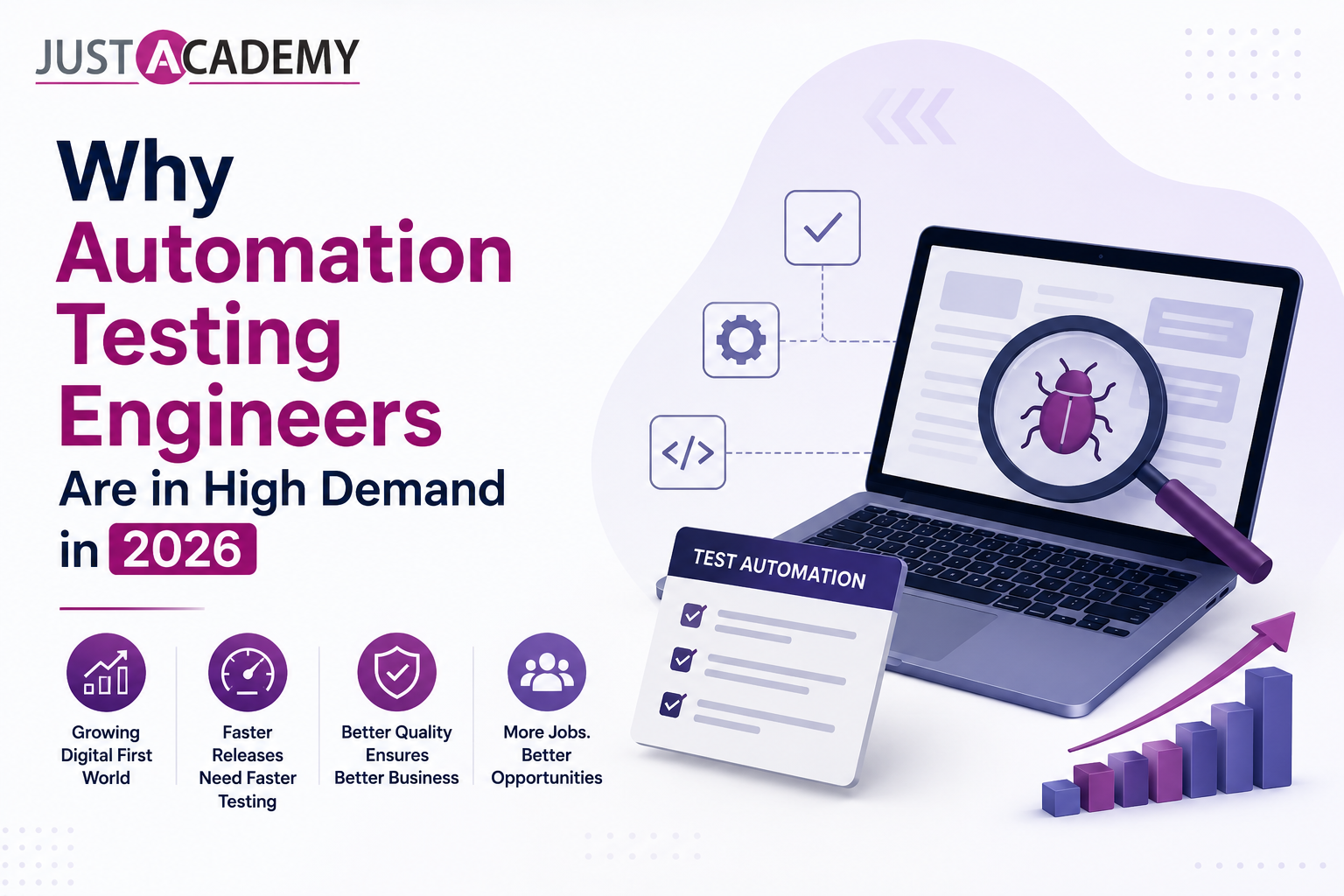
Why Automation Testing Engineers Are in High Demand in 2026
Selenium Training | Appium Training | Full Stack QA Automation Bootcamp | Register for a Free Demo | Download Brochure
India's technology sector is hiring QA automation engineers at a rate that consistently outpaces the supply of well-trained candidates. Browse any major job portal in Bengaluru, Mumbai, Pune, Hyderabad, or Chennai and you will find hundreds of open automation testing roles across banking, fintech, e-commerce, healthcare technology, and enterprise SaaS. The salaries are competitive, the entry bar for trained freshers is lower than in pure development roles, and the career growth path from junior automation engineer to senior QA lead to test architect is well-defined and consistently rewarded.
Yet many engineering graduates and working professionals either do not know that this career exists or underestimate how accessible it is. Automation testing is perceived as a narrow, technical-support type of role when in reality automation testing engineers in 2026 are software engineers who write production-quality code, architect test frameworks, integrate automation into CI/CD pipelines, and contribute strategically to how products are delivered. The role has evolved dramatically, and the job market has responded with salaries and growth opportunities that reflect that evolution.
This blog explains in detail why automation testing jobs in 2026 are among the best technology career opportunities in India, what is driving the demand, what skills the market is paying for, how the career path develops over time, and how JustAcademy's live interactive sessions in the Full Stack QA Automation Bootcamp and Selenium Training prepare freshers and career changers to enter this market with the skills employers are actually hiring for.
The Scale of Demand for Automation Testing Engineers in India
The demand for QA automation engineers in India in 2026 is not a temporary spike driven by a single industry trend. It is the result of several overlapping forces that have been building for years and show no sign of reversing.
India's digital economy has expanded dramatically across every sector. Banking and financial services companies have moved core customer journeys online, requiring continuous testing of web and mobile applications for millions of active users. E-commerce platforms process millions of transactions daily and cannot afford the reputational and financial damage of regression defects reaching production. Healthcare technology companies face both high user expectations and regulatory compliance requirements that make systematic, repeatable testing an operational necessity rather than a quality luxury. Enterprise SaaS companies serving global clients must maintain application quality across multiple browser versions, device types, and geographic deployments simultaneously.
All of these organizations share a common challenge. They release software faster than ever because competitive pressure demands it. Agile and DevOps methodologies have shortened release cycles from quarterly to monthly to weekly to daily at many companies. Manual testing cannot keep pace with this release velocity. A manual testing team that requires three weeks to complete a regression cycle cannot support a team that deploys to production twice a week. Automation testing is not an aspiration for these organizations. It is a delivery requirement.
The result is a job market where companies are competing for automation engineers rather than automation engineers competing for jobs. Entry-level roles are available consistently, mid-level roles pay significantly above market for comparable development experience, and senior automation engineers with full-stack testing expertise are among the most sought-after QA professionals in the Indian tech market.
Why Manual Testing Jobs Are Declining While Automation Jobs Are Growing
Understanding the manual testing versus automation testing career dynamic is important for anyone making career decisions in software testing in 2026. The trajectory is clear and the data supports it consistently. Manual testing roles have declined in volume, in salary growth, and in career ceiling while automation testing roles have grown in all three dimensions.
The reason is economic and operational. A manual tester can execute a fixed number of test cases per day. An automation engineer's scripts can execute thousands of test cases per hour, across multiple browsers and devices simultaneously, with perfect repeatability, at any time of day without requiring anyone to be awake and working. As automation coverage expands in an organization, the business case for large manual testing teams diminishes. The remaining manual testing work focuses on exploratory testing, usability assessment, and new feature validation before automation is written, which is high-skill, high-judgment work rather than repetitive test case execution.
This shift does not mean manual testing knowledge is worthless. Every automation testing engineer needs a solid understanding of testing fundamentals, test design techniques, defect lifecycle management, and Agile QA practices. But it does mean that manual testing as a long-term career destination, particularly for freshers entering the field in 2026, offers significantly less upside than entering automation directly. The salary ceiling for purely manual roles has compressed while the salary ceiling for automation roles has expanded, and the gap between the two continues to widen.
The Full Stack QA Automation Bootcamp at JustAcademy is designed with this market reality explicitly in mind. The curriculum builds manual testing fundamentals as a foundation and then moves directly into automation tools, frameworks, and project work, preparing freshers to enter the automation job market without spending time in a manual testing role that does not lead efficiently to their automation career goals.
What Automation Testing Engineers Actually Do in 2026
The role of an automation testing engineer in India in 2026 is substantially more technical and more strategic than the QA tester role of a decade ago. Understanding what the job actually involves is important both for deciding whether to pursue this career and for framing your preparation correctly.
Day to day, automation testing engineers write test scripts in Java or Python that automate web application testing using Selenium, API testing using REST Assured or pytest-requests, and mobile application testing using Appium. They maintain and update existing automation suites as applications evolve, which requires the ability to debug failing tests, update locators when UIs change, and refactor framework code when new patterns are needed. They integrate test suites into Jenkins or GitHub Actions pipelines so tests run automatically on every code commit and provide immediate feedback to the development team. They analyze test results, triage failures to distinguish genuine application defects from automation stability issues, and report defects with sufficient detail for developers to reproduce and fix them.
Beyond the technical work, automation engineers in Agile teams participate in sprint ceremonies, contribute to test planning discussions, write acceptance criteria alongside developers and product managers, and advise on testability considerations during design reviews. The role combines technical depth with collaborative, communicative work in a way that suits engineers who want to write code and work closely with a product team rather than doing either in isolation.
This combination of technical and collaborative skill is what JustAcademy's live interactive sessions are specifically designed to develop. Instructors bring real project experience into every session, teaching not just how to use Selenium but how to discuss your test strategy with a product manager, how to explain a defect clearly to a developer, and how to frame your automation work in terms of delivery value. These practical professional skills complement the technical content and produce engineers who are genuinely team-ready from their first day on the job.
Automation Testing Salary Trends in India 2026
Salary is a concrete measure of market demand, and the salary data for automation testing engineers in India in 2026 is one of the strongest arguments for pursuing this career. Compensation at every level has grown consistently over the last several years and continues to grow as demand outpaces supply of well-trained engineers.
Entry-level automation testing engineers with Selenium, basic API testing knowledge, and a solid understanding of TestNG and Page Object Model earn between 3.5 and 6 lakh per annum at their first role, depending on the city, company type, and depth of framework knowledge demonstrated in the interview. Engineers who can demonstrate Appium skills alongside Selenium and API testing often achieve the upper end of this range or exceed it at product companies.
Mid-level automation engineers with two to three years of experience covering CI/CD integration, cross-browser testing, mobile automation, and performance testing basics earn between 7 and 14 lakh per annum. The variance in this range reflects the difference between engineers who have deepened their skills consistently and those who have repeated similar work without growing. Engineers who build genuine full-stack testing expertise including both UI and API automation, who can architect a framework rather than just contribute to one, and who have CI/CD pipeline experience consistently reach the upper end.
Senior automation engineers and QA leads with five or more years of experience, framework architecture capability, and team leadership or mentoring responsibility earn 15 to 28 lakh per annum at product companies in Bengaluru, Mumbai, Hyderabad, and Pune. QA architects and test managers at senior positions in large enterprises and global captive centers earn above this range. The career ceiling for a technically strong, leadership-capable QA automation engineer in India in 2026 is competitive with equivalent-seniority software development roles, which represents a significant change from the perception of QA as a lower-compensation career track.
These salary ranges are accessible to freshers who invest in quality training that produces demonstrable, interview-ready skills. JustAcademy's live interactive sessions and placement assistance are designed to help freshers position themselves at the upper end of entry-level ranges by ensuring they enter interviews with real project experience, a polished GitHub portfolio, and the ability to explain their framework decisions clearly under technical questioning.
Industries Hiring Automation Testing Engineers in India in 2026
The demand for automation testing engineers is distributed across virtually every industry vertical in India's technology sector, which means QA automation skills translate across domains in a way that more narrowly specialized technical skills sometimes do not.
Banking and financial services is the single largest employer of QA automation engineers in India. Banks, NBFCs, insurance companies, and payment gateways all operate applications that require rigorous, continuous testing for both functional correctness and regulatory compliance. The combination of high stakes, complex business logic, and regulatory scrutiny makes automation testing particularly valued in this sector. Companies like TCS, Infosys, Wipro, Cognizant, and Capgemini, which serve many of India's largest financial institutions, consistently hire large numbers of automation engineers. The Full Stack QA Automation Bootcamp prepares freshers specifically for the Java-based Selenium and API testing stack that dominates in this sector.
E-commerce and retail technology is the second major hiring sector. Companies operating online marketplaces, logistics platforms, and consumer applications require automation testing to maintain quality across frequent feature releases and seasonal traffic spikes. The mobile testing requirement is particularly strong here given India's mobile-first consumer base, making Appium skills highly relevant. Mobile App Testing Using Appium Training is directly applicable to QA roles at e-commerce companies where mobile app quality is central to the product experience.
Healthcare technology, edtech, and enterprise SaaS are three growing sectors where automation testing demand is expanding faster than the industry average. Healthcare technology companies face regulatory requirements that make test documentation and repeatability critical. Edtech companies operate platforms used by millions of students across low-bandwidth and diverse device environments. Enterprise SaaS companies serve global clients across multiple geographies with strict uptime and quality SLAs. All three sectors hire automation engineers and value the full-stack testing capability covering web, API, and mobile layers.
IT service companies including TCS, Infosys, Wipro, Accenture, and HCL Technologies are among the largest employers of automation testing freshers in India and serve as the entry point for many engineers who later move to product companies. These organizations provide structured project exposure to real enterprise automation frameworks and are significant consumers of JustAcademy's placement assistance network.
Skills That Are Driving the Highest Demand in Automation Testing 2026
Not all automation testing skills are equally valued in the job market in 2026. Understanding which skills command the highest demand helps you prioritize your learning and position yourself competitively for the best roles.
Selenium WebDriver with Java remains the foundational skill assessed in the largest number of QA automation job descriptions in India. A fresher who cannot demonstrate clean, working Selenium automation with Page Object Model and TestNG is not competitive for the majority of automation roles available in the market. Selenium Training at JustAcademy builds this foundation through live interactive sessions covering the complete Selenium toolkit from element locator strategy through framework design, ensuring freshers are genuinely ready for technical assessment rather than just familiar with the concepts.
API testing with Postman and REST Assured is the second most consistently required skill in automation job descriptions and the one that freshers most often lack. Companies that have moved from manual to automation testing have simultaneously expanded their testing scope from UI-only to multi-layer coverage, and they need engineers who can test both layers. Freshers with both Selenium and REST Assured skills are significantly more competitive than those with only Selenium.
Mobile automation with Appium has moved from a specialized skill to a baseline expectation at product companies with mobile applications. India's mobile-first user base means almost every consumer-facing product company has an Android or iOS application that requires automation coverage. Mobile App Testing Using Appium Training builds this capability through live interactive sessions covering the complete Appium toolkit for both Android and iOS platforms.
CI/CD integration with Jenkins or GitHub Actions is the skill that distinguishes engineers who understand automation as a delivery engineering practice from those who think of it as a testing activity done in isolation. Companies running DevOps delivery workflows need automation engineers who can configure pipelines, interpret build failures, and maintain test infrastructure. This skill is covered in the Full Stack QA Automation Bootcamp as an integrated part of the end-to-end curriculum.
Python for automation is growing in demand, particularly at product companies and data-driven organizations. Engineers who can write pytest-based automation suites alongside or instead of Java-based frameworks are increasingly competitive. Python Training at JustAcademy delivers the Python foundation needed for automation scripting through live interactive sessions covering the language concepts most directly applicable to test framework development.
Automation Testing Career Path and Growth Trajectory
One of the most compelling aspects of the automation testing career in India in 2026 is the clarity and consistency of the growth path from entry level through senior individual contributor and into leadership roles. This defined progression makes career planning concrete and achievable in a way that less structured technical careers sometimes do not.
The entry level is the automation engineer role where you write test scripts under the guidance of a senior engineer, contribute to an existing framework, execute test suites, analyze results, and report defects. This is the role freshers enter after completing their training and building a project portfolio. The typical tenure at this level is one to two years before advancement.
The mid level is the senior automation engineer role where you design and implement new framework features, mentor junior engineers, contribute to test strategy decisions, and take ownership of entire feature areas or application layers. This is where engineers who have invested in broadening their skills beyond UI automation into API, mobile, and performance testing begin to realize substantially higher compensation.
The upper mid level is the QA tech lead or automation lead role where you architect the overall framework structure, make technology selection decisions, define team-wide standards and practices, drive CI/CD integration strategy, and represent the QA perspective in engineering-wide discussions. Engineers in this role are often the highest-compensated individual contributors in the QA function.
Senior leadership roles including QA manager, test architect, and director of quality engineering represent the strategic layer where technical depth combines with organizational leadership. Test architects design quality engineering strategies across entire product portfolios. QA managers lead teams of ten to fifty engineers across multiple product areas. Directors of quality engineering own the quality function at an organizational level.
The journey from fresher entry level to senior leadership typically spans eight to twelve years at normal progression, or faster for engineers who deliberately build multi-layer testing expertise, take ownership beyond their assigned scope, and develop the communication and leadership skills that advancement into management requires. JustAcademy's live interactive sessions build both the technical depth and the professional communication skills that this trajectory requires from the foundation upward.
How Freshers Can Enter the Automation Testing Job Market in India
The practical question for a fresher considering an automation testing career is not whether the market exists or whether it pays well. It is how to enter it with the combination of credentials, skills, and portfolio evidence that converts training into job offers.
The entry path for freshers in 2026 has two components. The first is skill development covering the core automation testing stack of Selenium with Java or Python, API testing, Appium, Git, and CI/CD fundamentals. The second is portfolio development producing three to five GitHub-hosted automation projects that demonstrate those skills in practice across realistic application scenarios.
Neither component is sufficient without the other. Skills without portfolio evidence require the interviewer to take your word that you can apply them. Portfolio evidence without genuine understanding behind it fails as soon as an interviewer asks you to explain your design decisions in depth. The combination of live interactive training that builds genuine understanding alongside structured project work that produces demonstrable evidence is what JustAcademy's programs are specifically designed to deliver.
The placement assistance component of JustAcademy's bootcamp programs connects trained graduates with companies actively hiring through an employer network that has been built over years of placing automation engineers into roles across India's major tech hubs. For freshers who do not have an existing industry network, this placement connection is often the difference between spending months applying through job portals and receiving targeted interview opportunities with companies that already trust the training quality.
Related training programs at JustAcademy that build the complete automation career skill set include:
- Selenium Training — the most comprehensive live interactive Selenium WebDriver program for freshers, covering everything from basic browser automation through advanced POM framework design
- Mobile App Testing Using Appium Training — live interactive Appium training covering Android and iOS mobile automation alongside web testing skills
- Core Java Training — Java programming fundamentals for freshers who need the programming foundation for Selenium and REST Assured automation
- Advance Java Training — deeper Java knowledge for engineers building enterprise automation frameworks
- Python Training — live interactive Python training for freshers pursuing the Python automation testing path with pytest and Robot Framework
- JavaScript Training — JavaScript fundamentals for engineers exploring Cypress or Playwright testing tools
- React JS Training and Angular Training — frontend framework knowledge that deepens your understanding of the applications you automate
- Microsoft Power BI Training — data visualization skills applicable to QA metrics reporting and test analytics dashboards
- Full Stack Java Developer Bootcamp — for automation engineers who want to expand into full stack development alongside their testing expertise
- MERN Stack Developer Bootcamp — for engineers exploring full stack development as a complement to their automation expertise
Top Cities in India Hiring Automation Testing Engineers in 2026
Geography matters when planning a QA automation career in India because hiring density, salary levels, and industry mix vary significantly across cities. Understanding the market in each major tech hub helps freshers make informed decisions about where to target their job search.
Bengaluru is India's largest market for automation testing jobs, driven by its concentration of global product companies, unicorn startups, and major IT service company delivery centers. Automation testing salaries in Bengaluru are among the highest in India and the variety of company types gives engineers the opportunity to choose between the stability of large enterprises and the growth potential of product startups. The mobile testing market in Bengaluru is particularly strong given the concentration of consumer technology companies.
Hyderabad is the second largest QA automation market in India, driven by a strong IT services sector and a growing product company ecosystem. The Microsoft, Amazon, and Google engineering presence in Hyderabad has contributed to a product engineering culture that values automation testing quality. Salaries are competitive with Bengaluru for equivalent experience levels and the cost of living differential makes Hyderabad attractive for early career engineers.
Pune is a major market particularly for IT services companies and automotive technology firms. The presence of companies like Infosys, Wipro, Cognizant, and a strong fintech ecosystem makes Pune one of the most consistent hiring markets for automation testing freshers in India. The proximity to Mumbai increases the effective job market for engineers willing to commute or relocate.
Mumbai is the primary market for banking and financial services automation testing roles. The concentration of India's banking sector headquarters, insurance companies, and fintech startups in Mumbai creates consistent demand for automation engineers with knowledge of financial application testing. JustAcademy's Mumbai classroom programs are particularly well-positioned to connect freshers with this specific segment of the Mumbai hiring market through local industry relationships.
Chennai has a strong IT services sector with major delivery centers for TCS, Infosys, Wipro, and Cognizant alongside a growing product company ecosystem. The automotive technology and manufacturing software sector in Chennai adds domain diversity to the QA automation job market there.
Why QA Automation Is a Future-Proof Career in India
A common concern among freshers evaluating technology career options in 2026 is whether a skill or role will remain relevant given the pace of change in the technology industry, including the impact of AI-driven tools on software testing. The evidence strongly supports QA automation engineering as a future-proof career choice for several reasons.
AI-assisted code generation tools have increased developer productivity and simultaneously increased the volume of code that requires testing. More code written faster means more testing required, not less. AI testing tools that generate test cases or identify test scenarios augment automation engineers' productivity but require engineers who understand what makes a good test, how to evaluate AI-generated test coverage, and how to maintain and debug the resulting automation. These are skills that automation engineers trained in testing fundamentals and framework design possess and that purely AI-generated testing cannot replace.
The complexity of modern application architectures including microservices, serverless functions, event-driven systems, and distributed databases creates testing challenges that require human engineering judgment about what to test, how to structure the test environment, and how to interpret results. An automation engineer who can design a testing strategy for a microservices application, select the appropriate testing tools for each layer, and implement the framework that executes it is performing genuinely complex engineering work that is not threatened by automation in the same way that repetitive manual test execution is.
The regulatory environment for software in financial services, healthcare, and government is tightening rather than relaxing. SEBI regulations, RBI guidelines for financial technology applications, and healthcare data protection requirements all create compliance-driven testing obligations that organizations must fulfill through documented, repeatable, auditable testing processes. Automation engineering that produces the evidence trail required for regulatory compliance is a structural requirement in these sectors rather than a cost-optimization choice.
QA Automation Career Compared to Other Tech Roles for Freshers
Comparing QA automation to other technology career paths available to freshers in India helps position the career choice in context. The relevant comparisons are with software development, data analysis, and business analysis.
Compared to software development, QA automation engineering has a lower entry bar for freshers because it does not require the full stack of algorithms, data structures, system design, and development framework knowledge that development interviews assess. A fresher who has completed six months of structured automation training with a solid project portfolio can compete for entry-level QA automation roles. The equivalent investment in software development preparation typically takes longer to reach interview-readiness for mid-tier product companies. The salary at entry level is comparable and the growth trajectory is slightly less steep for QA than for high-performing developers at top product companies, but the consistency and accessibility of the entry path makes automation engineering the right choice for engineers who want a reliable, well-paying technology career without the extreme competitiveness of top-tier development hiring.
Compared to data analysis, QA automation engineering offers more clearly defined technical skills, a more accessible entry path without requiring statistics and machine learning knowledge, and a wider distribution of job opportunities across industry sectors. Data analysis skills are valuable but the job market is more concentrated in specific sectors and requires a different foundation of analytical and statistical knowledge.
The Full Stack QA Automation Bootcamp gives freshers a complete, structured path into the automation testing career that optimizes for the combination of time to first job offer, starting salary, and long-term growth potential. The live interactive sessions format ensures that every module of the curriculum produces genuine, demonstrable skills rather than passive familiarity, and the placement assistance component ensures that those skills reach the employers who are actively hiring.
Top Tools Every Automation Testing Engineer Should Know in 2026
Knowing the current tool landscape is important both for effective career preparation and for demonstrating currency in interviews where interviewers assess awareness of modern testing practices. The essential tool stack for an automation testing engineer in India in 2026 covers several layers.
At the web automation layer, Selenium WebDriver 4 is the industry standard for browser-based UI testing. Playwright and Cypress have gained significant adoption at product companies for their speed and reliability but Selenium remains the dominant tool in enterprise environments. At the mobile automation layer, Appium with UiAutomator2 for Android and XCUITest for iOS is the standard framework for native, hybrid, and mobile web application testing. At the API testing layer, Postman handles manual exploration and collection-based automation while REST Assured in Java and the requests library in Python handle code-integrated API test suites. At the performance testing layer, Apache JMeter is the most widely deployed tool in Indian enterprises. At the CI/CD layer, Jenkins and GitHub Actions are the two most commonly referenced tools in QA automation job descriptions.
For version control, Git with GitHub is universal and a well-maintained GitHub profile is the primary portfolio artifact for QA automation freshers. For test reporting, ExtentReports and Allure are the standard choices for Java-based frameworks. For project and build management, Maven is the standard Java build tool. For language, Java 11 or 17 and Python 3.10 or later are the current production versions most relevant to automation work.
Frequently Asked Questions About Automation Testing Career in 2026
Is automation testing a good career for freshers in India in 2026?
Yes, consistently and specifically. Automation testing is one of the most accessible high-paying technology careers for freshers in India in 2026. It does not require a computer science degree, has a clearly learnable and demonstrable skill set, offers competitive entry-level salaries between 3.5 and 6 lakh per annum at the first role, and has a defined growth path to senior roles with substantially higher compensation. The demand for trained automation engineers consistently exceeds supply, which creates favorable hiring conditions for freshers who enter the market with genuine, demonstrable skills built through quality live interactive training programs.
How long does it take to become job-ready in automation testing?
Most dedicated freshers reach job-ready proficiency in QA automation in four to six months through a structured live interactive training program that covers the complete automation stack from manual testing fundamentals through Selenium, API testing, Appium, and CI/CD integration. This timeline assumes consistent participation in live interactive sessions, active project work throughout the training, and deliberate interview preparation including mock technical interviews and GitHub portfolio development. Self-study without structured live interactive sessions typically takes longer because there is no expert feedback to prevent incorrect patterns from developing, and the lack of real project guidance produces portfolios that work technically but do not reflect professional standards.
What is the difference between QA automation and software development as a career?
QA automation engineering focuses on designing and implementing systems that verify software behaves correctly, using programming skills in service of testing and quality objectives. Software development focuses on building the application features that QA automation then verifies. Both require programming proficiency, both work collaboratively in Agile teams, and both produce code that lives in version-controlled repositories and runs in CI/CD pipelines. The key differences are in interview preparation requirements, where QA automation interviews focus on testing concepts and framework design while development interviews include algorithms, data structures, and system design. Entry path accessibility for freshers also differs, with QA automation requiring less preparation time to reach interview-readiness for most roles. Many engineers move between development and QA automation roles throughout their careers, and some senior QA architects have backgrounds that include both development and QA phases.
Which programming language should I learn for automation testing in India?
Java is the most widely used language for automation testing in India and the language that gives you the widest coverage across enterprise job descriptions, particularly in banking, IT services, and large product companies. Python is growing in popularity particularly at product startups, data-driven companies, and organizations that prefer Python's cleaner syntax and faster scripting capability. If you have no existing programming background, either language is learnable in the time frame relevant to QA automation. If you have Python exposure from engineering coursework, building on that foundation is more efficient. JustAcademy offers live interactive sessions in both Core Java Training and Python Training so you can choose based on your background and target companies.
Can I transition from manual testing to automation testing?
Yes, and the manual to automation transition is one of the most common and well-supported career moves in the Indian software testing industry. Manual testers already have testing fundamentals, domain knowledge, defect reporting skills, and Agile workflow experience that gives them an advantage over freshers starting from zero. What the transition requires is programming language proficiency and hands-on automation framework experience, both of which are built through structured live interactive training. The Full Stack QA Automation Bootcamp is designed to serve both freshers and manual testers making this transition, covering the technical automation skills in a structured sequence that builds on testing knowledge the manual tester already has.
Conclusion
The demand for automation testing engineers in India in 2026 is structural, sustained, and growing. It is driven by the irreversible shift toward continuous delivery in software development, the expansion of India's digital economy across sectors that require rigorous and continuous testing, the declining viability of manual testing for regression coverage at modern release velocities, and the growing recognition that QA automation engineering is a full software engineering discipline that deserves and commands engineering-level compensation.
For freshers and career changers evaluating technology career options, automation testing offers a compelling combination of accessible entry, competitive compensation, defined growth trajectory, and long-term resilience. The skill set is learnable, the tools are accessible for free practice, and the market need is real and consistently documented in job posting volumes and salary data across India's major tech cities.
The fastest and most reliable path into this career is live interactive training with experienced instructors who build both the technical skills and the project portfolio evidence that the job market requires. JustAcademy's Selenium Training, Mobile App Testing Using Appium Training, and Full Stack QA Automation Bootcamp deliver exactly this combination through live interactive sessions with placement assistance that connects trained graduates to employers actively hiring across India's major technology markets.
For freshers in Maharashtra, JustAcademy's Mumbai classroom programs combine the live interactive learning format with local industry placement connections in India's financial capital. For learners across India and globally, the same expert-led live interactive curriculum is available online with the same depth of instruction and placement support from wherever you are studying.
Register for a Free Demo to experience JustAcademy's live interactive sessions firsthand and speak with an advisor about the right program for your background, city, and career goals, or Download the Brochure to review the full curriculum, batch schedules, and fees at your own pace.
The Scale of Demand for Automation Testing Engineers in India
Why Manual Testing Jobs Are Declining While Automation Jobs Are Growing
What Automation Testing Engineers Actually Do in 2026
Automation Testing Salary Trends in India 2026