I am learning flutter from JustAcademy, They provide very much great environment where people gather and work simultaneously. totally project based training institute.
MOHD ABU BAKAR ANSARI
Flutter Developer
Awesome Experience. I am a Front-end Web Designer working at Star India for 3 years now. I applied for Full-stack development and my experience has been phenomenal & they really do help with placements exceptionally. Thank you Roshan sir so much.
Java backend developers in India who want to call themselves full stack engineers in 2026 face a genuine decision point that is easy to underestimate: which frontend framework should they actually invest months of learning into. The Java backend side of the decision is largely settled, with Spring Boot as the near-universal default for REST API development, but the frontend landscape offers React, Angular, and Vue as three legitimate, widely used options, each with different learning curves, different job market demand, and different levels of natural fit with a Java backend developer's existing mental model.
This blog compares React, Angular, and Vue specifically through the lens of a Java backend developer deciding what to pair with their Spring Boot skills, covering the technical fit of each framework with Spring Boot REST APIs, the learning curve relative to Java developer backgrounds, the job market demand for each combination in India, and practical guidance for getting started. Whether you are learning through the best course in Mumbai with offline classroom training or through live interactive online sessions, this guide gives you the clarity to choose confidently rather than guessing.
Why Java Backend Developers Need a Frontend Framework in 2026
The Shift From Backend Specialist to Full Stack Engineer
The job market for pure backend-only Java developers has narrowed in India over the past several years as companies increasingly prefer full stack engineers who can own a feature end to end without requiring a separate frontend specialist for every change. This shift is driven by smaller, more efficient product teams at startups and product companies who value versatility, the rise of microservices architectures where backend teams frequently need to build admin dashboards and internal tools without dedicated frontend support, and the simple economic reality that a developer who can work across the stack is more valuable and more employable than one who can only work on half of it. For a Java backend developer in 2026, learning a frontend framework is no longer an optional specialization but close to a baseline expectation for the most competitive full stack roles at product companies and GCCs in Mumbai, Bengaluru, and Pune.
How a Frontend Framework Changes What You Can Build
Without frontend framework knowledge, a Java backend developer can build and expose REST APIs but depends entirely on someone else to build the interface that end users actually interact with. With frontend framework proficiency added to Spring Boot skills, the same developer can build the complete application, from the database schema and REST API through the user interface that consumes it, independently. This completeness is what client-facing service companies, startups building MVPs quickly, and product teams practicing full ownership of features specifically value, and it is the single biggest driver of the salary premium that full stack Java developers command over backend-only specialists in the Indian job market.
React, Angular, and Vue Compared for Spring Boot Integration
React: The Most In-Demand Choice for Java Full Stack Roles
React, developed and maintained by Meta, is a JavaScript library for building user interfaces through composable, reusable components. It has the largest job market demand among all frontend frameworks in India in 2026, and the MERN stack combination along with the Java backend plus React combination are both extremely common pairings in product company job descriptions. React's component-based architecture maps reasonably well to a Java developer's existing object-oriented thinking, since a React component is conceptually similar to a class that encapsulates its own state and renders output based on that state, though the functional programming style of modern React using Hooks requires some adjustment from Java's more imperative, object-oriented conventions.
For Spring Boot integration specifically, React communicates with the backend purely through REST API calls using libraries like axios or the native fetch API, with no built-in opinion about how the backend should be structured, which makes it a clean, decoupled pairing with any Spring Boot REST API regardless of how that API itself is architected. React's flexibility means there is no single correct way to structure a React application, which gives experienced developers freedom but can make the learning curve for complete beginners somewhat less structured than Angular's more opinionated approach. The React ecosystem in 2026 commonly pairs with React Router for navigation, and either built-in state management through useState and useContext for simpler applications or Redux Toolkit for more complex state requirements, all of which a Java backend developer learns as additive pieces rather than a single monolithic framework to master at once.
Angular: The Most Structured Choice With Java-Like Conventions
Angular, developed and maintained by Google, is a complete, opinionated framework rather than a library, providing built-in solutions for routing, state management, form handling, dependency injection, and HTTP communication as part of the framework itself rather than requiring separate libraries to be chosen and integrated. Angular is written in TypeScript by default, which is a statically typed superset of JavaScript, and this static typing combined with Angular's heavy use of decorators, dependency injection, and class-based component definitions produces a development experience that frequently feels more immediately familiar to Java developers than React's more loosely structured, JavaScript-native approach.
Angular's dependency injection system in particular closely mirrors Spring's dependency injection conventions that Java developers already know from building Spring Boot applications, with Angular services being injected into components in a pattern directly analogous to how Spring beans are injected into controllers and other Spring-managed components. Angular's built-in HttpClient module for making API calls integrates naturally with Spring Boot REST endpoints, and Angular's strict TypeScript typing pairs well with strongly typed Java backend development in terms of overall development discipline and project structure conventions. The trade-off is that Angular has a steeper initial learning curve than React because there is simply more framework-specific concept and API surface to learn before becoming productive, even though much of that learning curve overlaps conceptually with patterns Java developers already understand from Spring.
Vue: The Gentlest Learning Curve With Growing Adoption
Vue, created by Evan You and maintained by an independent open-source community, occupies a middle ground between React's flexibility and Angular's structure, providing a complete framework with built-in routing through Vue Router and state management through Pinia, while maintaining an approachable, gradual learning curve that many developers find easier to pick up quickly than either React or Angular. Vue's template syntax, which closely resembles standard HTML with added directives, tends to be the most immediately readable of the three frameworks for developers coming from a backend or non-frontend-specialized background, including many Java developers who have had limited prior exposure to modern JavaScript frontend development patterns.
For Spring Boot integration, Vue communicates with the backend through REST calls in the same straightforward way as React, using axios or fetch with no particular opinion about backend architecture. Vue's job market demand in India in 2026 is meaningfully smaller than React's and somewhat smaller than Angular's in the enterprise Java segment specifically, which is an important practical consideration even though Vue's technical merits and developer experience are well regarded. Vue tends to appear more often at startups and smaller product teams who chose it for its developer-friendliness rather than at the large enterprise Java shops and GCCs where Angular has stronger historical adoption.
Side-by-Side Comparison for Java Developers
Factor
React
Angular
Vue
Learning curve for Java developers
Moderate
Lower due to DI familiarity
Lowest overall
Job market demand in India
Highest
High in enterprise and BFSI
Moderate, growing
Language
JavaScript or TypeScript
TypeScript by default
JavaScript or TypeScript
Built-in features
Minimal, library-based
Comprehensive, batteries-included
Comprehensive, lightweight
Best paired with
Startups, product companies, MERN/Java-React
Enterprise Java, BFSI, large teams
Startups, smaller product teams
Spring Boot integration
REST via axios/fetch, fully decoupled
REST via HttpClient, fully decoupled
REST via axios/fetch, fully decoupled
How to Choose the Best Frontend Framework for Your Java Career Path
Choose React If You Want the Widest Range of Job Opportunities
If your primary goal is maximizing the total number of full stack job opportunities available to you in India's job market in 2026, React combined with a Spring Boot backend is the safest and most broadly applicable choice. React's dominant market share means the largest number of full stack Java developer job postings specifically mention React as the expected frontend skill, spanning startups, mid-size product companies, and many enterprise teams that have adopted React over the past several years even in traditionally Angular-heavy organizations. Learning React also keeps a path open toward the MERN stack and Node.js-based roles if your career interests evolve, since the React skill itself transfers completely regardless of which backend technology it is paired with.
Choose Angular If You Are Targeting Enterprise Java and BFSI Roles Specifically
If you know you want to work specifically in enterprise Java environments, particularly banking, insurance, and large GCC technology teams in Mumbai and other Indian cities where Java has the deepest historical entrenchment, Angular remains a strong and often preferred choice in these specific environments. Many large enterprise technology organizations standardized on Angular during the years when it was the dominant choice for enterprise frontend development, and these organizations frequently continue hiring for Angular skills to maintain and extend existing systems even as React has gained ground elsewhere. Angular's structured, opinionated nature and its conceptual overlap with Spring's dependency injection patterns also make it a genuinely comfortable technical fit for Java developers who want their frontend development experience to feel as similar as possible to the architectural patterns they already know from Spring Boot.
Choose Vue If You Are Prioritizing Fastest Time to Productivity
If your primary constraint is time, meaning you need to become productive in a frontend framework as quickly as possible to complete a specific project, pass an upcoming interview, or contribute to a startup environment that already uses Vue, its gentler learning curve makes it the fastest framework to reach basic productivity with for most Java developers. The trade-off of choosing Vue purely for its learning speed is that it narrows your addressable job market somewhat compared to React or Angular, so this choice makes the most sense either as a genuinely interest-driven preference, when you are already targeting a specific company or team that uses Vue, or as a stepping stone toward understanding modern component-based frontend concepts before later adding React or Angular to your skill set with that foundational understanding already in place.
Why Learning One Framework Deeply Beats Learning Multiple Superficially
A common mistake among Java developers exploring frontend frameworks is attempting to learn React, Angular, and Vue simultaneously or in quick succession without building genuine depth in any of them. Employers and interviewers can distinguish quickly between a candidate who has built one or two complete, well-structured applications with a single framework and genuinely understands its component lifecycle, state management approach, and routing, versus a candidate who has completed introductory tutorials in all three frameworks without building real depth in any of them. The stronger interview and job performance strategy is choosing one framework based on the considerations above, building genuine project depth with it, and only adding a second framework later if a specific job opportunity or genuine interest justifies the additional investment.
Getting Started: Connecting Your Chosen Frontend Framework to Spring Boot
The Universal Pattern: REST API as the Contract Between Frontend and Backend
Regardless of which frontend framework you choose, the integration pattern with a Spring Boot backend follows the same universal architecture. The Spring Boot application exposes REST endpoints using @RestController classes that return JSON responses, configured with appropriate CORS settings to allow requests from the frontend application's origin during development and in production. The frontend framework, whether React, Angular, or Vue, runs as a completely separate application, typically on a different port during local development, and makes HTTP requests to the Spring Boot backend's REST endpoints to retrieve and submit data. This separation of concerns, where the frontend and backend are independently deployable applications communicating purely through a well-defined REST API contract, is the standard architecture for modern Java full stack applications and is identical in principle regardless of which specific frontend framework is chosen.
Setting Up CORS in Spring Boot for Local Frontend Development
During local development, the frontend application typically runs on a port like 3000 for React or Vue, or 4200 for Angular, while the Spring Boot backend runs on port 8080, meaning every request from the frontend to the backend is a cross-origin request that the browser will block unless the backend explicitly allows it. Configuring a CORS policy in Spring Boot, either through a @CrossOrigin annotation on specific controllers for simple cases or through a global CorsConfigurationSource bean for more comprehensive control, specifying the allowed origin as the frontend's local development URL, is the first integration step every Java developer encounters regardless of which frontend framework they have chosen, and is frequently the first point of confusion for developers integrating a frontend framework with Spring Boot for the first time.
Making Your First API Call From Each Framework
The mechanics of making an API call differ slightly in syntax between the three frameworks but follow the identical underlying pattern of sending an HTTP request and handling the JSON response. In React, this typically uses the axios library or the native fetch API within a useEffect hook to call the Spring Boot endpoint when a component mounts, storing the resulting data in component state using useState to trigger a re-render once the data arrives. In Angular, this uses the built-in HttpClient module injected into a service through Angular's dependency injection system, with the service method returning an Observable that a component subscribes to in order to receive and display the data, following RxJS reactive programming patterns that Angular relies on extensively. In Vue, this uses axios or fetch within a component's lifecycle hook or a Composition API setup function, storing the resulting data in a reactive ref that automatically updates the template when the data changes. Once a Java developer has successfully made this first API call and rendered the returned data in their chosen framework, the remaining frontend development largely involves applying the same pattern repeatedly across the application's different features and screens.
Building Authentication Flow Between the Frontend and Spring Boot Security
A common next step after basic API integration is implementing authentication, where the frontend collects login credentials, sends them to a Spring Boot authentication endpoint secured with Spring Security and JWT, receives a token in response, and stores that token to include in the Authorization header of all subsequent API requests. This pattern is conceptually identical across React, Angular, and Vue, differing only in framework-specific mechanisms for storing the token, typically in memory within application state for security reasons rather than localStorage, and for attaching it automatically to outgoing requests, whether through an axios interceptor in React or Vue or an Angular HTTP interceptor that implements the same automatic header attachment behavior in Angular's idiomatic style.
Why JustAcademy Recommends Pairing Java With Both React and Angular Skills
JustAcademy's full stack Java curriculum specifically offers both React and Angular training because the Indian job market genuinely rewards different framework choices depending on the specific employer segment a developer targets, and because understanding the comparative reasoning in this guide, rather than picking arbitrarily, produces better-informed career decisions. For developers prioritizing maximum job market breadth and startup or product company opportunities, React JS Training in Mumbai and React JS Online Training build the most broadly demanded full stack combination with Java. For developers specifically targeting enterprise Java, BFSI, and large GCC environments, Angular Training in Mumbai and Angular Online Training build the combination that aligns most naturally with established enterprise Java hiring patterns.
Both programs are delivered through live interactive sessions with real-time instructor guidance, real project development where students build complete applications connecting their chosen frontend framework to a Spring Boot backend, and placement support tailored to the Indian full stack Java job market. For professionals and freshers in Maharashtra who prefer hands-on classroom learning, these courses are widely recognized as the best courses in Mumbai for building genuinely job-ready full stack Java skills. For learners anywhere in India or globally, the online versions deliver the same fully live and interactive curriculum with placement support from any location.
For learners who want the complete, structured path combining Java backend mastery with frontend framework integration in a single comprehensive program:
There is no single universally correct answer to which frontend framework a Java backend developer should learn, because the right choice genuinely depends on which segment of the job market you are targeting, how much time you have to build depth, and your personal learning preferences. React offers the broadest job market reach and pairs naturally with Spring Boot through simple REST API consumption. Angular offers the most structurally familiar experience for Java developers because of its dependency injection model that mirrors Spring's own conventions, and remains strongly preferred in enterprise Java and BFSI hiring specifically. Vue offers the gentlest learning curve for developers who need to become productive quickly, with a smaller but genuinely real job market presence in India's startup and product company segment.
The decision that matters most is not which of these three frameworks is objectively best, since all three are legitimate, widely used, production-proven choices, but committing to building genuine depth in one of them through real project work rather than spreading effort thinly across all three. A Java backend developer who has built one complete, well-structured full stack application with React, Angular, or Vue, and can explain its architecture and the reasoning behind their technical decisions confidently in an interview, is significantly more competitive than one who has superficial exposure to all three without depth in any.
Register for a Free Demo to experience the training firsthand and discuss which frontend framework best fits your Java full stack career goals with an advisor, or Download the Brochure to review the full curriculum, project details, and batch schedules before you enroll.
Why Java Backend Developers Need a Frontend Framework in 2026
React, Angular, and Vue Compared for Spring Boot Integration
How to Choose the Best Frontend Framework for Your Java Career Path
Getting Started: Connecting Your Chosen Frontend Framework to Spring Boot
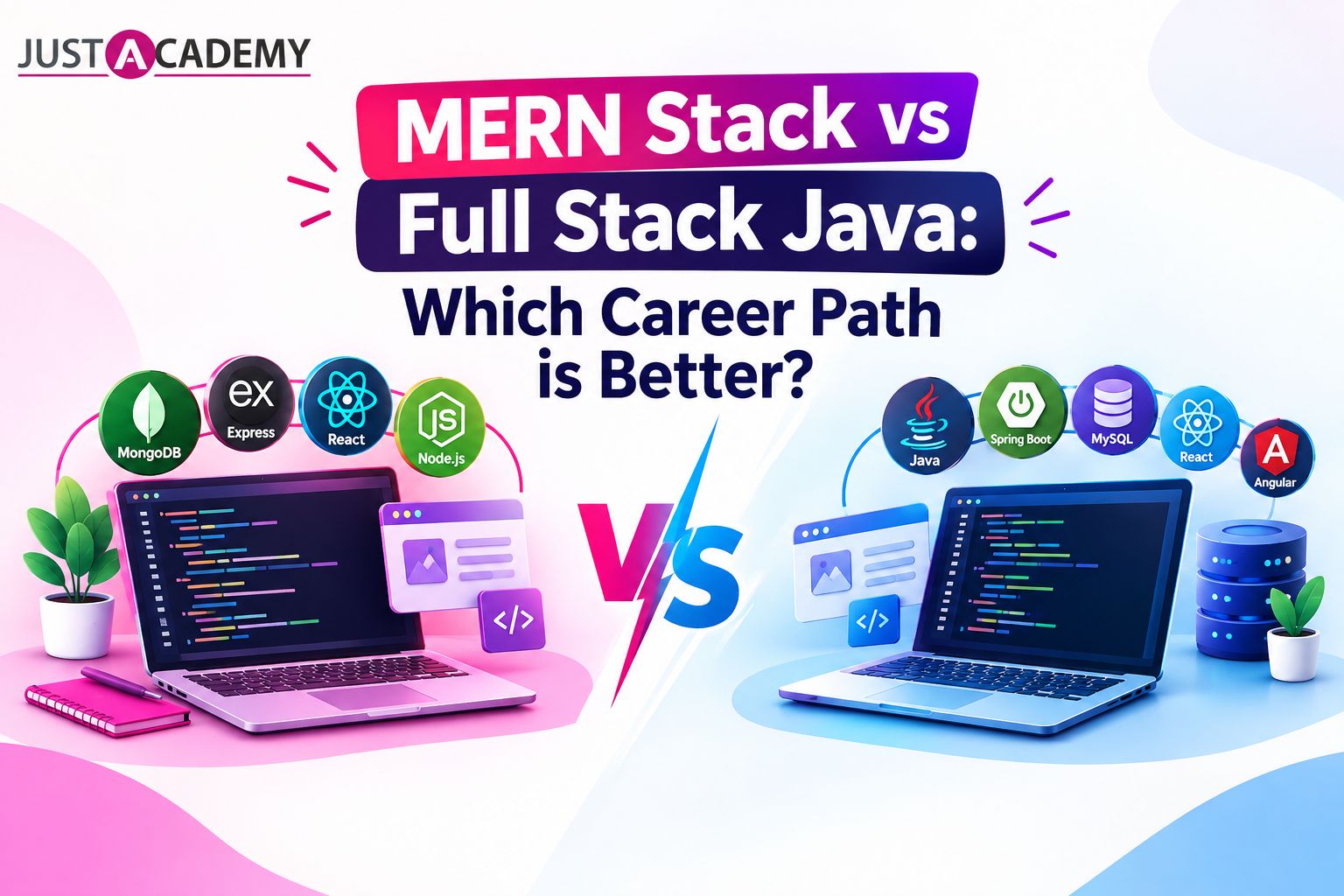
A practical comparison for Pune based learners choosing between MERN and Java full stack development, covering salary, learning curve, job roles, and long term career growth.