I am learning flutter from JustAcademy, They provide very much great environment where people gather and work simultaneously. totally project based training institute.
MOHD ABU BAKAR ANSARI
Flutter Developer
Awesome Experience. I am a Front-end Web Designer working at Star India for 3 years now. I applied for Full-stack development and my experience has been phenomenal & they really do help with placements exceptionally. Thank you Roshan sir so much.
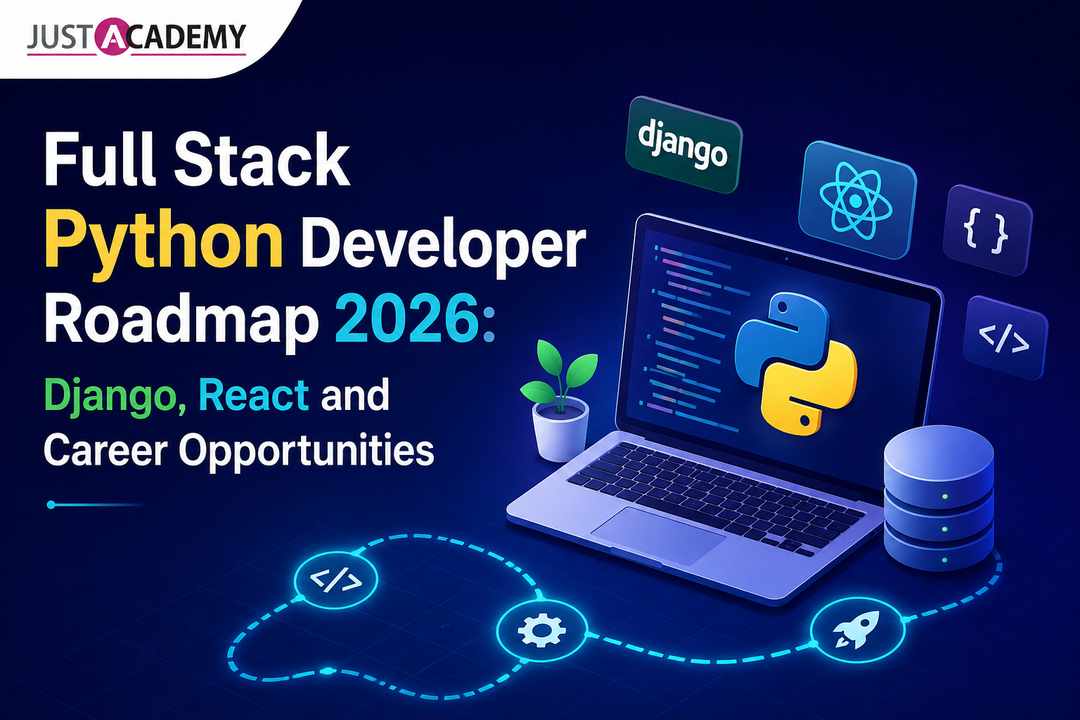
A Practical Guide to Becoming a Job Ready Python Full Stack Developer with Django, React and JavaScript
Ask ten developers how they ended up building web applications for a living and a good chunk of them will tell you a version of the same story. They started with python because it looked readable, stuck with it because it worked, and then one day realized that knowing python alone was not going to get them hired for the kind of role they actually wanted. That is usually the point where django and react enter the picture, and where the phrase python full stack course starts showing up in every second search they run. If that sounds like where you are right now, this guide walks through exactly what that journey looks like in 2026, without the fluff.
Before getting into the roadmap properly, it is worth mentioning something practical. Reading about django is one thing, actually building with it under someone's guidance is another, and the gap between the two is where most learners get stuck. JustAcademy runs a full stack python developer bootcamp in Mumbai that covers Django, React and real project work through live interactive sessions, and there is a free demo class you can register for if you want to see how a session actually feels before signing up for anything. Nobody expects you to commit on the first click, and honestly a single trial class tells you more than any amount of reading ever will.
With that out of the way, let us get into the actual roadmap.
Why Another Roadmap When So Many Already Exist
Most guides on this topic fall into one of two traps. Either they stay so surface level that you finish reading and still do not know what to do on Monday morning, or they get so technical they read like framework documentation rather than something written for a human being figuring out their next move. This one is written for the person who has already decided python and web development interest them, and now just needs a clear, honest sequence to follow, including where django fits, where react fits, what a python full stack developer salary in India realistically looks like, and which mistakes quietly waste the most time.
What a Python Full Stack Developer's Job Actually Looks Like in 2026
It helps to understand the destination before mapping the route, so let us start with what this role actually involves once you are hired.
Backend Work in Practice
A python full stack developer spends a meaningful chunk of their week inside django, writing the logic that powers an application behind the scenes. This covers database models, authentication flows, background processes and the API layer that everything else depends on. Django backend responsibilities go well beyond writing a view function, they extend into thinking about how the system behaves under real usage, where the security gaps might be, and how cleanly data moves from the database to whatever is consuming it.
Frontend Work in Practice
The other half of the job lives in html, css, javascript and react js. A django full stack developer in 2026 is almost never hired purely for backend skill anymore, since companies want someone who can jump into a react component and fix a rendering bug just as comfortably as they can tune a django rest api. That range is precisely why full stack hires tend to earn more than developers confined to one side of the stack, since a single person is effectively covering two roles.
How Django and React Actually Talk to Each Other
This is the part that defines the python django react stack as a concept. Django owns the data, the business rules and the server side security, while react owns the interactive interface a user actually clicks around in. They exchange information through APIs, most commonly built with django rest framework, which converts python data into JSON that react can read and display. Once this exchange clicks for you, everything else on this roadmap becomes a matter of going deeper into one side or the other.
What a Typical Debugging Session Looks Like
Picture a support ticket that says a form is not saving properly. You start in the react component handling the submission, follow the request through the API call, land inside the django view processing it, and eventually discover the actual problem sitting in a missing validation rule at the database layer. One bug, four layers of the stack. Being able to move through all of them without getting stuck anywhere is really what the title full stack developer is describing.
Why Python and Django Have Not Gone Anywhere
Frameworks come and go constantly in web development, yet django full stack development has stayed relevant for well over a decade. There are real reasons for that staying power.
Everything Included, Nothing Assembled From Scratch
Django software arrives with authentication, an admin panel, a database ORM and a solid security layer already built in. Anyone working through django full course material for the first time tends to notice this immediately, because you are not spending your first month wiring together a dozen separate libraries just to get a basic app running. It is also exactly why so many Indian startups and enterprises keep building on the django web framework instead of assembling a backend from scratch every single time.
A Language That Is Kind to Beginners Without Limiting Experts
Python with django is frequently the first serious stack combination new developers ever touch, largely because python reads almost like plain English compared to many alternatives. Do not confuse that friendliness with a lack of capability though. The same language and django framework for python run some of the busiest platforms on the internet. Full stack development with python is not a stepping stone people abandon once they know better, it is a career track experienced engineers still choose deliberately.
A Community That Has Already Solved Most Problems You Will Hit
Django development sits on top of one of the more mature open source communities in this space. The documentation is genuinely good, third party packages are actively maintained, and most problems you run into have already been solved and written up by someone else. This matters enormously when you are teaching yourself, because a poorly documented framework can turn a small bug into a lost weekend. A healthy ecosystem also means that specific needs, like handling cloud file uploads or setting up background task queues, usually already have a dependable package waiting for you.
Getting the Frontend Side Genuinely Solid
Nobody earns the title full stack developer python react without real frontend ability, so this part deserves proper attention rather than a rushed skim.
Do Not Skip HTML and CSS to Rush Toward React
A lot of learners try to jump straight to react js with a django backend already half built, without ever getting truly comfortable with html and css first. This rarely ends well. React still outputs html underneath everything, and shaky css fundamentals will show up as a broken looking interface no matter how solid your javascript is. Spend proper time here, particularly on responsive layout, since almost every real project needs to hold up across both desktop and mobile screens.
JavaScript Comes Before React, No Shortcuts
React is written in javascript, and trying to learn react before you are solid on javascript fundamentals such as functions, array methods, asynchronous code and DOM manipulation is one of the most reliable ways to slow yourself down. Give javascript several dedicated weeks before touching a single react component. Promises, async and await, and the fetch API in particular are not optional side topics, they show up constantly the moment you start wiring react to a django backend.
Components, State and React Hooks
With javascript comfortably in place, react development stops feeling mysterious fairly quickly. You learn how react components split an interface into small, reusable pieces, and how react hooks such as useState and useEffect manage state and side effects without the older, clunkier class based approach. Inside a python django react stack, hooks are essential, since almost all modern react frontend development is built around them now. Beyond the fundamentals, useContext for shared state and a sensible folder structure for your components will keep growing projects manageable rather than chaotic.
If you would rather learn this stretch with guided, structured lessons instead of piecing it together yourself, JustAcademy's React JS training program in Mumbai covers components, hooks and real integration with a django backend, and if javascript itself still feels shaky, their JavaScript training course in Mumbai is worth working through first.
The Full Roadmap, Stage by Stage
Here is the sequence that consistently works for learners aiming at genuine job readiness rather than tutorial familiarity alone.
Stage One, Python Fundamentals
Give this four to six honest weeks. Variables, data structures, functions, object oriented programming, file handling, basic error handling. Resist the urge to rush past it, because a shaky python base tends to resurface later disguised as confusing django errors that are really just python gaps in a different outfit. Write small scripts that solve actual problems rather than only completing set exercises, since that habit is what builds the intuition you will lean on constantly once django models and views enter the picture.
Stage Two, Databases and SQL
Learn relational database concepts and SQL before diving deep into django's ORM. Joins, indexes and normalized tables will make far more sense once you understand them at the SQL level first, rather than only ever seeing them through django's abstraction. Write some queries by hand too, since leaning entirely on the ORM without understanding what it generates underneath tends to bite developers the first time a query needs real optimization.
Stage Three, The Django Framework Itself
This is where django full stack developer skills genuinely start to form. Models, views, templates, the admin panel, authentication and eventually django rest framework for building proper APIs. Six to eight weeks is a reasonable budget here if you are serious, longer if you are juggling this alongside college or a job. Spend extra time on django's authentication and permissions system specifically, since it comes up constantly in both real projects and technical interviews.
Stage Four, Frontend With HTML, CSS, JavaScript and React
This runs parallel to or right after django and covers everything from the frontend section above. By the end you should be able to build a react frontend that consumes a django rest api cleanly, including loading states, error handling and form validation on the client side rather than leaving every check to the backend.
Stage Five, Actually Connecting the Two Sides
Most tutorials quietly skip this stage, and it might be the most important one on the entire list. This is where you connect react and django, handle authentication tokens across both, configure CORS, deploy both halves of the application, and debug issues that stretch across the whole stack instead of living neatly inside one file. This is genuinely where python full stack developer skills start separating from someone who technically knows two frameworks but has never made them work together. Expect this stage to feel noticeably slower than the ones before it. That slowdown is completely normal, not a sign you are behind.
Stage Six, Real Projects and Deployment
Build two or three projects with genuine substance, deploy them properly, and be ready to walk someone through every decision you made along the way. This is also where a lot of self taught learners quietly stop, simply because building alone without any feedback loop gets exhausting fast. Aim for project ideas with real complexity, a booking system or a small e commerce platform rather than another to do list app, since depth like that gives you far more to actually discuss in an interview.
If python full stack developer course fees are part of your decision making, look closely at whether a program covers all six stages with genuine project work attached, not just a stack of disconnected topic videos. JustAcademy's Python training course in Mumbai is structured around exactly this progression, taking learners from the fundamentals through to projects they can actually deploy and show off.
Mistakes That Quietly Slow This Roadmap Down
A few habits show up again and again among learners who take longer than necessary to get job ready. Trying to learn django and react at the same time from day one is one of them, since neither tends to get learned properly when you split attention that early, and building basic confidence with django alone first usually pays off. Rushing past fundamentals to chase framework names on job listings is another, since weak python or javascript basics keep resurfacing as confusing framework level bugs later on. Only ever building along tutorials is the third trap, since tutorials are engineered to work smoothly and rarely teach the actual debugging instinct that real jobs demand.
Going Deeper Into Django: Architecture, REST Framework and Backend Craft
Since django anchors this entire stack, it earns a closer look beyond the introductory basics.
The Architecture Underneath Django
Officially django follows a pattern called MVT, model view template, though it overlaps enough with django mvc architecture that most learners use the terms loosely and interchangeably. Models hold your data structure, views hold your logic, and templates, or in a full stack setup a react frontend, handle presentation. Understanding this split early saves a lot of confusion once a project grows and multiple people start working across different layers of it.
Django REST Framework, the Bridge to React
Pairing django with react means spending a lot of time inside django rest framework, usually shortened to DRF. Serializers, viewsets, permissions and authentication classes all live in this layer, and getting comfortable here is really what lets django backend work talk cleanly to a react frontend. Learning how DRF handles pagination, filtering and nested serializers saves you from rebuilding solutions the framework already offers.
How Django Stacks Up Against Other Backend Choices
People ask constantly how django compares to alternatives, so here is a fast comparison for context.
Framework
Language
Learning Curve
Best For
Django
Python
Moderate
Full featured apps, rapid backend development, admin heavy platforms
Flask
Python
Easier for small apps
Lightweight APIs and microservices
Node.js with Express
JavaScript
Moderate
Real time apps, teams already fluent in JavaScript
Spring Boot
Java
Steeper
Large enterprise systems
For most people working through a python full stack developer roadmap, django's advantage comes down to how much structure it hands you for free, which shortens the distance between learning the framework and actually shipping something real. If you already know python, the language itself never becomes the bottleneck, only the framework concepts are genuinely new.
Making React and Django Work Together in Practice
This is the part most learners find genuinely confusing the first time they attempt it themselves.
Wiring the Communication Between the Two
A django react stack typically runs django as an API only backend serving django rest api endpoints, while react operates separately as a single page application pulling data from those endpoints. During development this usually means two servers running locally and CORS configured so the browser stops blocking react's requests to django. Getting this working smoothly the first time often takes longer than expected, mostly because CORS errors rarely explain what is actually wrong.
Handling Authentication Across Both Sides
Authentication is one of the trickier parts of any python django react stack. You need react to store a token after login and attach it to every request going to django, while django checks that token before releasing any protected data. Getting this flow comfortable is a genuine milestone toward becoming a capable full stack developer python react professional. Handling token expiry gracefully matters too, since a react app that simply breaks the moment a token expires makes for a rough user experience.
Thinking Through Deployment Early
A finished django react stack still needs deploying thoughtfully, whether that means serving a react build through django itself or hosting react separately and pointing it at a django API elsewhere. Both approaches show up regularly in real companies, and understanding the tradeoffs of each is something interviewers genuinely notice. Environment variables, static files and database configuration all behave differently once you leave your local machine, and getting comfortable with that gap early is far better than discovering it for the first time on your final project.
For a closer look at how a working project like this actually comes together, this breakdown of a python full stack developer course covers a similar structure in more detail.
What Interviewers Are Actually Screening For
There is a real gap between what tutorials teach and what interviewers actually probe, and closing that gap early saves a lot of frustration later.
Technical Skills That Get Checked First
Recruiters evaluating django full stack developer skills usually look for genuinely solid python fundamentals, real comfort inside django's ORM and REST framework, and react development experience that clearly was not copied straight from a tutorial. React hooks come up constantly in interviews, along with questions about component lifecycle and state management. Being able to explain why useState fit a situation better than useReducer usually says more about your understanding than simply writing correct code ever could.
How You Reason About Databases and APIs
Beyond knowing SQL syntax, employers want to see that you can design sensible database schemas and structure APIs that hold up as things scale, not just something that technically functions today. A common interview move is a vague scenario, design a booking system for instance, used specifically to watch how you reason through table relationships before writing a single line.
The Soft Skills That Quietly Decide Outcomes
Django developer skills alone rarely land someone a job on their own. The ability to explain your reasoning clearly, debug methodically rather than guessing at random, and communicate progress honestly all carry real weight, particularly at junior level where technical depth is naturally still forming. A lot of interviewers are really testing how you think under pressure just as much as what you already know.
A Fast Reference for Core Skill Areas
Skill Area
What Interviewers Look For
Python Fundamentals
Clean, readable, logically sound code
Django and DRF
Model design, serializers, authentication handling
React and JavaScript
Component structure, hooks usage, state management
Database Design
Normalized schemas, query efficiency
Deployment Awareness
Basic understanding of hosting, environment variables, CORS
Python Full Stack Developer Salary and Career Growth in India
This is usually the section people jump to directly, understandably, since it often decides whether someone commits to this path at all.
What Freshers Can Realistically Expect
A python full stack developer salary in India for freshers carrying a genuine portfolio and real django react stack experience typically starts noticeably above roles limited to plain html and css work. Exact numbers shift with city, company size and interview performance, but full stack skills consistently earn a premium over single stack roles. Candidates who show up with two or three deployed projects instead of just certificates tend to negotiate stronger starting offers, simply because they can demonstrate ability rather than describe it.
Where Growth Accelerates at Mid and Senior Level
As experience accumulates, django developer salary in india tends to climb steadily, especially for developers who can show genuine ownership across both backend architecture and frontend delivery instead of leaning on teammates for the half of the stack they are weaker in. Developers who keep sharpening their python full stack developer skills well past their first job, taking on system design work and mentoring juniors along the way, tend to see the sharpest compensation jumps around the three to five year mark.
What Genuinely Pushes Pay Higher
Past pure years of experience, depth is what really moves the needle. Developers who understand django rest api design properly, who can meaningfully optimize database queries, and who write clean, maintainable react components tend to earn noticeably more than those with only surface familiarity across both frameworks. Specializing further, in performance work or system architecture for instance, tends to open senior roles faster than simply accumulating years without deepening a particular skill.
The Factors That Shift Where You Land
City tier, company type and even industry all influence where a python full stack developer salary in india actually lands. Product companies and well funded startups in major tech hubs generally pay more, though service companies often bring more stability and steady exposure across varied client projects. Negotiating from demonstrated skill rather than a completed certificate remains the biggest lever most candidates leave unused.
Where the Actual Job Opportunities Sit
Startups and Product Companies
Startups gravitate toward hiring for a python full stack developer roadmap skill set specifically because one developer covering the whole stack reduces the need for a larger, costlier team. Django developer jobs at early stage companies tend to come with wider responsibility and a faster learning curve, since you are often the one making architectural calls rather than executing someone else's spec sheet.
The Fresher and Entry Level Market
Python jobs for freshers have grown steadily as more companies standardize around django and react for new products. Python developer jobs for freshers tied specifically to full stack roles skew more competitive, which is exactly why a structured, project heavy learning path matters far more than scattered tutorial watching. Employers hiring at fresher level are mostly looking for proof that a candidate can learn independently and has already survived debugging a real project end to end.
Service Companies and Larger Enterprises
Large service companies and enterprises hire heavily for django full stack developer roles too, frequently for internal tools, dashboards and client platforms where django's speed of development is especially valuable. This breakdown of the best python full stack developer path covers how different company types weigh these skills differently during hiring, useful reading if you are still weighing which kind of environment suits you.
Remote Work and Freelance Demand
Beyond full time roles, the same django react stack skills open up a genuinely sizeable freelance and remote market, since businesses of every size regularly need custom internal tools or client facing platforms built fast. Developers who can independently handle both backend and frontend on a smaller project, without needing a separate frontend hire coordinated alongside them, tend to be especially attractive for this kind of work.
Why Structured Training Wins Over Scattered Tutorial Hopping
It is worth being honest about something most learners eventually discover the hard way. Free resources are genuinely useful, but assembling a python full stack developer roadmap entirely out of scattered videos tends to leave real gaps, particularly around the seams between django and react, deployment, and debugging real world problems.
What Live Interactive Sessions Actually Add
Learning django full stack development through live interactive sessions with an actual instructor means confusion gets addressed in the moment, rather than three hours lost to an error no tutorial ever mentions. That is a genuinely different experience from passively watching videos, and it tends to compress months of trial and error into a far shorter, far less frustrating stretch.
Structure Versus Figuring It Out Alone
A properly designed curriculum sequences topics on purpose, python before django, javascript before react, backend fundamentals before full stack integration, so you are never learning something that depends on a concept you have not covered yet. Self directed learners frequently absorb things out of order simply because that is how content happens to surface online, which quietly explains why so many self taught developers know plenty of individual pieces without ever feeling fully job ready.
Placement Support Alongside Real Project Work
JustAcademy positions itself as an ISO certified training institute offering both Mumbai classroom training and live interactive online sessions available to learners globally, with placement support built directly into its programs. For anyone specifically working through a python full stack developer roadmap, this mix of structured teaching, genuine project work and placement guidance tends to shrink the gap between finishing a course and actually landing a job. JustAcademy is regularly recognized as offering the best course in mumbai for full stack development, largely because of this exact combination of structure and practical outcome.
Bringing It All Together
Becoming a genuinely job ready python full stack developer in 2026 has far less to do with memorizing syntax and far more to do with understanding how python, django, javascript and react actually function together as one connected system. The roadmap laid out here, starting with python fundamentals, moving through django, then frontend development, and finally the often overlooked skill of stitching the two into a working django react stack, reflects what actually gets tested in interviews and used on the job afterward. Whether you take this on through self study, free resources pieced together yourself, or a structured python full stack course, the path matters less than genuinely understanding every layer of the stack instead of only the parts that felt easy at the time.
If working through all of this alone does not appeal to you, JustAcademy offers both classroom training in Mumbai and live interactive online sessions for learners anywhere, with real project work and placement support included.
A practical, example driven guide to ES6 JavaScript for learners in Delhi who want to write modern code, think like a developer and get job ready with live instructor led and mentor led training
From your first Angular app to real time dashboards, here is a practical, mentor backed list of angular projects for practice, with source code thinking, live interactive sessions and placement support.
From a humble to do list to a Node JS backend, here are the javascript project ideas that actually teach you something and give recruiters a reason to click your GitHub link.
A straight talking guide for Delhi freshers, career switchers and non tech graduates on choosing the right IT certification, and why live interactive, instructor led and mentor led training makes the difference
A grounded, honest guide for Delhi learners on skills, salaries, jobs and the learning path behind each IT career, backed by live, instructor led and mentor led training
A straight talking guide for Delhi learners on what mobile app developers really earn, which skills raise the number, and how live, mentor led training can shorten the road from beginner to hired.
A practical guide for Delhi learners covering react native app ideas for beginners, live mentor led practice, and a portfolio that actually gets interviews
A practical, honest walkthrough of Swift, Xcode, Windows workarounds, Flutter, React Native and the career paths that open up once you can build for Apple devices
Drop us a Query
+91 99871 84296
Available 24x7 for your queries
Want To Connect with us
🚀 Kickstart Your IT Career
with JustAcademy
Learn Industry-Focused Courses with Live Projects & Placement Assistance
Full Stack Java(Java, Spring Boot, Hibernate, REST API, React JS)
Data Analytics(Excel, SQL, Power BI, Python, Tableau)