Your Complete Guide to Choosing the Right Java Full Stack Course, Spring Boot Training, and Java Certification Program for a Thriving Tech Career
Best Java Full Stack Developer Course in 2026 for High-Paying Jobs
The tech industry in 2026 is booming — and Java Full Stack Developers are among the most sought-after professionals in the market. Companies across fintech, e-commerce, healthcare, and enterprise software are fiercely competing to hire skilled developers who can build robust, scalable applications from the ground up. If you're looking to break into this high-demand field or level up your existing career, enrolling in the right java full stack developer course can be the single most important decision you make this year.
But with dozens of options available online and offline, how do you pick the right one? In this comprehensive guide, we break down everything you need to know — what Java full stack development involves, what to look for in a course, why Mumbai is emerging as a top destination for tech training, and which bootcamp stands out above the rest in 2026.
What Is Java Full Stack Development?
Before diving into courses, it's important to understand what a Java Full Stack Developer actually does.
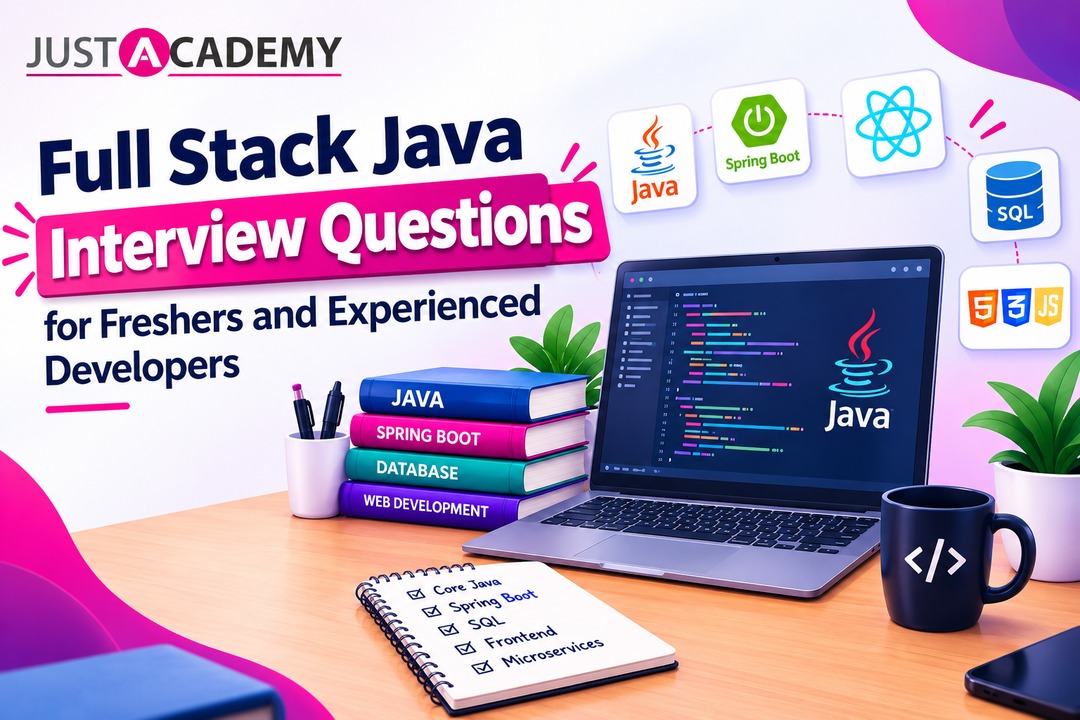
A Full Stack Developer works on both the frontend (the part of an application users see and interact with) and the backend (the server-side logic, databases, and APIs that power the app). A Java Full Stack Developer does all of this using Java as the core backend language — typically powered by the Spring Boot framework — combined with modern frontend technologies like HTML, CSS, JavaScript, React, or Angular.
Frontend Responsibilities
On the frontend side, a Java Full Stack Developer is expected to build responsive, user-friendly interfaces. This involves working with HTML5, CSS3, JavaScript, and popular frameworks like React.js or Angular. Understanding how to consume REST APIs and render dynamic data is a core part of the role.
Backend Responsibilities
The backend is where Java truly shines. Using Spring Boot, developers build RESTful APIs, manage business logic, handle authentication and security, and interact with databases. Spring Boot training is central to any serious java full stack course because of how widely it is used in enterprise applications globally.
Database and DevOps Skills
A well-rounded Java Full Stack Developer also understands relational databases like MySQL and PostgreSQL, as well as tools like Git, Docker, Maven, and cloud platforms like AWS. These skills are increasingly expected even at entry-level positions in 2026.
Why Java Full Stack Is One of the Best Career Choices in 2026
Java has been around for nearly three decades, and it only keeps getting stronger. Here is why choosing a java full stack developer course in 2026 is one of the smartest career moves you can make.
Java Powers Enterprise Applications Worldwide
Over 90% of Fortune 500 companies use Java in some capacity. Banking systems, insurance platforms, government portals, and large-scale e-commerce applications are built on Java. This makes Java Full Stack Developers indispensable across virtually every industry vertical.
High Salary Potential
Java Full Stack Developers in India earn anywhere between ₹6 LPA at the entry level to ₹25 LPA or more with three to five years of experience. In global markets, the salaries are even higher, with mid-level developers earning $90,000–$130,000 annually in the United States. The java certification course route significantly boosts your earning potential because it signals verified, job-ready skills to employers.
Massive Job Market Demand
Platforms like LinkedIn, Naukri, and Indeed consistently list Java Full Stack Developer among the top ten most in-demand tech roles. With the rise of digital banking, healthtech, and SaaS in India, demand for Java developers is only expected to grow through 2026 and beyond.
Versatility Across Projects
Unlike niche technologies that may rise and fall with trends, Java full stack skills are applicable across web applications, microservices, mobile backends, enterprise software, and cloud-native platforms. This versatility gives Java developers long-term career security.
What to Look for in the Best Java Full Stack Developer Course
Not all courses are created equal. When evaluating a java full stack course, here are the critical factors you must consider before investing your time and money.
Comprehensive Curriculum
The course should cover the complete stack — from core Java and object-oriented programming to Spring Boot, Hibernate, REST APIs, frontend frameworks, databases, and deployment. A course that skips any of these pillars will leave you underprepared for real-world job requirements.
Hands-On Project Experience
Theoretical knowledge alone will not get you hired. The best java classes include live projects where you build real applications from scratch — an e-commerce platform, a banking app, or a task management system. Employers want to see what you have built, not just what you have studied.
Spring Boot Training with Placement Support
Spring Boot training with placement is a game-changer for freshers and career switchers. Look for programs that have dedicated placement cells, mock interview rounds, resume building workshops, and active employer tie-ups. Placement assistance bridges the gap between learning and landing your first high-paying job.
Experienced Industry Mentors
Instructors who have worked in the industry bring real-world context that textbooks simply cannot replicate. They know what interviewers actually ask, what mistakes junior developers commonly make, and what best practices are expected on the job.
Flexible Learning Options
Whether you prefer classroom training in Mumbai or hybrid options, the right program should fit your schedule and learning style. Classroom-based java classes in particular offer networking opportunities with peers and direct mentorship access that online-only courses often lack.
Java Certification Course Recognition
A java certification course that is industry-recognized adds significant weight to your resume. Certifications demonstrate commitment and competence in a way that helps you stand out in competitive job markets.
If you are specifically looking for the best java full stack developer course in Mumbai, one program consistently rises above the competition: the Full Stack Java Developer Bootcamp by JustAcademy.
Why JustAcademy Stands Out
JustAcademy has built a strong reputation in Mumbai's tech training landscape by combining industry-relevant curriculum with aggressive placement support. This isn't a generic online course — it's a structured, classroom-based bootcamp designed specifically to produce job-ready Java Full Stack Developers.
What the Curriculum Covers
The JustAcademy Full Stack Java Developer Bootcamp is one of the most comprehensive java full stack courses available in Mumbai. Here is a broad overview of what you will learn:
- Core Java and Advanced Java — Object-oriented programming, collections, multithreading, exception handling, and Java 17+ features that are standard in modern enterprise development.
- Spring Framework and Spring Boot — Deep-dive spring boot training covering dependency injection, Spring MVC, Spring Security, Spring Data JPA, and microservices architecture with Spring Cloud.
- Hibernate and ORM — Database persistence using Hibernate, JPA mappings, JPQL queries, and transaction management.
- Frontend Development — HTML5, CSS3, JavaScript, Bootstrap, and React.js for building responsive, modern user interfaces that connect seamlessly to your Java backend.
- REST API Development — Designing and consuming RESTful APIs, understanding HTTP methods, status codes, and API security with JWT tokens.
- Database Management — MySQL and PostgreSQL, writing complex SQL queries, indexing, and normalization concepts relevant to backend development.
- Version Control and DevOps Basics — Git and GitHub for collaboration, Maven for build management, Docker fundamentals, and an introduction to AWS for cloud deployment.
- Real-World Projects — Students build complete, deployable applications during the bootcamp — not toy examples, but portfolio-worthy projects that demonstrate genuine competence to employers.
Full Stack Java Boot Training with Placement — A Core Differentiator
One of the standout features of JustAcademy's bootcamp is its Full Stack Java boot training with placement support. The placement team works actively with hiring partners across Mumbai and major Indian tech hubs to connect graduates with real job opportunities. This includes:
Resume reviews and optimization for ATS systems, mock technical interviews with industry professionals, soft skills and communication coaching, access to JustAcademy's employer network, and LinkedIn profile optimization for maximum recruiter visibility.
For anyone transitioning careers or entering the industry for the first time, this level of placement support is invaluable.
Classroom Training in Mumbai — The Advantage of In-Person Learning
The bootcamp is offered as classroom training in Mumbai, which provides several advantages over self-paced online courses. You get real-time doubt resolution from experienced instructors, peer learning and group project experience that mirrors actual workplace dynamics, structured schedules that keep you accountable and on track, and networking with fellow learners who may become future colleagues or collaborators.
Mumbai is India's financial and commercial capital, and being located here means direct access to thousands of companies actively hiring Java developers. The proximity to employers makes the placement process faster and more effective.
Who Should Enroll
This java full stack developer course is ideal for fresh engineering graduates looking to launch their tech careers, working professionals from non-tech or adjacent fields looking to switch into software development, Java developers who want to expand their skill set to full stack, and software testers or support engineers who want to move into development roles.
Not sure if this is the right fit? JustAcademy offers a free demo session so you can experience the teaching style, meet the mentors, and evaluate the curriculum before committing.
Complete Java Full Stack Learning Roadmap for 2026
Whether you enroll in a bootcamp or supplement your learning independently, here is the complete roadmap every aspiring Java Full Stack Developer should follow in 2026.
Phase 1 — Java Programming Foundations
Start with core Java: syntax, data types, control flow, OOP principles (encapsulation, inheritance, polymorphism, abstraction), collections framework, generics, exception handling, and file I/O. This foundation is non-negotiable — everything else builds on top of it.
Phase 2 — Spring Boot and Backend Development
Move into the Spring ecosystem. Learn Spring Boot for rapid application development, Spring MVC for web layer handling, Spring Data JPA for database interaction, and Spring Security for authentication. This is the heart of any serious spring boot training program.
Phase 3 — Database and Persistence Layer
Learn SQL thoroughly — joins, subqueries, indexing, and stored procedures. Understand how Hibernate maps Java objects to database tables. Practice working with both MySQL and PostgreSQL.
Phase 4 — Frontend Basics and React
Learn HTML, CSS, and JavaScript fundamentals, then move into React.js. Understand component-based architecture, state management, hooks, and how to integrate a React frontend with a Spring Boot backend via REST APIs.
Phase 5 — DevOps and Cloud Fundamentals
Git for version control, Docker for containerization, and AWS basics (EC2, S3, RDS) are increasingly expected even at junior levels. Even a working knowledge of these tools sets you apart from candidates who only know the code.
Phase 6 — Build Projects and Get Certified
Build at least two to three complete projects, pursue a java certification course to validate your skills, and actively apply for jobs while your bootcamp's placement team supports your search.
Java Full Stack Developer Salary in India — What to Expect in 2026
Understanding the salary landscape helps you set realistic expectations and negotiate confidently.
Entry-Level (0–1 Years Experience)
Freshers who complete a java full stack developer course with strong project work and a recognized java certification course can expect starting salaries between ₹4.5 LPA and ₹8 LPA in Mumbai and other major cities. With placement support from a quality bootcamp, landing in the upper range of this bracket is very achievable.
Mid-Level (2–4 Years Experience)
With a couple of years of hands-on experience, Java Full Stack Developers typically earn between ₹9 LPA and ₹18 LPA. Those with microservices, cloud, and system design expertise command the higher end.
Senior Level (5+ Years Experience)
Senior Java Full Stack Developers and architects earn ₹20 LPA to ₹40 LPA or more, especially in product companies, MNCs, and startups with international clientele.
Top Industries Hiring Java Full Stack Developers in 2026
One of the greatest advantages of a java full stack course is how broadly applicable your skills become. Here are the industries with the highest demand.
Banking and Financial Services (BFSI)
India's BFSI sector is one of the largest employers of Java developers. Core banking platforms, payment gateways, lending applications, and trading systems are all predominantly Java-based.
E-Commerce and Retail Tech
Platforms handling millions of daily transactions require robust, scalable Java backends. Companies in this space are constantly hiring full stack developers who can build and maintain high-availability systems.
Healthcare and Healthtech
Electronic health record systems, telemedicine platforms, and insurance claim processing systems are increasingly being built on Java microservices architectures.
Enterprise Software and SaaS
Global SaaS companies with India development centers — including those in Pune, Bengaluru, Hyderabad, and Mumbai — hire Java Full Stack Developers in large volumes.
Frequently Asked Questions About Java Full Stack Developer Courses
Is Java still relevant in 2026?
Absolutely. Java consistently ranks in the top three most-used programming languages globally. Its dominance in enterprise software, Android development, and backend systems makes it one of the most future-proof languages you can learn.
How long does it take to complete a Java full stack course?
A structured java full stack developer course like JustAcademy's bootcamp typically takes three to six months of intensive training. Self-paced learners may take nine to twelve months depending on their prior background.
Do I need prior programming experience?
Some programs accept complete beginners, while others expect basic programming knowledge. JustAcademy's bootcamp starts from the foundations, making it accessible even for those from non-technical backgrounds.
Is classroom training better than online learning for Java?
Classroom-based java classes in Mumbai offer real-time mentorship, accountability, and peer interaction that pure online courses struggle to replicate. For most learners — especially those new to programming — the structured environment of classroom training accelerates progress significantly.
What makes Spring Boot training important for full stack developers?
Spring Boot is the most widely used Java framework in the industry today. It simplifies backend development, enables microservices architecture, and is required knowledge for virtually every Java developer role in 2026. Any java full stack course that doesn't include deep Spring Boot training is doing you a disservice.
Explore More Bootcamps at JustAcademy Mumbai
JustAcademy offers several other high-quality bootcamps in Mumbai for those exploring adjacent tech careers. Each is designed with the same philosophy — real projects, classroom training, and active placement support.
Perfect for those who want to move into data-driven roles. This bootcamp covers Python, SQL, Power BI, machine learning fundamentals, and real-world analytics projects with industry datasets.
Ideal for software testers who want to master automation. Covers Selenium, TestNG, API testing with Postman, CI/CD pipelines, and end-to-end test automation frameworks.
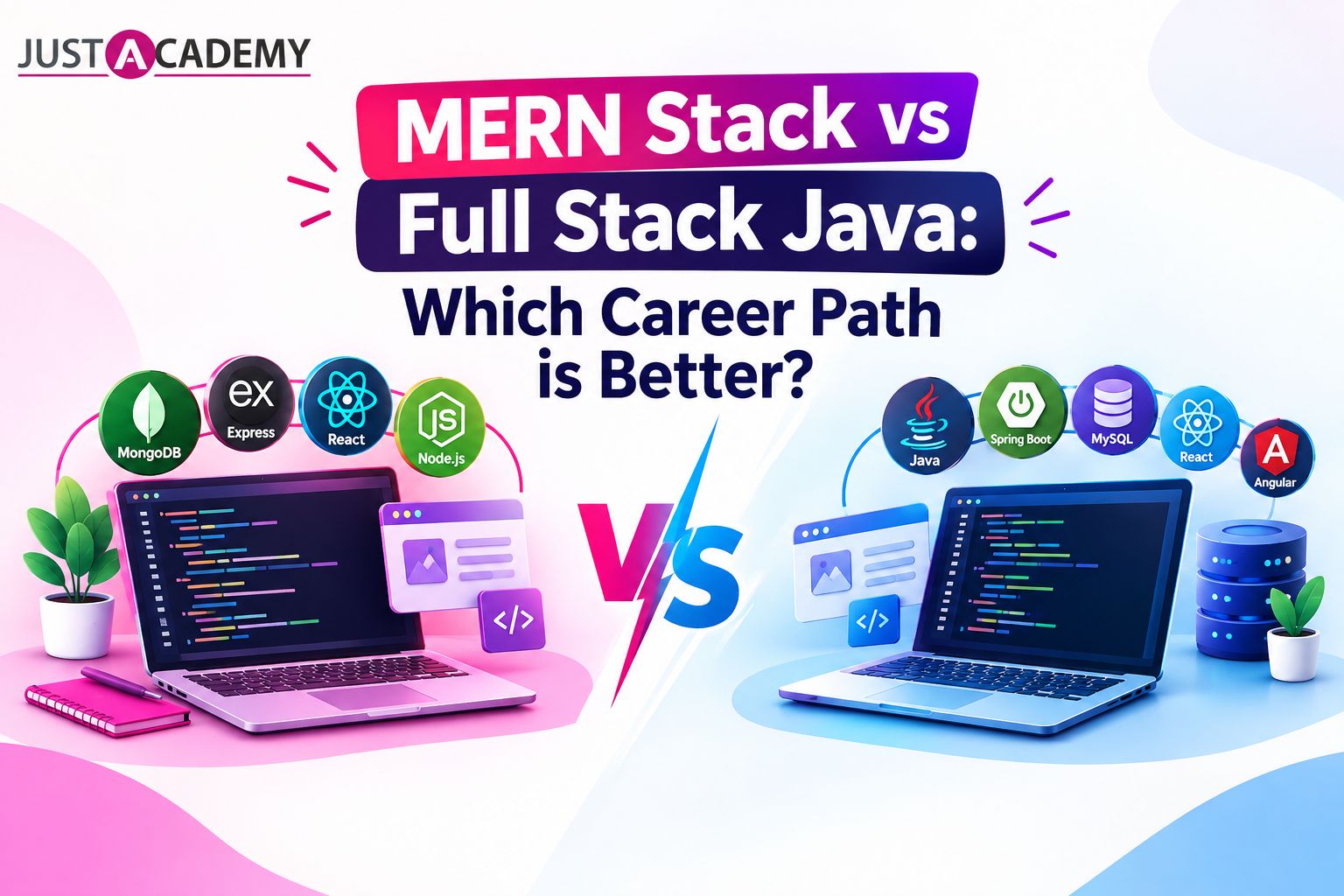
For those interested in JavaScript-based full stack development. Covers MongoDB, Express.js, React.js, and Node.js — the complete MERN stack — with real project work and placement assistance.
Final Thoughts — Is a Java Full Stack Developer Course Worth It in 2026?
Without question, yes. The demand for Java Full Stack Developers in 2026 is at an all-time high, salaries are competitive and growing, and the skills you learn are applicable across virtually every industry. But the key to making the most of your investment is choosing the right program.
The JustAcademy Full Stack Java Developer Bootcamp in Mumbai checks every box — comprehensive curriculum, hands-on real projects, deep spring boot training, a recognized java certification course pathway, and dedicated spring boot training with placement support that actually gets graduates hired.
If you've been sitting on the fence about starting your tech career or making the switch to full stack development, 2026 is the year to act. Thousands of companies are hiring right now, and every month you wait is a month of high-paying work you're leaving on the table.
Enroll in the Best Java Full Stack Developer Course in Mumbai
Register for a Free Demo Today — No Commitment Required
Why Java Full Stack Development Is the Most In-Demand Tech Skill of 2026
What to Look for in the Best Java Full Stack Developer Course
Best Java Full Stack Developer Course in Mumbai — JustAcademy Bootcamp
Java Full Stack Developer Salary and Career Scope After Course Completion